
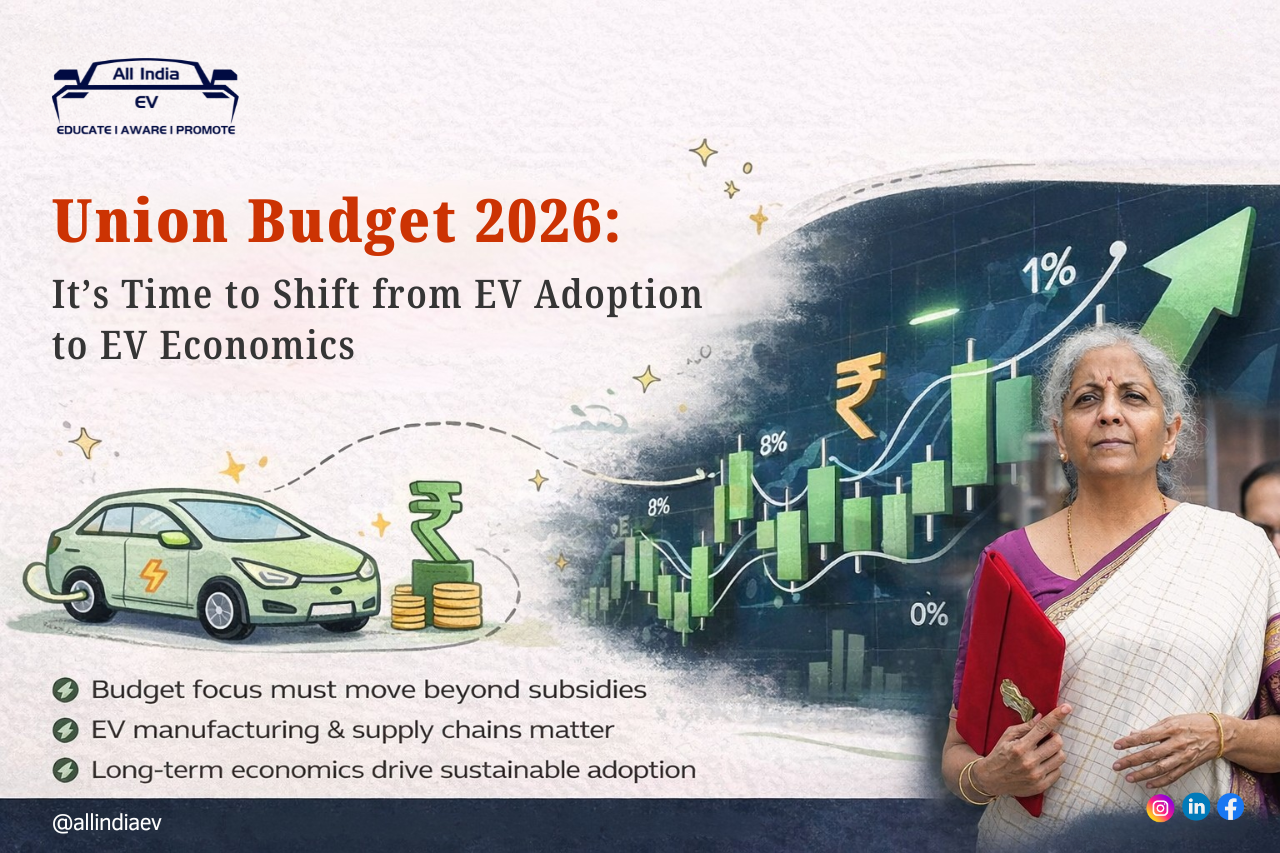


Experts urge Finance Ministry to extend focus beyond incentives, back domestic manufacturing, supply chains and long-term cost solutions for India’s electric mobility push
As India prepares for the Union Budget 2026–27, industry leaders and electric vehicle (EV) stakeholders are urging the government to go beyond short-term adoption incentives and address the deeper economics of electric mobility. They argue that while past budgetary measures helped accelerate EV sales, the next phase of growth hinges on strengthening manufacturing, stabilising supply chains and reducing lifecycle costs for consumers and producers alike.
Since the introduction of schemes such as Faster Adoption and Manufacturing of Electric Vehicles (FAME), later subsumed under PM E-DRIVE, India has witnessed noticeable growth in EV uptake. Combined sales of EVs touched nearly 2.3 million units in 2025, marking about 8% of new vehicle registrations in the country. However, experts say demand-side incentives alone cannot sustain this momentum without deep structural support.
From Subsidies to Sustainable Growth
Historically, the government has relied on direct subsidies and rebates to boost EV adoption, which helped reduce the upfront cost gap between electric and internal combustion engine (ICE) vehicles. But beyond subsidies, several systemic challenges persist, ranging from high import dependence on critical components to costly logistics and tax discrepancies that inflate the overall cost of EVs.
According to EV advocates, the upcoming Budget must shift emphasis from short-term adoption metrics to long-term economic viability. This includes targeted incentives for domestic battery manufacturing, expanding production-linked incentive (PLI) schemes for EV component sectors, and streamlining indirect taxes that inflate operating costs.
Manufacturing and Supply Chain Bottlenecks
Industry executives highlight that India remains heavily reliant on imports for key EV inputs, particularly battery cells, lithium-ion components and rare earth magnets essential for electric motors and power electronics. Most of these materials are sourced from global markets, making EV production vulnerable to price volatility and supply disruptions.
Localising production of these elements, they say, would reduce manufacturing costs and hedge against geopolitical risks. For instance, expanded PLI schemes that cover batteries, cells, controllers and power electronics could attract investment, create jobs and lower the country’s import bill.
More EV News

Another concern is that India’s logistics costs remain significantly higher than global benchmarks, with inefficiencies in transporting critical parts adding to the final price tag of EVs. Rationalising freight costs and upgrading infrastructure could improve competitiveness and support a more sustainable EV ecosystem.
Tax Parity and Cost Barriers
Experts also point out a persistent tax mismatch in the EV value chain. While EVs attract a relatively low 5% GST, related services such as charging incur higher rates, raising the total cost of use for EV buyers. Policy clarity and rationalisation of GST and other levies could help reduce ownership costs and make EVs more affordable across segments.
Financing remains another hurdle. High costs of capital and limited access to affordable long-term loans make it harder for consumers and fleet operators to invest in EVs. Stakeholders say that budget measures aimed at interest subventions and broader green financing options could catalyse uptake, especially in commercial fleets where total cost of ownership economics are critical.
Critical Minerals and Recycling Focus
The upcoming Budget presents an opportunity to address India’s dependence on imported critical minerals such as lithium, nickel and cobalt key ingredients for EV battery production. Advocates suggest increasing allocations to the National Critical Mineral Mission, which could accelerate exploration, processing and refining capacities within India.
Furthermore, improved incentives for battery recycling and second-life applications could reduce lifecycle costs, lower environmental impact and stabilise supply by recovering high-purity materials from used cells. Battery end-of-life solutions remain largely untapped, and supporting them through policy could significantly boost local capabilities.
Skill Development and Infrastructure Support
As the EV industry scales, so does the need for skilled manpower. Budgetary support for skill development and specialised training centres could ensure a workforce capable of supporting EV charging infrastructure, battery production and vehicle assembly, enhancing overall competitiveness.
Charging infrastructure itself is a vital piece of the EV puzzle. Industry voices emphasize that rationalising taxes on charging services, incentivising battery-swap stations and expanding charging networks will improve consumer confidence and reduce barriers to adoption.
A Broader Policy Framework Required
Beyond direct EV economics, several industry reports suggest that the Union Budget 2026 should align EV policy with broader economic goals. Simplified tax laws, enhanced export incentives for automotive electronics and EV components, and stability in long-term policy frameworks will attract both domestic and foreign investments.As the government finalises its Budget proposals, industry stakeholders hope that policymakers will recognise the need for structural reforms over subsidy-led growth. By recalibrating the focus toward sustainable EV economics, India could emerge not just as a large consumer market, but as a global hub for efficient, affordable and innovative electric mobility.