

The Quick Update
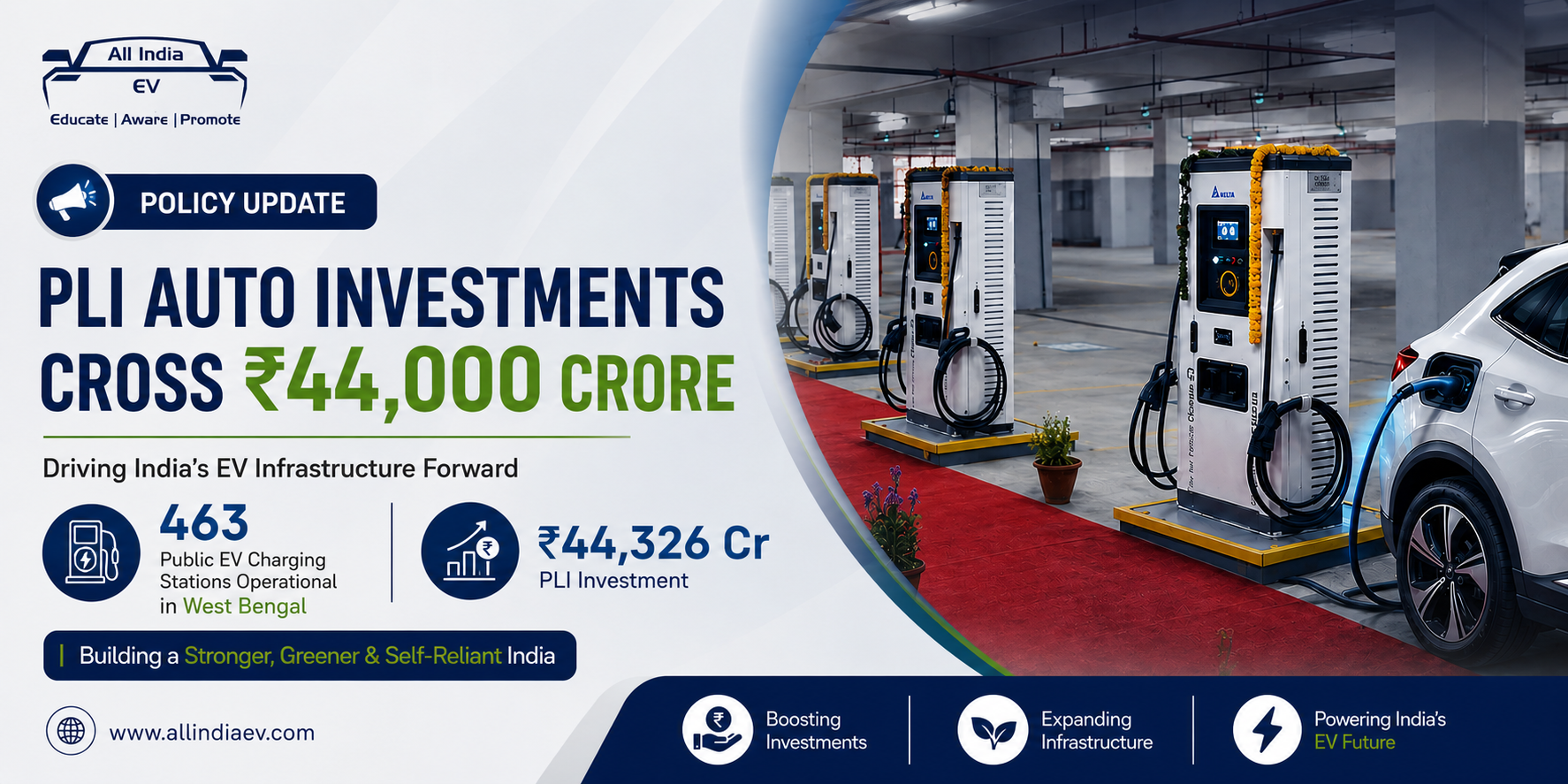
- What Happened: The Ministry of Heavy Industries has announced that the Production Linked Incentive (PLI) Scheme for the automobile and auto component industry has attracted ₹44,326 crore in investments as of March 31, 2026, exceeding its March 2027 target. The ministry also confirmed that 463 of 482 sanctioned public EV charging stations in West Bengal are operational under the FAME-II scheme.
- The Key Number: ₹44,326 crore in cumulative investments under the PLI-Auto scheme.
- Why It Matters: The figures highlight strong industry participation in India’s advanced automotive manufacturing programme while indicating continued progress in expanding public EV charging infrastructure.
The Core News
The Facts
- PLI Auto investments India have reached ₹44,326 crore, surpassing the investment target of ₹42,500 crore set for March 2027.
- The PLI Scheme for automobiles and auto components was launched with a budgetary outlay of ₹25,938 crore to promote Advanced Automotive Technology (AAT) manufacturing.
- Under the FAME-II scheme, 482 public EV charging stations were sanctioned in West Bengal, with 463 operational as of July 1, 2026.
The Context
- The operational charging stations have been deployed by Indian Oil Corporation (IOCL), Bharat Petroleum (BPCL) and Hindustan Petroleum (HPCL).
- The ministry stated that it has not conducted an assessment of whether the current charging infrastructure is adequate for the state’s growing EV demand.
- Under the PM E-DRIVE scheme, West Bengal has proposed five new public charging stations in South 24 Parganas, while no charging station has been proposed for Mathurapur.
The Significance
- Exceeding the PLI investment target ahead of schedule reflects continued industry confidence in India’s automotive manufacturing ecosystem.
- Expanding charging infrastructure supports the growing adoption of electric vehicles across the country.
- The government’s clarification that EV charging remains an unlicensed activity could encourage greater private sector participation in charging infrastructure deployment.
Breaking Down the Update
- PLI Investment: ₹44,326 crore invested as of March 31, 2026.
- Target Achieved: Investment exceeded the ₹42,500 crore target nearly a year ahead of schedule.
- Charging Infrastructure: 463 of 482 sanctioned EV charging stations are operational in West Bengal.
- Future Expansion: Five additional charging stations have been proposed in South 24 Parganas under PM E-DRIVE.
- Funding Status: No financial assistance has yet been released to West Bengal under the PM E-DRIVE scheme.
- Policy: Setting up EV charging stations remains an unlicensed activity across India
How PLI Auto investments India Will Help the Indian EV Market
The PLI Auto investments India programme continues to strengthen the country’s automotive manufacturing ecosystem by encouraging investments in Advanced Automotive Technology products. Surpassing the investment target ahead of schedule indicates strong industry participation and growing confidence in India’s long-term manufacturing policy.
Alongside manufacturing investments, the expansion of public charging infrastructure remains essential for accelerating EV adoption. With 463 charging stations already operational in West Bengal under the FAME-II scheme, the charging network continues to expand to support increasing electric vehicle usage across the state.
The government’s continued support through the PLI scheme and nationwide charging initiatives creates a foundation for higher localisation, technological innovation and increased private investment. At the same time, allowing charging stations to be established without licensing requirements simplifies market entry for companies interested in developing EV infrastructure.
As India advances towards greater electrification of transport, the combination of manufacturing incentives and charging infrastructure development will play a key role in building a more competitive and self-reliant EV ecosystem
Conclusion & Next Steps
The PLI Auto investments India programme has already exceeded its investment target, demonstrating sustained momentum in advanced automotive manufacturing. Going forward, attention will shift towards translating these investments into higher production, localisation and employment while continuing to expand charging infrastructure under FAME-II and PM E-DRIVE. Progress in both manufacturing and charging networks will remain central to India’s long-term electric mobility ambitions.
Read More: Catch up on All India EV’s related coverage on India’s evolving commercial EV subsidies and battery swapping policies at All India EV