

YC Electric retained the lead, while Hotage India and Move Stone Services recorded the strongest monthly growth among the top ten manufacturers
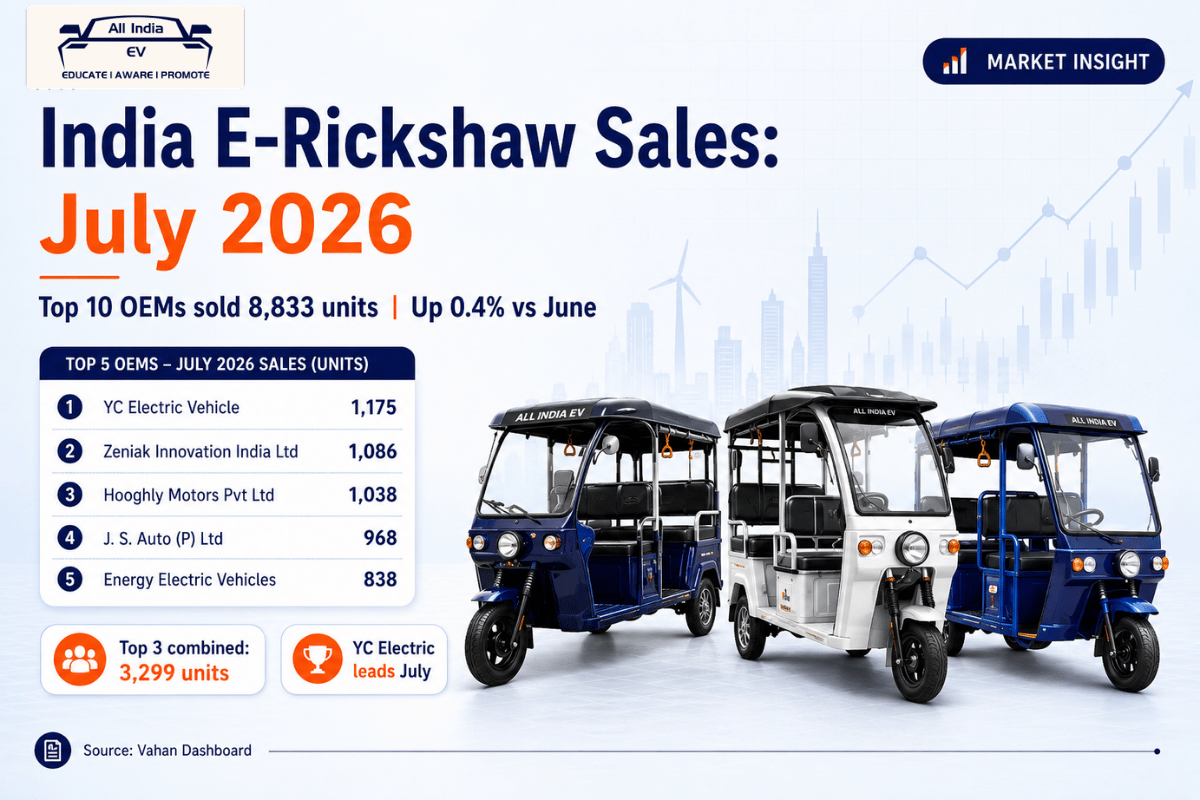
India’s organised e-rickshaw market remained largely stable in July 2026, with the ten manufacturers covered in this analysis collectively selling 8,833 vehicles, compared with 8,796 units in June.
- YC Electric retained the lead, while Hotage India and Move Stone Services recorded the strongest monthly growth among the top ten manufacturers
- June versus July 2026 e-rickshaw sales
- YC Electric stays on top despite a 13.9% decline
- Zeniak closes the gap with steady July growth
- Hooghly Motors retains third position
- J. S. Auto moves closer to the top three
- Energy Electric Vehicles posts steady growth
- Dilli Electric Auto records a marginal increase
- Hotage India records one of July’s strongest gains
- Move Stone Services delivers the fastest monthly growth
- Aahana Commerce reports the sharpest decline
- Terra Motors remains unchanged
- The market has recovered from April, but remains below January
- What is changing in India’s e-rickshaw market?
- Government support is increasingly tied to formal registration
- Advanced batteries are becoming more important
- Financing remains central to the purchase decision
- Regional distribution continues to shape sales
- Battery safety and digital control are entering the regulatory conversation
- A fragmented market with no unassailable leader
- The bigger story
The month-on-month increase was only 0.4%, indicating that July was more a month of redistribution among manufacturers than broad-based market expansion.
YC Electric Vehicle retained the top position with 1,175 units, followed by Zeniak Innovation India with 1,086 units and Hooghly Motors with 1,038 units. The top three manufacturers collectively accounted for 3,299 units, or approximately 37.3% of the top-ten July sales.
Unlike India’s electric scooter market, the e-rickshaw segment remains highly fragmented. The difference between the first-ranked and tenth-ranked manufacturers was fewer than 500 vehicles, leaving enough room for smaller companies to move rapidly through the rankings.
Source: Vahan Dashboard
Calculations: All India EV analysis based on the January–July 2026 sales data provided.
June versus July 2026 e-rickshaw sales
| Rank | Manufacturer | June 2026 | July 2026 | Monthly change |
|---|---|---|---|---|
| 1 | YC Electric Vehicle | 1,365 | 1,175 | -13.9% |
| 2 | Zeniak Innovation India | 1,068 | 1,086 | +1.7% |
| 3 | Hooghly Motors | 1,054 | 1,038 | -1.5% |
| 4 | J. S. Auto | 922 | 968 | +5.0% |
| 5 | Energy Electric Vehicles | 791 | 838 | +5.9% |
| 6 | Dilli Electric Auto | 814 | 827 | +1.6% |
| 7 | Hotage India | 666 | 775 | +16.4% |
| 8 | Move Stone Services | 621 | 748 | +20.5% |
| 9 | Aahana Commerce | 813 | 696 | -14.4% |
| 10 | Terra Motors India | 682 | 682 | 0.0% |
| Total | 8,796 | 8,833 | +0.4% |
Six of the ten manufacturers increased their sales in July, three recorded declines and Terra Motors remained unchanged.
The overall market barely moved because gains by mid-sized manufacturers were offset by lower sales at YC Electric and Aahana Commerce.
YC Electric stays on top despite a 13.9% decline
YC Electric Vehicle sold 1,175 units in July, down from 1,365 units in June.
The company retained the number-one position, but its monthly sales fell by 190 units, representing a decline of 13.9%.
YC Electric’s lead is therefore narrower than the ranking alone suggests. Zeniak finished July just 89 units behind, while Hooghly Motors was only 137 units behind the market leader.
The company’s longer-term trajectory also warrants attention. Its sales declined from 1,929 units in January to 1,175 units in July, a reduction of approximately 39.1%.
Nevertheless, YC Electric generated the highest cumulative volume among these manufacturers during the first seven months of 2026, selling 9,694 units.
Its challenge is not market visibility, but maintaining monthly consistency as regional manufacturers expand distribution and product availability.
Zeniak closes the gap with steady July growth
Zeniak Innovation India recorded 1,086 units in July, compared with 1,068 units in June, translating into modest growth of 1.7%.
The company moved within striking distance of the market leader and finished only 89 units below YC Electric.
However, Zeniak’s sales remain significantly below the 2,412 units recorded in January. July volume was approximately 55% lower than the beginning of the year.
This highlights an important distinction within the data: a strong ranking in July does not necessarily indicate continuous growth.
Several leading e-rickshaw manufacturers started 2026 at considerably higher monthly volumes before sales contracted sharply between February and April.
Zeniak’s recent performance suggests stabilisation, but the company has not yet returned to its early-year scale.
Hooghly Motors retains third position
Hooghly Motors sold 1,038 units in July, down slightly from 1,054 units in June.
The monthly decline of 1.5% was relatively limited, allowing the company to remain above the 1,000-unit mark for the second consecutive month.
Hooghly’s sales fell sharply between February and March, dropping from 1,265 units to 681 units, before recovering during June.
The July result suggests that its recent recovery may be consolidating, even though sales remain approximately 38.8% below January levels.
For a regional commercial-vehicle manufacturer, sustaining volumes above 1,000 units may depend on dealer availability, financing access and vehicle uptime rather than brand-led consumer demand.
J. S. Auto moves closer to the top three
J. S. Auto recorded 968 units in July, up from 922 units in June, an increase of 5%.
Among the top ten manufacturers, J. S. Auto displayed one of the most stable sales patterns during the first seven months of the year.
Its monthly sales remained between 922 and 1,057 units throughout the period, avoiding the steep peaks and collapses seen among several competitors.
July sales were only 5.7% below January, making J. S. Auto one of the most consistent manufacturers in the dataset.
That stability is commercially valuable in the e-rickshaw market, where sales can be influenced by state-level demand, dealer inventory, local financing and fleet procurement cycles.
Energy Electric Vehicles posts steady growth
Energy Electric Vehicles sold 838 units in July, compared with 791 units in June, representing growth of 5.9%.
The company’s July performance was also close to its January volume of 868 units. This indicates a relatively stable base despite fluctuations during the intervening months.
Energy Electric’s monthly sales bottomed at 687 units in April before recovering during May and July.
The company appears to be building volume gradually rather than relying on a single high-sales month, placing it among the more stable mid-table manufacturers.
Dilli Electric Auto records a marginal increase
Dilli Electric Auto sold 827 units in July, up from 814 units in June.
The monthly increase of 1.6% was modest, while sales remained significantly below the 1,532 units registered in January.
The company’s July volume was approximately 46% lower than its January level, illustrating the broader slowdown experienced by several manufacturers during the first half of 2026.
Dilli Electric’s name and likely market concentration also reflect a defining characteristic of the e-rickshaw industry: demand is often geographically concentrated.
Success in one state or city can generate significant monthly volume, but it can also expose manufacturers to local permit rules, financing conditions and fleet replacement cycles.
Hotage India records one of July’s strongest gains
Hotage India emerged as one of the strongest performers during July.
Sales increased from 666 units in June to 775 units in July, representing month-on-month growth of 16.4%.
Hotage was also one of only two manufacturers in the top ten to sell more vehicles in July than in January. Its July sales were 21.3% above the 639 units recorded at the beginning of the year.
The company has climbed by maintaining gradual momentum rather than recording a sudden one-month spike.
If this trajectory continues, Hotage could challenge the manufacturers currently occupying the fifth and sixth positions.
Move Stone Services delivers the fastest monthly growth
Move Stone Services registered the fastest monthly growth among the ten manufacturers.
Its sales rose from 621 units in June to 748 units in July, an increase of 20.5%.
The company added 127 units, the largest absolute gain among the manufacturers that expanded during the month.
Move Stone’s July volume was still slightly below the 772 units recorded in January. However, the company has recovered strongly from the 516 units recorded in April.
The July performance shows how quickly rankings can change in a fragmented market. A gain of around 100 to 150 vehicles can move a manufacturer several positions within a single month.
Aahana Commerce reports the sharpest decline
Aahana Commerce recorded 696 units in July, down from 813 units in June.
The decline of 14.4% was the sharpest percentage reduction among the top ten manufacturers.
Sales were also approximately 48.9% below January, when the company recorded 1,361 units.
Aahana’s performance reflects the volatility of the e-rickshaw segment. Manufacturers can generate strong volumes through dealer stocking or institutional orders, but these numbers may not repeat consistently every month.
For analysts, this means that one-month rankings should be considered alongside six-month or annual sales patterns.
Terra Motors remains unchanged
Terra Motors India sold 682 units in both June and July.
The flat monthly performance came after sales had fluctuated between 593 and 748 units during the preceding four months.
While July brought no growth, Terra’s stability helped it retain a place among the ten leading manufacturers.
However, sales remained approximately 34.8% below January levels, showing that the company has yet to recover its early-year volume.
The market has recovered from April, but remains below January
The ten manufacturers collectively sold:
- 13,282 units in January
- 7,768 units in April
- 8,796 units in June
- 8,833 units in July
The data shows a sharp contraction during the first four months of the year, followed by a gradual recovery.
July sales were 13.7% above April, but remained 33.5% below January.
This means the July result should not be described as a high-growth month. It represents stabilisation after a difficult first half.
| Month | Combined top-ten sales |
|---|---|
| January | 13,282 |
| February | 9,926 |
| March | 8,379 |
| April | 7,768 |
| May | 8,191 |
| June | 8,796 |
| July | 8,833 |
The direction since April is positive, but the recovery is moving slowly.
What is changing in India’s e-rickshaw market?
Government support is increasingly tied to formal registration
The PM E-DRIVE scheme covers registered e-rickshaws, e-carts and L5 electric three-wheelers used commercially. It aims to support approximately 3.2 lakh electric three-wheelers, although only vehicles using eligible advanced batteries qualify for demand incentives.
This framework is important because it encourages the market to move toward registered vehicles, certified components and traceable manufacturers.
India’s e-rickshaw ecosystem has historically included a large unorganised manufacturing and assembly base. Formal incentives can gradually shift demand toward compliant OEMs with approved battery systems, warranties and service networks.
Advanced batteries are becoming more important
PM E-DRIVE limits incentives to eligible electric three-wheelers equipped with advanced batteries.
That requirement could accelerate the transition away from conventional lead-acid systems toward lithium-ion and other advanced battery chemistries.
For drivers, an advanced battery can offer lower weight, faster charging and a longer usable life. However, the upfront vehicle cost is generally higher, making financing and monthly cash flow critical.
The industry’s next growth phase will therefore depend on whether manufacturers can make advanced-battery e-rickshaws affordable on a daily-income basis.
Financing remains central to the purchase decision
An e-rickshaw is usually a commercial earning asset rather than a discretionary consumer purchase.
Drivers often evaluate the vehicle through:
- Down payment
- Daily or monthly instalment
- Passenger earning potential
- Battery replacement cost
- Charging expense
- Maintenance downtime
- Resale value
A technically better vehicle will not automatically win if the driver cannot obtain affordable credit.
Manufacturers with strong relationships across banks, non-banking financial companies, dealers and local financiers may therefore outperform brands offering stronger specifications but weaker financing support.
Regional distribution continues to shape sales
Unlike the electric scooter market, e-rickshaw demand is not evenly distributed across the country.
Local passenger demand, municipal permissions, charging access, road conditions and enforcement practices can vary sharply from one district to another.
This explains why smaller manufacturers can remain competitive. A company does not always require a pan-India network to generate meaningful volume. A strong dealer cluster across a few high-demand regions can support hundreds of monthly sales.
Battery safety and digital control are entering the regulatory conversation
India is also preparing a broader automotive cybersecurity framework following reported incidents involving unauthorised tampering with e-rickshaw batteries through mobile applications. The proposed framework is expected to address connected-vehicle and software-related vulnerabilities.
This development signals that the next phase of regulation will extend beyond vehicle registration and mechanical safety.
As batteries, telematics, financing locks and fleet-management systems become connected, cybersecurity and data control will become part of commercial vehicle reliability.
A fragmented market with no unassailable leader
The July sales data reveals a market that remains wide open.
YC Electric held the first position, but its lead over Zeniak was only 89 units. Fewer than 500 vehicles separated the first and tenth-ranked manufacturers.
The top three companies controlled only 37.3% of the sales covered in this analysis. By comparison, India’s electric scooter market is far more concentrated around its leading manufacturers.
This fragmentation creates opportunity, but it also exposes a structural challenge.
The e-rickshaw industry includes many regional manufacturers selling broadly similar products. As the market formalises, success will increasingly depend on factors beyond initial vehicle price:
- Certified battery systems
- Financing availability
- Local service infrastructure
- Spare-parts supply
- Vehicle durability
- Driver uptime
- Warranty transparency
- Regulatory compliance
The bigger story
July 2026 was not a breakout month for India’s e-rickshaw industry.
Sales among the ten leading manufacturers increased by only 0.4%, while combined volume remained substantially below January.
Yet the numbers show that the market has stabilised after reaching a low point in April.
More importantly, the competitive order is changing. YC Electric remains the leader, but Zeniak and Hooghly Motors are close behind. J. S. Auto and Energy Electric are maintaining steady volumes, while Hotage and Move Stone Services are moving upward quickly.
The next stage of the market will not be decided only by who can manufacture the lowest-cost e-rickshaw.
It will be decided by who can deliver a complete commercial proposition: affordable finance, dependable batteries, high vehicle uptime, accessible service and enough durability to survive years of intensive urban use.
In the e-rickshaw business, the vehicle is not merely transport. It is the driver’s daily revenue engine.