

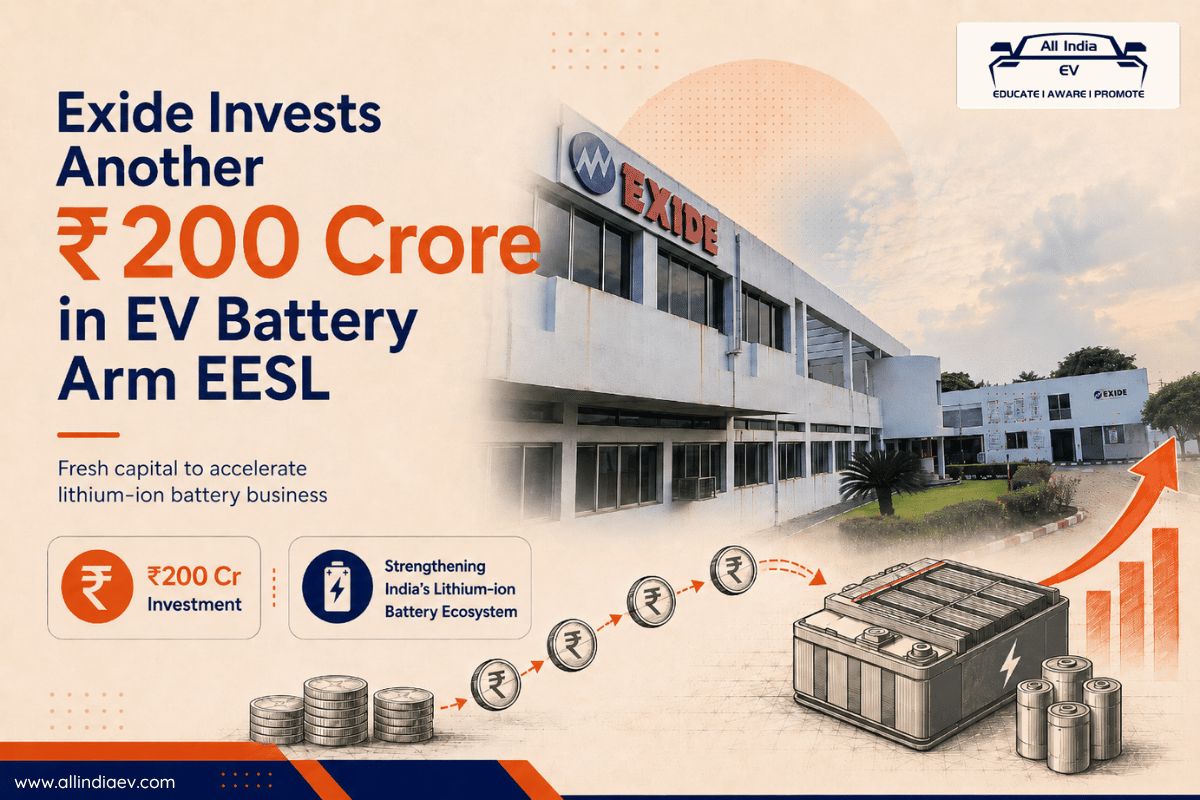
Exide Industries has invested another ₹199.99 crore in Exide Energy Solutions Limited, taking its cumulative investment in the wholly owned lithium-ion battery subsidiary to ₹5,102.23 crore.
The fresh capital was invested on August 18 through a rights-based subscription to 57,142,857 equity shares at ₹35 per share, comprising a face value of ₹10 and a premium of ₹25.
Exide’s ownership of EESL remains unchanged at 100%.
The transaction is another tranche of capital flowing towards Exide’s attempt to build a domestic lithium-ion cell manufacturing business alongside its established lead-acid battery operations.
Exide Is Building Up to 12 GWh of Cell Capacity
EESL is developing a greenfield lithium-ion cell manufacturing facility in Bengaluru.
The project has an initial planned capacity of approximately 6 GWh, scalable to 12 GWh, and is expected to manufacture cylindrical and prismatic cells using chemistries including LFP and NMC.
The facility is intended to address both the electric mobility and stationary energy-storage markets.
Exide’s board had already approved an additional investment of up to ₹1,400 crore in EESL in January 2026, to be deployed in one or multiple tranches.
The August investment therefore appears to be another step in that larger capital programme.
Interestingly, this is not the first infusion in recent months.
On July 15, Exide invested approximately ₹100 crore into EESL, at which point cumulative investment stood at ₹4,902.23 crore.
Barely a month later, the cumulative figure has crossed ₹5,100 crore.
Why the ₹5,102 Crore Number Matters
The more important story is not the latest ₹200 crore cheque in isolation.
It is the amount of capital Exide is progressively committing to building a new battery business.
India currently imports a significant portion of the lithium-ion cells used in electric vehicles and energy-storage systems. Domestic cell manufacturing is therefore emerging as one of the biggest industrial opportunities created by electrification.
But cell manufacturing is also capital intensive.
Companies need manufacturing lines, dry rooms, formation equipment, testing systems, material handling infrastructure and highly controlled production environments before meaningful commercial volumes can emerge.
Exide’s repeated capital infusions demonstrate the scale of investment necessary to move from conventional battery manufacturing into advanced lithium-ion cells.
The company already has deep relationships across India’s automotive battery ecosystem. EESL gives Exide an opportunity to extend that position into the technologies expected to power the next generation of vehicles and energy-storage systems.
The next milestone now matters more than another investment announcement: how quickly this ₹5,102 crore-plus capital commitment translates into commercially produced lithium-ion cells at scale.
Explore the EV Investment & Funding