

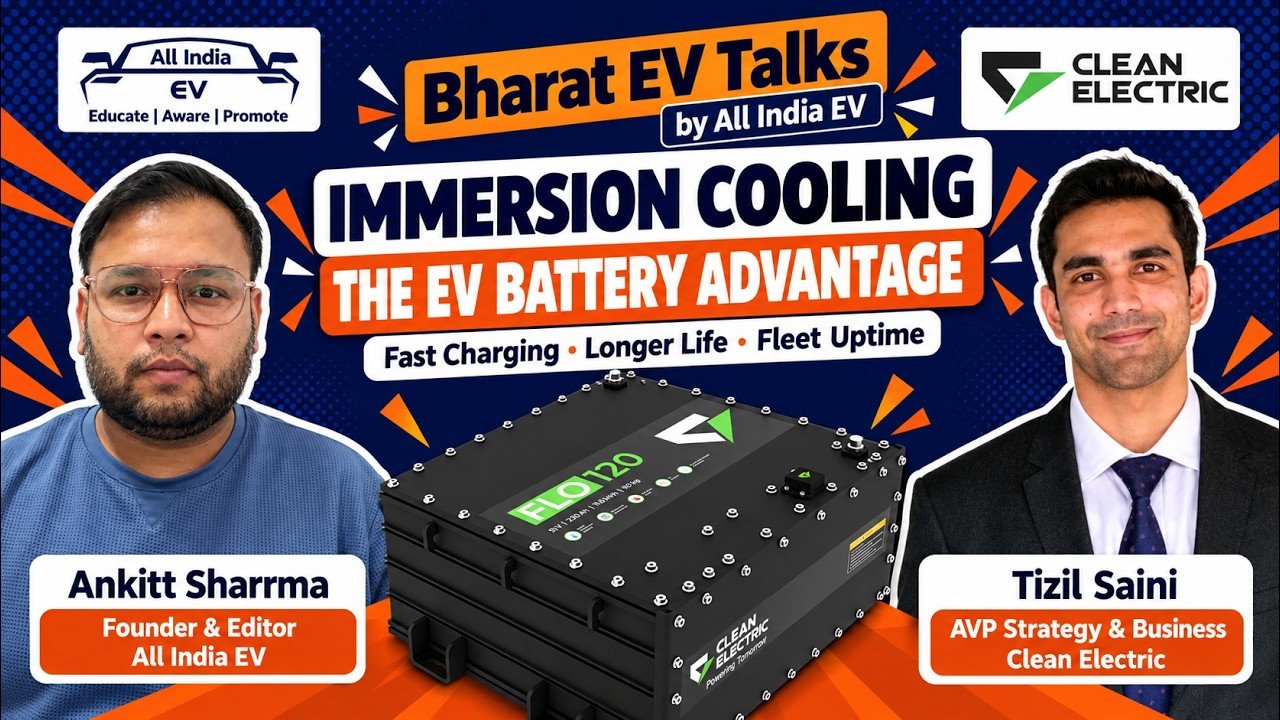
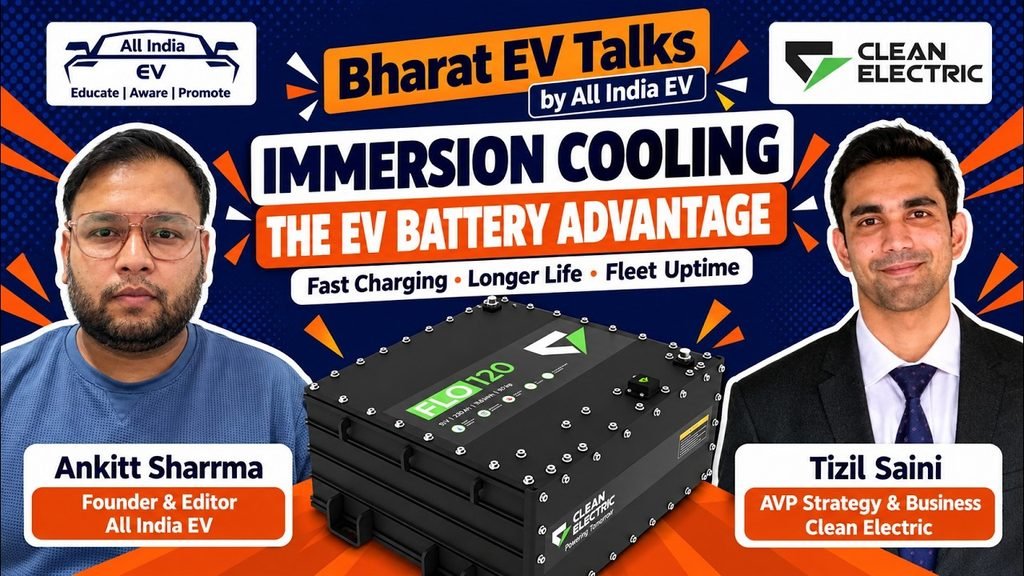
In this episode of The Bharat EV Talks by All India EV, host Amit Sharma sits down with the leadership team from Clean Electric to discuss how immersion liquid cooling is reshaping EV battery durability, thermal safety, and fleet economics across India’s rapidly growing electric mobility landscape.
The Shift to Direct Immersion Liquid Cooling
As Indian summers become hotter and longer, EV operators frequently battle thermal cutoffs and rapid battery degradation. While conventional electric two- and three-wheelers rely on passive air cooling or cold-plate systems, Clean Electric deploys dielectric liquid immersion cooling where cells are submerged directly in a thermally conductive, electrically non-conductive fluid.
This architecture delivers three distinct advantages:
- Thermal Stability: Complete elimination of summer thermal cutoffs during intense charging and discharging cycles.
- Fast Charging Support: Efficient heat extraction at the cell level, allowing true DC fast charging without triggering thermal runaway.
- Extended Cycle Life: Doubling the battery pack lifespan compared to passive air cooling and extending it by 1.5 times compared to standard cold-plate liquid cooling.
Density and Packaging: Cell-to-Pack Innovation
Addressing industry concerns that immersion coolant fluid adds dead weight and occupies module space, Clean Electric utilizes a patented Cell-to-Pack (CTP) architecture. By stripping out modular frames and packaging cells directly within the fluid-jacketed enclosure, their LFP commercial packs achieve up to 150 Wh/kg.
For compact two-wheeler platforms, their cylindrical NMC battery pack (Insta 250) achieves a volumetric density of nearly 300 Wh/L, packaging 2.5 kWh into a compact footprint ideal for removable and fast-charging applications.
Transforming Three-Wheeler and Cargo Fleet Economics
With three-wheelers leading EV adoption in India—surpassing 50% penetration in L5 commercial segments—driver earnings are tied directly to daily vehicle uptime. Traditional air-cooled battery packs frequently degrade within 3 to 5 years, forcing operators to bear costly pack replacements.
By mitigating degradation and supporting rapid turnaround DC charging, Clean Electric backs its three-wheeler packs with an industry-leading 8-year or 300,000 km warranty. This enables cargo and passenger auto operators to run their vehicles for their entire operational lifespan without a mid-life battery overhaul.
Heavy Commercial Vehicles & Electric Buses: The Storm 360
Unlike stationary data center cooling, automotive immersion systems must withstand intense mechanical vibration, road shock, and rigorous daily duty cycles. Clean Electric scales this modular technology up to heavy commercial transport with its Storm 360 architecture for electric buses.
State transport undertakings and fleet operators typically bid on 12-year operational tenders, which traditionally budget for two separate battery packs across the contract life. The Storm 360 is engineered to last the full 12-year concession on a single battery pack, dramatically improving the Total Cost of Ownership (TCO) and fleet uptime.
In-House Vertical Integration and Proprietary BMS
Clean Electric vertically integrates its embedded electronics, developing proprietary Battery Management Systems (BMS) in-house rather than off the shelf. This enables hardware-software co-optimization, running intelligent pulse-charging algorithms and accurate State-of-Charge (SoC) estimation models that preserve cell health during rapid charging.
Looking ahead, Clean Electric aims to expand immersion cooling adoption across small commercial trucks, heavy buses, and passenger vehicles, establishing thermal management as the cornerstone of India’s electric transition.