

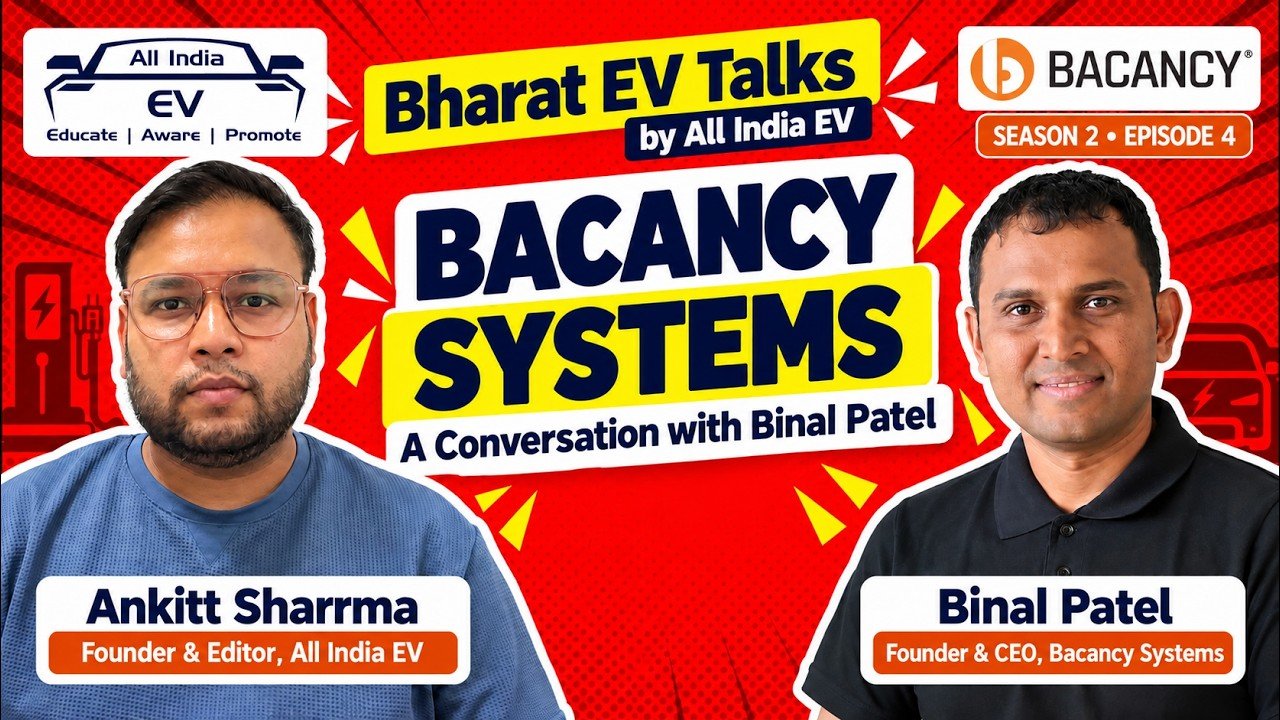
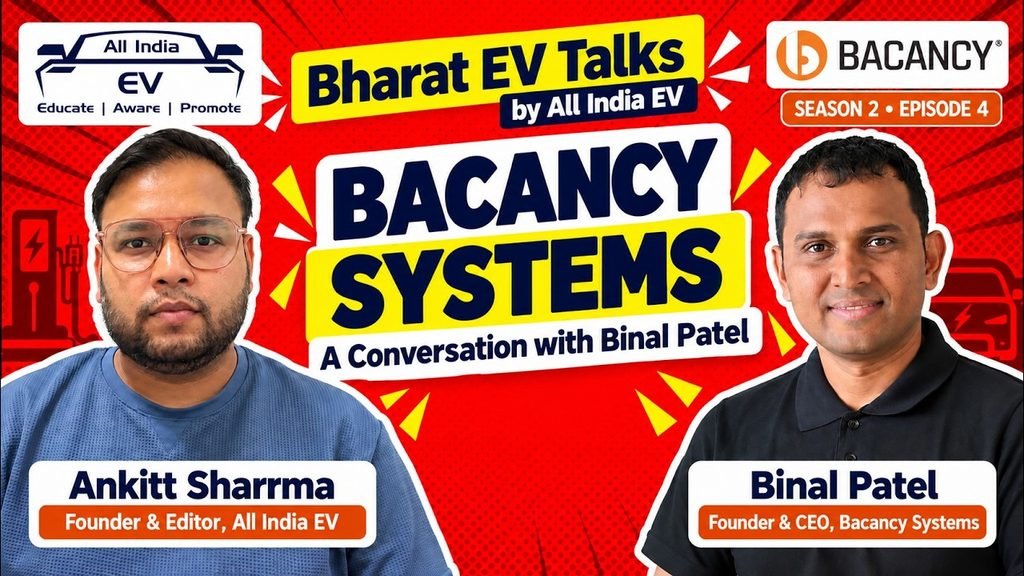
In this insightful episode of The Bharat EV Talks , host Ankit Sharma sits down with Binal Patel, founder and leader at Bacancy Systems, to delve into the rapidly evolving Indian EV charging infrastructure. The discussion explores how indigenous hardware design, patented shared power architecture, and dynamic load balancing are redefining economics for Charge Point Operators (CPOs) across India.
The Evolution of Domestic EV Manufacturing in India
The dialogue opens with Binal reflecting on the origins of Bacancy Systems. After returning from Canada in 2019, he identified a critical gap: despite the domestic demand surge, India heavily relied on imported power electronics and sub-assemblies.
When asked where India stands on the journey from basic assembly (0) to comprehensive indigenous manufacturing (1), Binal notes that the sector has progressed from barely 10% localization in 2021–2022 to nearly 80%–90% domestic design and production today. While specialized items like rectifiers and contactors are still imported in part, Indian engineers now own the firmware, schematic design, and hardware manufacturing stacks.
Rethinking Charger Architecture: Decoupling Power from Dispensers
Conventional DC fast charging relies on standalone all-in-one bays, each packing rectifiers, cooling systems, and controllers into a single cabinet. While suitable for uniform corporate fleets, this model struggles in public highways and high-throughput hubs:
- Sub-optimal Utilization: An expensive 180 kW standalone charger is severely underutilized when an EV capable of drawing only 30 kW connects.
- High Multi-Bay Capex: Replicating heavy electronics across 10 to 12 bays inflates infrastructure and thermal management costs unnecessarily.
To solve this, Bacancy Systems patented a split/centralized architecture. By separating a centralized power unit (e.g., up to 1.92 MW) from lightweight dispenser pedestals, up to 12 charging points can draw from a common power bank.
Intelligent Load Distribution vs. Legacy FIFO Methods
Traditional imported charging setups often allocate power on a strict First-In, First-Out (FIFO) basis, starving late arrivals until the first vehicle unplugs.
Bacancy’s proprietary system communicates continuously with each vehicle’s Battery Management System (BMS) over CCS2 protocols. It dynamically shifts wattage depending on real-time acceptance curves:
- A vehicle entering at 15% state of charge (SoC) receives prioritized fast charging.
- A vehicle tapering off above 75% SoC yields excess capacity back to the shared pool.
- CPOs retain the flexibility to configure guaranteed minimum power baselines per bay.
Overcoming Thermal Constraints & Real-World Deployments
Centralizing multi-megawatt power brings serious heat dissipation demands. Bacancy engineered modular thermal solutions—combining high-efficiency air cooling with optional liquid-cooling configurations tailored for extreme ambient summer temperatures across Central and Western India.
The architecture is already moving into real-world validation, with initial customer installations live in cities like Hyderabad.
Key Takeaway for Aspiring Engineers
Closing the session, Binal outlined advice for young engineers entering the e-mobility domain: prioritize a product-first mindset and master fundamental power electronics and physics. While software and AI accelerate execution, high-power DC systems ultimately depend on foundational hardware rigor and thermal reliability.