

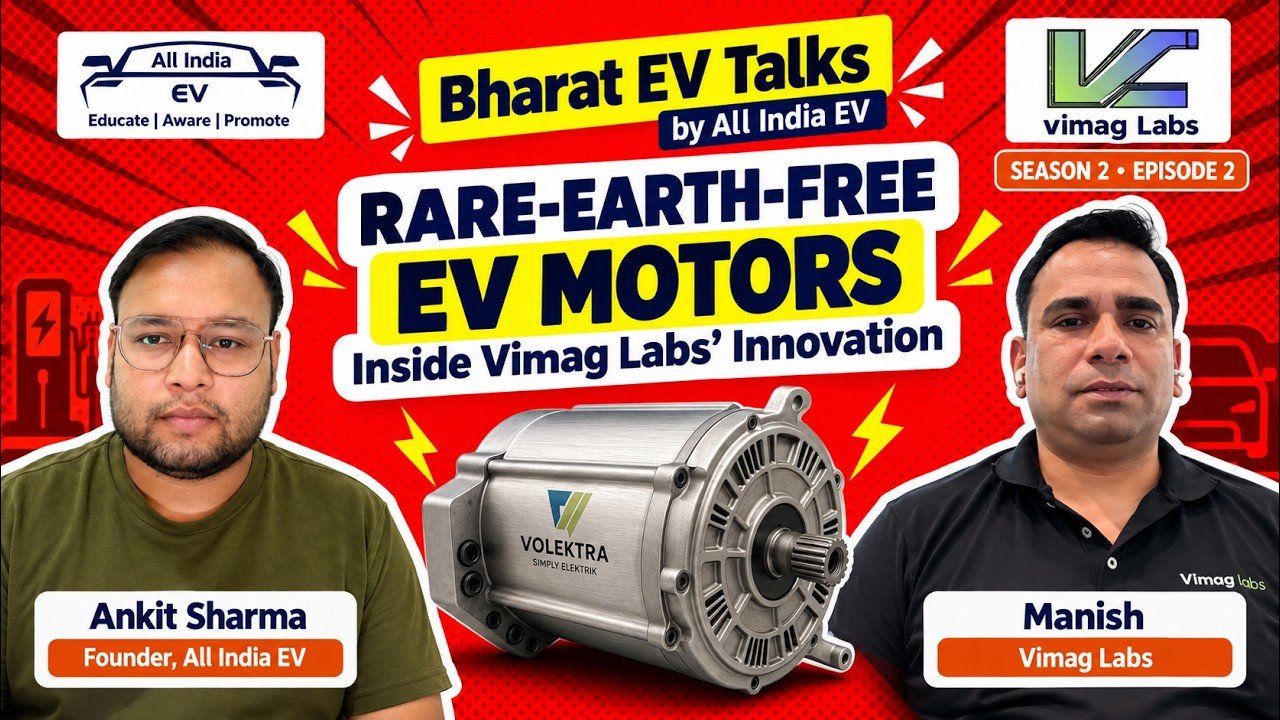
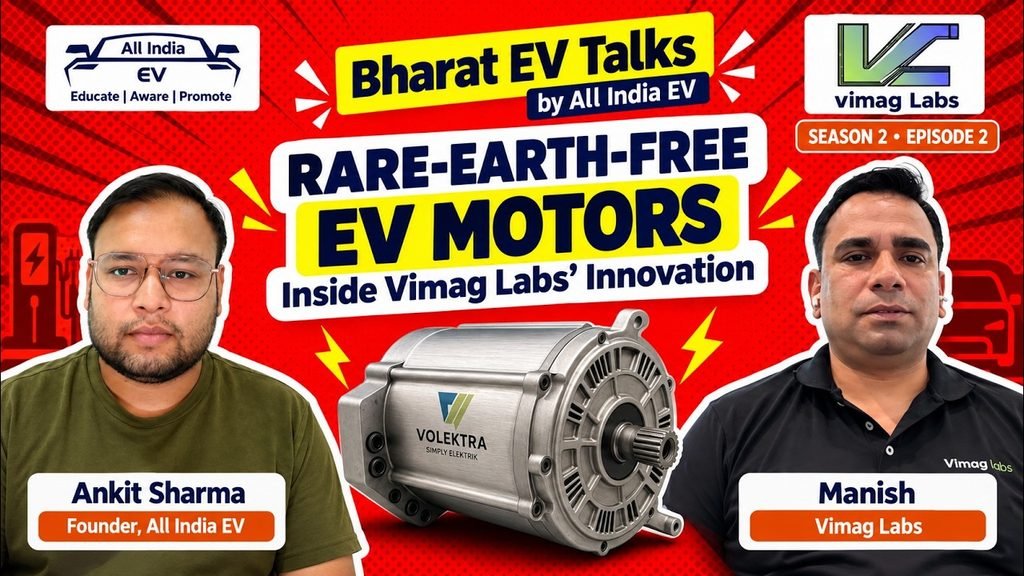
In this episode of The Bharat EV Talks by All India EV, host Ankit sits down with Manish, founder of Vimag Labs, to explore one of the most critical frontiers in India’s electric mobility revolution: rare-earth-free electric motor technology. With the geopolitical push toward domestic supply chains and mineral independence, this deep-dive unpacks how homegrown deep-tech innovation can transform the global EV architecture.
The Bottleneck: Moving Beyond China’s Magnet Monopoly
Motors are an established 200-year-old technology, starting from Nikola Tesla’s magnet-free AC induction motor to brushed DC units, brushless DC (BLDC) motors, and finally modern Permanent Magnet Synchronous Motors (PMSMs).
As global automotive design prioritized high power density, neodymium-based permanent magnets became standard. Because China strategically built out its rare-earth mining, refining, and supply chains decades ago, countries worldwide—including India—ended up heavily reliant on Chinese imports. Manish emphasized that as long as manufacturers follow existing foreign architectures rather than pioneering frontier engineering, true energy sovereignty will remain out of reach.
VMS Architecture: Breaking Compromises
Historically, magnet-free alternatives such as Synchronous Reluctance Motors (SynRM) or traditional AC induction motors traded off volumetric efficiency, requiring bulkier frames to generate equivalent torque. Vimag Labs developed its proprietary VMS motor architecture, combining externally excited inductive power transfer with custom software-defined magnetic fields.
Key engineering benchmarks of the sub-10 kW VMS motor include:
- Higher Volumetric Power Density: 8% to 10% smaller in volume compared to an equivalent PMSM.
- Weight Reduction: Weighs around 8.3–8.4 kg compared to approximately 9.3 kg for an equivalent PMSM—shaving off nearly 1 kg without heavy magnets.
- Efficiency: Matches peak efficiency while delivering superior drive-cycle efficiency across real-world duty cycles.
- Software-Driven Dynamics: Software-controlled flux parameters allow dynamic real-time field shaping for optimal torque.
Every stage—from electromagnetic simulation and proprietary PCB design to custom embedded firmware—is engineered in-house.
Commercialization Roadmap and Industry Adoption
Vimag Labs has taken an integrated testing approach, retrofitting prototype vehicles and testing them on real roads under automotive validation standards. Their market rollout centers around two primary avenues:
- Light Electric Vehicles (2W & 3W): Sub-10 kW systems ready for initial commercial rollout to OEMs and fleets, capitalising on India’s booming commercial 3-wheeler segment.
- Heavy Commercial Vehicles (Buses & Trucks): High-power 150 kW+ systems designed for heavy transport repowering, retrofitting, and OEM supply. Commercial heavy vehicles consume large quantities of dysprosium and neodymium, making magnet independence in this segment a massive strategic win.
The Turning Tide for Indian Hardware Deep-Tech
The inception of Vimag Labs stemmed from sheer necessity: when COVID-19 border bottlenecks halted imported magnet shipments, Manish chose to reinvent motor physics rather than wait on fragile external supply lines.
With government semiconductor and electronics manufacturing incentives, deep-tech investment interest is maturing—highlighted by tier-one venture firms like Accel backing Vimag Labs. This shift marks a vital transition: Indian engineers are moving beyond services and pure software to build sovereign, cutting-edge hardware for the world.