


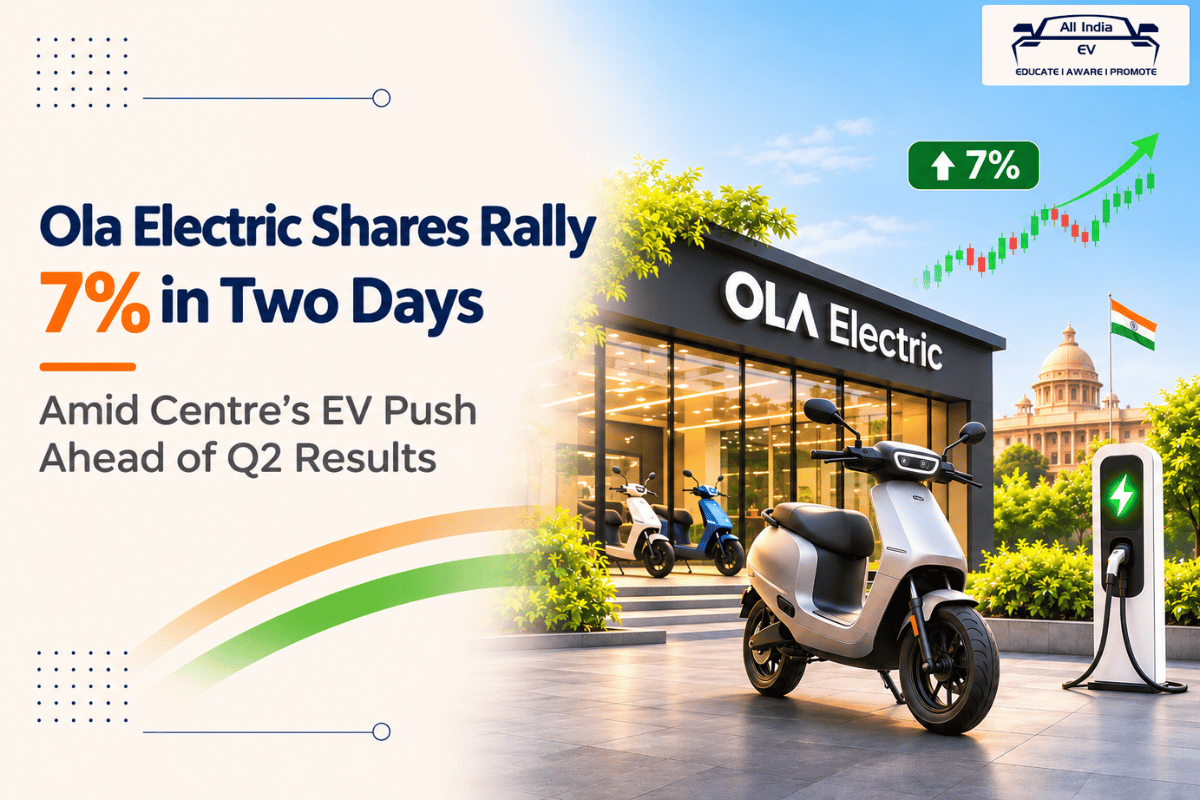
Ola Electric Mobility shares surged around 9% over two trading sessions, gaining investor attention following the Centre’s latest electric vehicle procurement policy. The rally also came ahead of the company’s Q2 FY27 financial results, with market participants looking for signs of improvement in its business performance.
Ola Electric Shares Gain 9% in Two Trading Sessions
Shares of Ola Electric Mobility witnessed a strong recovery in the stock market on November 12, 2026, rising more than 7% during Thursday’s trading session. The stock touched approximately ₹37 per share on the National Stock Exchange (NSE), marking the second time in a month that it crossed this level.
The company’s shares had already gained around 9% over two trading sessions following the Central Government’s decision to make electric vehicles the preferred option for government staff-car procurement.
The rally added more than ₹1,400 crore to Ola Electric’s market capitalisation, taking its valuation above ₹17,150 crore. The positive movement reflected renewed investor interest in India’s electric mobility sector, particularly as government policies increasingly support EV adoption.
Centre Makes Electric Vehicles the Default Choice for Government Cars
A major factor behind the recent rally is the Finance Ministry’s revised procurement policy, which makes electric vehicles the default and preferred choice for staff-car purchases across central government ministries and departments.
Under the revised guidelines, government departments are expected to prioritise electric cars when replacing or purchasing new staff vehicles. The policy also increases the net dealer price (NDP) ceiling for electric vehicles to ₹20 lakh, compared with ₹10 lakh for internal combustion engine (ICE) vehicles, including petrol, diesel and hybrid models.
The government has also extended preference to electric vehicles when hiring cars for official purposes.
The initiative is aimed at accelerating electric mobility adoption, reducing dependence on fossil fuels and supporting India’s transition towards cleaner transportation. By providing EVs with a higher procurement price limit, the government has also widened the scope for departments to consider a broader range of electric car models.
Although the revised policy primarily focuses on electric passenger cars, its wider impact could benefit the overall EV ecosystem by strengthening market confidence, encouraging manufacturers and supporting the development of India’s electric mobility industry.
Ola Electric Stock Performance and Investor Sentiment
Ola Electric’s stock has experienced considerable volatility since its market debut in August 2024. After reaching a lifetime high of ₹157.40 per share later that year, the stock witnessed a prolonged decline and touched a lifetime low of ₹22.25 in March 2026.
The company subsequently recovered, with its shares nearly doubling from the March low within three months to reach a 52-week high of ₹49.05 in June 2026.
However, the stock has continued to experience fluctuations. Despite the latest two-day rally, Ola Electric shares remained down more than 2% during 2026 and approximately 15% over the previous year, according to the November 12 market report.
Q2 FY27 Results in Focus
Investors were also closely watching Ola Electric’s second-quarter financial results for FY2027, scheduled for announcement on November 12. The results were expected to provide important insights into the company’s sales performance, operating costs, profitability and overall business recovery.
The combination of supportive government policies and expectations surrounding quarterly earnings has brought Ola Electric back into market focus.
The latest rally highlights how policy developments can influence investor sentiment towards electric mobility companies. However, the company’s ability to improve sales, manage costs and strengthen its financial performance will remain important factors in determining its long-term market position.
With India’s EV ecosystem continuing to expand, Ola Electric’s future performance will depend not only on favourable government policies but also on its ability to rebuild consumer demand and deliver sustainable business growth.