

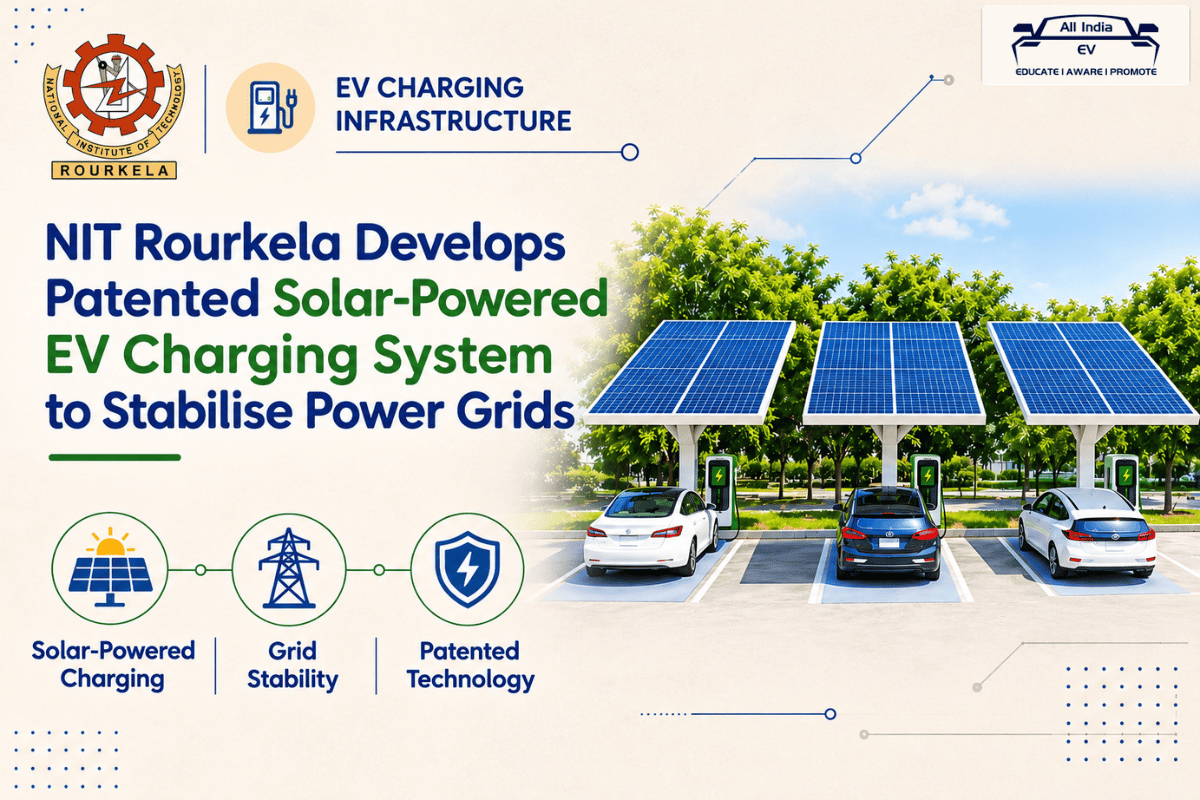
Researchers at the National Institute of Technology (NIT) Rourkela have developed a patented solar-powered electric vehicle (EV) charging system designed to improve charging efficiency, strengthen electricity grid stability and support the growing demand for electric mobility in India. The innovation combines solar energy, conventional grid electricity and an advanced energy storage system to make EV charging infrastructure more reliable and sustainable.
The newly developed technology uses a solar-powered microgrid integrated with batteries and supercapacitors. This combination is designed to manage fluctuations in renewable energy generation and sudden increases in electricity demand, addressing some of the major challenges associated with the expansion of EV charging networks.
As electric vehicle adoption continues to increase, charging infrastructure is facing growing pressure on local electricity distribution networks. When multiple electric vehicles charge simultaneously, they can create sudden spikes in electricity consumption, potentially affecting the stability and reliability of conventional power grids. The situation becomes more challenging for solar-powered charging stations, where electricity generation depends on weather conditions, cloud cover, seasonal variations and daylight availability.
To overcome these challenges, the NIT Rourkela research team has introduced a hybrid energy storage architecture that combines conventional batteries with supercapacitors. While batteries are designed to supply electricity during prolonged and sustained demand, supercapacitors can absorb and release energy much faster, making them suitable for handling sudden fluctuations in power requirements.
According to Professor Pravat Kumar Ray from the Department of Electrical Engineering at NIT Rourkela, this combination helps reduce the electrical stress experienced by batteries during sudden changes in current demand. By allowing supercapacitors to manage short-duration fluctuations, the system can potentially extend battery life and improve the overall performance of EV charging stations.
Another important feature of the technology is its intelligent power management system. It can regulate electrical voltage, control the amount of electricity supplied to an EV based on its battery’s state of charge and manage electricity flowing between vehicles and the power grid.
The research team has also introduced an improved mixed droop control technique, which automatically distributes power among different energy sources and storage components depending on changing operating conditions. According to Associate Professor Arnab Ghosh, this mechanism enables stable power sharing between batteries and supercapacitors, helping the microgrid maintain reliable operations despite variations in electricity generation and demand.
The patented system also supports both Grid-to-Vehicle (G2V) and Vehicle-to-Grid (V2G) charging technologies. While G2V allows electric vehicles to draw electricity from the grid for charging, V2G enables EV batteries to supply stored electricity back to the grid whenever required. This two-way energy exchange could allow electric vehicles to function as distributed energy storage resources and support electricity networks during periods of peak demand.
The researchers have already developed a prototype of the proposed microgrid and tested its performance under simulated variations in solar power generation and electricity demand.
As the next step, the team plans to scale up the prototype for higher-power EV charging applications. Further development will include advanced battery management systems, energy optimisation algorithms, grid-forming control and the integration of multiple electric vehicles. The researchers also intend to conduct real-time field trials to develop an industry-ready smart EV charging solution.
Once commercialised, the technology could find applications across residential complexes, commercial establishments, educational institutions and public EV charging stations.
The development represents a promising step towards strengthening India’s EV charging ecosystem. By combining renewable energy, advanced storage technologies and intelligent electricity management, NIT Rourkela’s innovation could help reduce pressure on conventional power grids while supporting the country’s transition towards cleaner and more sustainable electric mobility.