

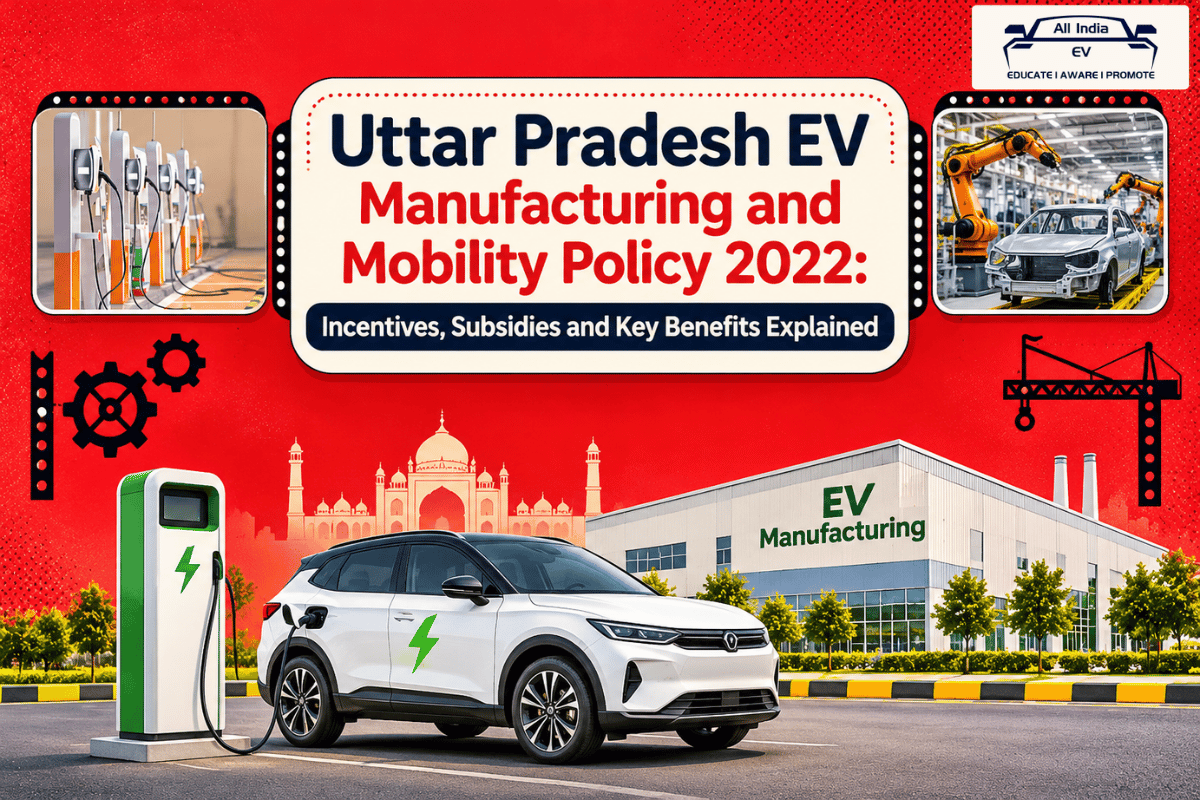
Uttar Pradesh is strengthening its position in India’s electric vehicle (EV) industry through its Electric Vehicle Manufacturing and Mobility Policy, 2022. The policy aims to establish the state as a major hub for electric vehicle manufacturing, battery production, charging infrastructure and sustainable transportation by attracting investments and encouraging wider EV adoption.
Introduced on October 14, 2022, the policy replaced the state’s earlier EV policy of 2019. It provides a framework covering the entire electric mobility ecosystem, from vehicle and battery manufacturing to charging facilities and consumer incentives. The policy has a validity period of five years from its notification, subject to subsequent amendments.
Major Objectives of Uttar Pradesh’s EV Policy
The Uttar Pradesh government introduced the policy to accelerate the transition towards cleaner transportation while creating new industrial and employment opportunities.
Its major objectives include:
- Establishing Uttar Pradesh as a leading EV manufacturing destination.
- Attracting domestic and international investments in the EV sector.
- Promoting battery manufacturing and EV component production.
- Expanding public charging and battery-swapping infrastructure.
- Encouraging consumers and fleet operators to adopt electric vehicles.
- Supporting research and development in battery technology, electric drivetrains and EV electronics.
- Generating employment through manufacturing and technical development.
The policy covers electric cars, two-wheelers, three-wheelers, electric buses, commercial vehicles, batteries, charging equipment and associated technologies.
Capital Subsidies for EV Manufacturing Companies
One of the major attractions of the policy is its financial support for companies investing in EV and battery manufacturing facilities.
The government has introduced different capital subsidy structures based on investment size and project category.
| Project category | Capital subsidy | Maximum subsidy |
|---|---|---|
| Integrated EV Project | 30% | ₹1,000 crore |
| Ultra-Mega Battery Project | 30% | ₹1,000 crore |
| Mega EV Project | 20% | ₹500 crore |
| Mega EV Battery Project | 20% | ₹500 crore |
| Large EV Projects | 18% | ₹90 crore |
| MSME Projects | 10% | ₹5 crore |
The highest incentives are reserved for the first two eligible Integrated EV and Ultra-Mega Battery projects. Mega projects also receive substantial financial support to encourage large-scale manufacturing investments.
However, manufacturers must meet prescribed capacity utilisation requirements to receive the applicable subsidies. The policy links incentives to actual production rather than simply establishing manufacturing capacity.
Incentives for EV Charging and Battery-Swapping Infrastructure
To address charging accessibility, the policy offers financial assistance to companies setting up EV charging and battery-swapping facilities.
Key benefits include:
- EV charging stations: 20% capital subsidy, up to ₹10 lakh per station, for eligible projects.
- Battery-swapping stations: 20% capital subsidy, up to ₹5 lakh per station.
- Government land: Eligible charging infrastructure developers can access government land under a revenue-sharing arrangement.
These incentives are intended to encourage private investment and improve charging availability across the state.
Additional Benefits for EV Manufacturers
Apart from capital subsidies, the policy offers several incentives to reduce manufacturing costs and support business expansion.
These include:
- Stamp-duty reimbursement on eligible industrial land investments.
- Reimbursement of up to 50% of quality certification expenses, subject to applicable limits.
- Patent registration assistance for domestic and international patents.
- Skill-development incentives of ₹5,000 per employee annually for the first 50 eligible employees.
The eligible investment period varies according to project size, ranging from three years for MSMEs to seven years for specified Integrated EV and Ultra-Mega Battery projects.
EV Adoption and Consumer Incentives
The policy also focuses on increasing electric vehicle adoption through purchase subsidies and exemptions on road tax and registration fees.
Initially, eligible electric two-wheelers, three-wheelers, four-wheelers, electric buses and goods carriers received purchase incentives under prescribed conditions.
However, the state subsequently revised its incentive framework. From October 14, 2025, purchase subsidies and road-tax and registration-fee benefits were restricted to eligible EVs manufactured or assembled, sold and registered in Uttar Pradesh under the revised provisions.
Uttar Pradesh’s Growing EV Manufacturing Ambitions
The Uttar Pradesh Electric Vehicle Manufacturing and Mobility Policy, 2022, represents an important step towards developing a comprehensive EV ecosystem in the state. By supporting manufacturing, battery production, charging infrastructure and consumer adoption, the government aims to attract investment and strengthen domestic supply chains.
With policy amendments and continued incentives for eligible businesses, Uttar Pradesh is positioning itself as an important destination for India’s electric mobility industry. The success of the initiative will depend on investment implementation, manufacturing capacity utilisation, infrastructure development and the creation of a reliable EV supply chain.
For manufacturers, infrastructure developers and technology companies, the policy offers opportunities to participate in India’s expanding electric mobility market.