

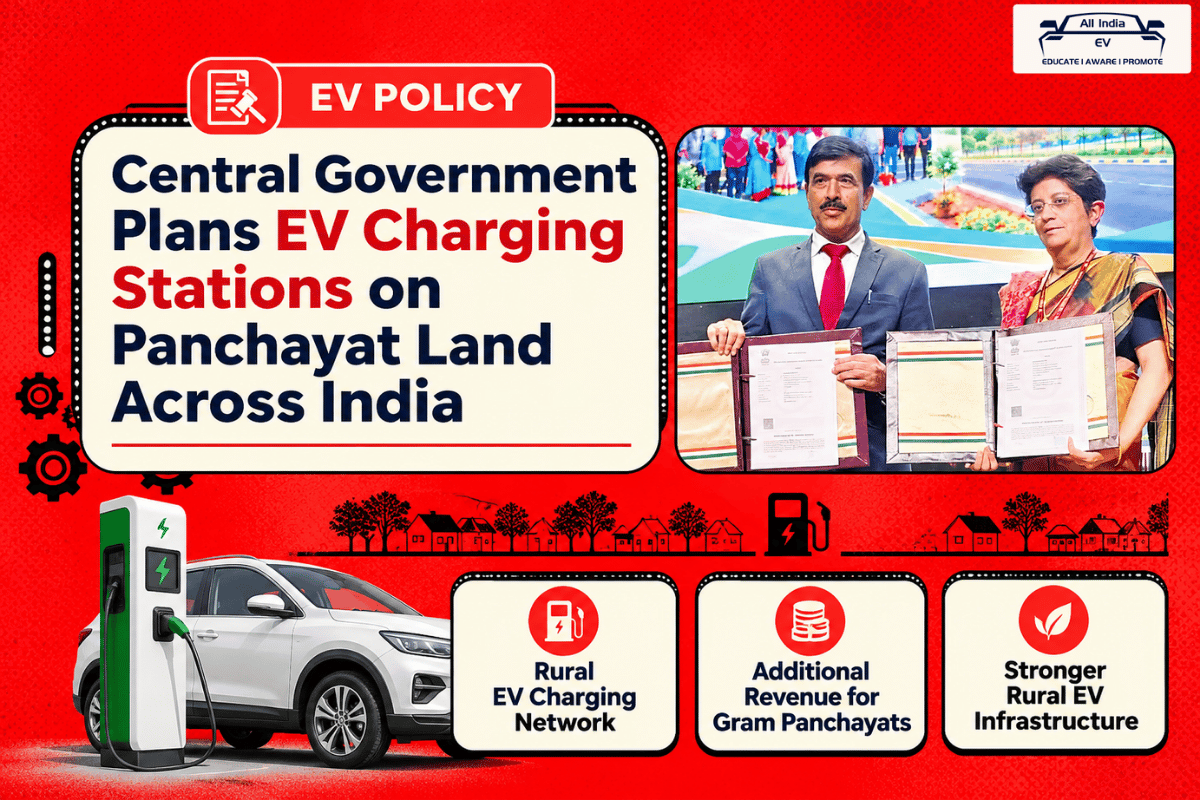
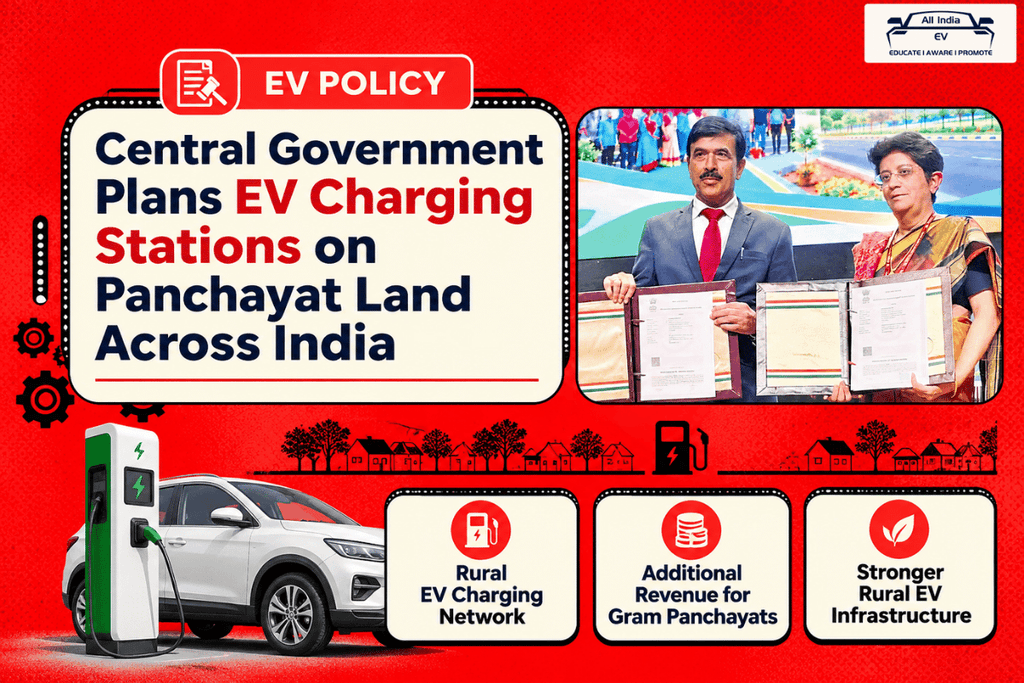
The Government of India is taking another major step towards expanding electric mobility infrastructure beyond metropolitan cities by planning to establish electric vehicle (EV) charging stations and battery-swapping facilities on Panchayat-owned land across the country. The initiative aims to strengthen rural EV infrastructure while creating additional and sustainable revenue opportunities for Gram Panchayats.
The development is expected to bring electric mobility services closer to rural communities, improve charging accessibility for EV owners and support India’s broader transition towards cleaner transportation.
The initiative will be implemented through a collaboration between the Union Ministry of Panchayati Raj (MoPR) and Convergence Energy Services Limited (CESL), a wholly owned subsidiary of Energy Efficiency Services Limited (EESL), which operates under the Ministry of Power. Both organisations have signed a Memorandum of Understanding (MoU) to explore the development of EV charging and battery-swapping infrastructure across Gram, Block and District Panchayats in different states.
The MoU was exchanged in New Delhi between Mukta Shekhar, Joint Secretary at the Ministry of Panchayati Raj, and Akhilesh Kumar Dixit, Director of CESL.
Panchayat Land to Support Rural EV Charging Infrastructure
Under the proposed initiative, available and underutilised Panchayat-owned land will be identified for setting up EV charging stations and battery-swapping facilities. Suitable locations may include areas near Gram Panchayat offices, public premises and land situated along State and National Highways.
By utilising these public assets, the government aims to develop a wider network of EV infrastructure that can serve rural residents, commercial vehicle operators and travellers using electric vehicles.
The proposed facilities are expected to support different categories of electric vehicles, including electric two-wheelers, three-wheelers, passenger cars and medium- and heavy-duty commercial vehicles.
Expanding charging infrastructure along important highways could also improve connectivity between urban and rural regions, making long-distance electric vehicle travel more practical.
Gram Panchayats to Generate Additional Revenue
A major objective of the partnership is to strengthen the financial independence of rural local bodies. Currently, several Panchayat-owned properties and land parcels remain underutilised. Developing EV charging and battery-swapping facilities on these properties could turn them into productive economic assets.
The revenue generated through the establishment and operation of these facilities will provide Gram, Block and District Panchayats with additional Own Source Revenue (OSR).
These additional earnings could be utilised to support essential civic services, improve local infrastructure, undertake community development activities and strengthen rural public facilities.
The initiative also aligns with the government’s efforts to encourage financially self-reliant Panchayats through transparent and locally driven revenue-generation mechanisms.
CESL to Manage Installation and Operations
Under the partnership, the Ministry of Panchayati Raj will coordinate with State Panchayati Raj Departments to identify suitable locations and monitor the development of the proposed infrastructure.
CESL will undertake several operational responsibilities, including site assessment, demand aggregation, equipment supply, installation, testing, commissioning, operation and maintenance of the charging and battery-swapping facilities.
This arrangement is expected to bring technical expertise and a structured implementation approach to developing charging infrastructure across rural locations.
CESL has also contributed to the government’s PM e-Bus Sewa initiative, supporting electric bus deployment in cities such as Delhi, Surat, Hyderabad and Bengaluru.
Strengthening India’s Rural Electric Mobility Ecosystem
The partnership represents an important step towards making India’s EV ecosystem more geographically inclusive. While electric mobility infrastructure has primarily expanded across major cities and urban centres, rural charging accessibility remains an important area for development.
Establishing charging and battery-swapping facilities on Panchayat land could encourage greater EV adoption in smaller towns and villages while supporting electric mobility along intercity routes.
The initiative is also expected to contribute to reducing carbon emissions, promoting cleaner transportation and supporting India’s long-term sustainability goals.
By combining rural public assets, government coordination and CESL’s technical capabilities, the initiative aims to connect rural development with India’s clean mobility transition. If implemented effectively, Panchayat-owned land could become an important part of the country’s expanding EV charging network while generating recurring income for local communities.