


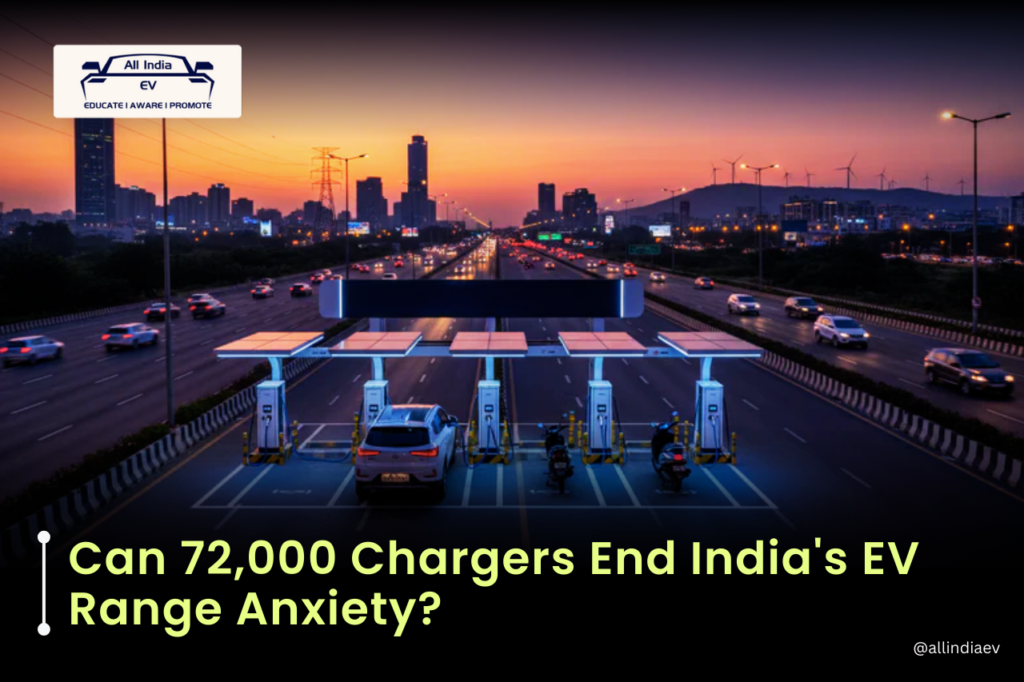
India Plans 72,000 New Public EV Chargers: Can Infrastructure Keep Up with Rising EV Demand?
India’s electric vehicle (EV) market is growing, but adoption remains uneven across segments. While more than half of India’s three-wheelers are now electric, other categories such as cars, buses, and two-wheelers continue to lag. According to an August report by Niti Aayog, global EV penetration reached 16.48% in 2024, whereas India’s penetration is just 7.66%.
One of the primary challenges hindering EV adoption is the lack of adequate charging infrastructure, which fuels range anxiety—the fear that a vehicle may run out of charge mid-journey. To tackle this, the government has launched the PM E-Drive scheme, aiming to install more than 72,000 public chargers by FY28 with a budget of ₹2,000 crore, focusing on urban areas and highways.
Current EV adoption figures remain modest. In 2025, only 6% of two-wheelers sold were electric, about 5% of cars, 5% of buses, and less than 1% of medium- and heavy-duty trucks were electric. Ashim Sharma of Nomura Research Institute told Mint on 2 December that widespread charging infrastructure would significantly boost EV adoption in India.
Why Public Chargers Are Critical for EV Growth
Electric vehicles run entirely on batteries. Once depleted, the vehicle stops functioning. This is a major concern for potential buyers, many of whom continue to prefer petrol or diesel vehicles due to range anxiety.
Public charging infrastructure is essential for building confidence among buyers, especially for long-distance travel and segments like cars and buses where charging demand is higher. Without sufficient chargers, adoption of EVs could remain slow, despite falling vehicle costs and growing interest.
More EV News

Types of EV Chargers in India
There are two main types of chargers:
- Slow AC Chargers: Typically 3.3 kW, these are commonly used for e-rickshaws and small electric scooters. Charging a small 3.5 kWh battery can take several hours.
- Fast DC Chargers: These have much higher capacities. Older models start at 15 kW, while modern chargers range from 30 kW to 350 kW, enabling much quicker charging.
India has standardised the Combined Charging System Type 2 (CCS2) for all public chargers. Urban DC chargers typically operate at 30–60 kW, while highway chargers range from 60–180 kW. This system aligns with European standards, making it compatible with most global EV makers.
Current Status of EV Chargers in India
Home chargers are generally bundled with vehicles and are not tracked separately. As of August 2025, India had just over 29,000 public EV charging stations, according to the Union Road Transport and Highways Ministry.
The government aims to expand this network significantly. Under the PM E-Drive scheme, more than 72,000 public chargers are planned in partnership with state governments and central public sector undertakings (PSUs). Two state-run oil marketing companies have already expressed interest in participating in the deployment.
A 2023 CII study estimated that India would need 1.32 million EV chargers by 2030 to meet the rising demand for zero-emission vehicles. Market intelligence from Mordor Intelligence projects India’s EV charging station market size to grow from $46 billion to $122 billion by 2030, at a CAGR of 21.57%.
Cost and Viability of EV Chargers
A charging station has two key components:
- Upstream infrastructure: Wires and connectors that draw electricity from the grid.
- Downstream infrastructure (EVSE): Equipment that connects directly to the vehicles.
Typically, EVSE costs around ₹8–10 lakh, while upstream infrastructure costs vary depending on factors like distance from the main grid. Land acquisition is another significant cost for charger deployment.
The PM E-Drive scheme covers most of the upstream infrastructure costs, with the remaining expense handled by charge point operators or other stakeholders.
Government support varies by location:
- Government-owned locations: 100% coverage for both upstream infrastructure and EVSE.
- Public-use locations (airports, parking lots): 80% coverage for upstream infrastructure, 70% for EVSE.
- Other public locations (city roads): 80% coverage for upstream infrastructure.
Proposal process: State governments, PSUs, or private operators must submit a detailed plan to the Ministry of Heavy Industries, including the number of chargers, land requirements, target vehicle segments, and operator details. Approved proposals move to the procurement phase.
Conclusion: Can India Reach Its EV Goals?
While the government’s plans under the PM E-Drive scheme are ambitious, deployment and adoption challenges remain. Building 72,000 chargers could significantly reduce range anxiety, but meeting the projected demand of 1.32 million chargers by 2030 will require continuous investment and coordination between the government, private sector, and state authorities.
With EV adoption rates still below global averages, the success of India’s electric mobility ambitions depends not just on vehicles but also on robust charging infrastructure, smart planning, and public awareness.
The next few years will be crucial in determining whether India can accelerate its EV adoption and transform into a global EV hub.
Author’s Comment:
India’s plan to install 72,000 public EV chargers under the PM E-Drive scheme is a bold step toward addressing range anxiety and boosting adoption. While it marks significant progress, achieving India’s EV goals will require sustained investment, strategic planning, and strong collaboration between the government, private sector, and state authorities.
The coming years will be decisive in determining whether India can truly accelerate its electric mobility journey and emerge as a global EV leader.