
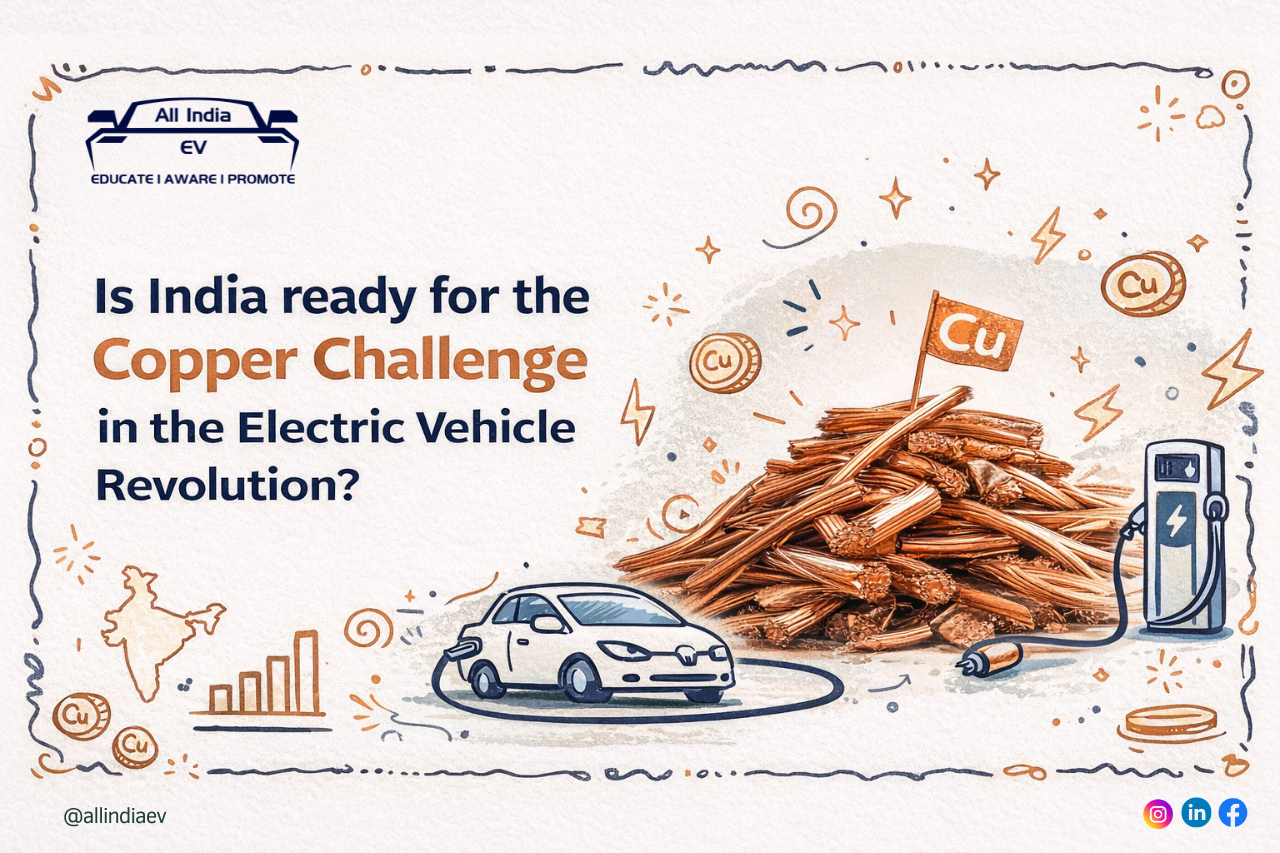

India’s ambitious EV targets depend on a strong copper supply chain from mining to recycling to close the demand-supply gap and reduce geopolitical risks.
As electric vehicles (EVs) quietly but steadily transform Indian roads, cutting tailpipe emissions and reducing dependence on fossil fuels, a less visible element has emerged as the backbone of this transition: copper. From batteries and motors to charging stations and grid connections, the red metal is fast becoming one of the most critical inputs in India’s clean mobility journey.
Industry estimates suggest that by 2030, EVs could account for nearly 40 per cent of global car sales, driving a sharp surge in copper demand worldwide. For India, which has set an ambitious target of achieving 30 per cent EV penetration by the end of the decade, the copper supply chain from mining and refining to recycling and advanced processing—has become a strategic concern.
Why Copper Matters for EVs
Copper’s importance lies in its unique physical properties. Its high electrical conductivity and durability make it indispensable in electric mobility. A single electric vehicle typically uses between 60 and 80 kilograms of copper in wiring harnesses, traction motors, inverters, and battery connections nearly three times more than a conventional internal combustion engine vehicle.
Thin copper foils inside lithium-ion batteries efficiently transfer electrons between cells and external circuits. In addition, copper’s corrosion resistance and ability to handle very high currents make it essential for fast-charging infrastructure. Ultra-fast chargers operating at up to 350 kilowatts rely on heavy copper cabling to avoid overheating, minimise energy losses, and reduce fire risks. Without such capacity, charging times increase, range anxiety worsens, and operating costs rise.
Bridging the Demand–Supply Gap
India’s copper challenge is not just about rising demand, but also about constrained domestic supply. At its peak, Sterlite Copper played a major role in meeting domestic refined copper needs, supporting downstream manufacturing and reducing import dependence capabilities closely aligned with today’s EV localisation and Production-Linked Incentive (PLI) ambitions.
However, policy bottlenecks persist. Industry stakeholders argue that the Mines and Minerals (Development and Regulation) Act, 1957, has not kept pace with modern requirements. Delays in auctions, limited exploration licences, and hurdles in brownfield expansion have slowed the development of new copper assets that are vital for EV battery and charging supply chains.
More EV News

Adding to the pressure is China’s dominance of nearly 60 per cent of the global refined copper market. Such concentration exposes countries like India to pricing risks and geopolitical vulnerabilities, especially during periods of global supply stress.
Global Competition for Copper Intensifies
International developments highlight the urgency of securing copper supplies. Leading battery manufacturers such as CATL and BYD have reportedly locked in long-term supplies through mine acquisitions and futures contracts. This race for resources has contributed to a sharp rise in copper prices, with rates on the London Metal Exchange jumping by nearly 45 per cent in 2025.
The United States, under its Inflation Reduction Act, is investing billions of dollars to develop large-scale copper extraction projects in Arizona, aimed at producing billions of pounds of the metal over the next four decades. The European Union, meanwhile, has mandated that at least 20 per cent of copper used in EVs should come from recycled sources by 2030.
For India, these global moves underline the need for a balanced policy mix that combines government incentives, tax breaks, and regulatory reforms. Industry experts suggest measures such as special economic zones for metal recycling, support for research into copper–aluminium hybrids, and fiscal incentives for modern smelters.
Environmental and Technological Challenges
Despite its strategic importance, copper mining carries environmental costs. The process is water-intensive and generates large volumes of tailings, often leading to community resistance concerns that have shaped public discourse around past projects. These issues make it imperative for policymakers to balance environmental safeguards with industrial growth.
Technological shifts could also influence future demand. Battery manufacturers are experimenting with sodium-ion chemistry, which could potentially reduce copper usage. However, analysts believe lithium-ion batteries will remain dominant at least until 2040, ensuring sustained demand for copper in the medium term.
Geopolitical risks further complicate the picture. Export restrictions from major producing nations could push copper prices up by as much as 30 per cent, threatening to raise EV costs and slow adoption in price-sensitive markets like India.
A Three-Pronged Strategy
Experts argue that India needs a triangulated approach to manage copper risk:
- Scale up recycling: India’s copper recycling rate has improved from 22 per cent in 2019–20 to about 43 per cent in 2023–24, but remains well below global best practices. With large domestic scrap reserves, recycling offers the fastest route to easing supply constraints.
- Diversify sourcing: Overseas partnerships with copper-rich regions such as the Zambian Copperbelt and Australian producers like Glencore could reduce over-reliance on any single market.
- Drive innovation: Advances such as graphene-coated copper wires can improve conductivity by 1–3.6 per cent, enabling thinner wiring and marginal reductions in overall copper usage without compromising performance.
Charging Infrastructure Adds to Demand
Beyond vehicles themselves, charging infrastructure is another major copper consumer. India plans to install nearly 3.9 million chargers by 2030, most of them low- to mid-capacity AC chargers. In addition, around 1,000–2,000 fast DC chargers are expected along highways, each requiring between 100 and 300 kilograms of copper.
Emerging technologies like vehicle-to-grid (V2G), which allow two-way energy flow between EVs and the power grid, could further increase copper requirements due to higher current loads and more complex wiring.
No Easy Substitute
There are few viable alternatives to copper. Silver, while more conductive, is prohibitively expensive. Superconductors require extremely low temperatures, making them impractical for everyday automotive and infrastructure use. Incremental efficiency improvements in copper wiring remain the most realistic way to manage demand.
India’s strengths abundant scrap availability, a strong engineering talent base, and a projected 10-million-vehicle EV market by 2030 provide a foundation to address the challenge.
What’s at Stake
Failure to secure adequate copper supplies could derail India’s net-zero emissions target for 2070, push battery prices up by an estimated 25 per cent, and slow EV adoption. Conversely, a strong domestic copper ecosystem could create jobs across dozens of new mines, save up to $15 billion in imports, and enhance energy security through locally built charging networks.
Copper, often overlooked, is wiring India’s EV ambitions to reality. As battery technologies evolve, this metal is likely to remain indispensable—conducting not just electricity, but also economic opportunity. India’s task now is clear: match its growing demand with resilient supply, turning a potential bottleneck into a copper-clad advantage.