

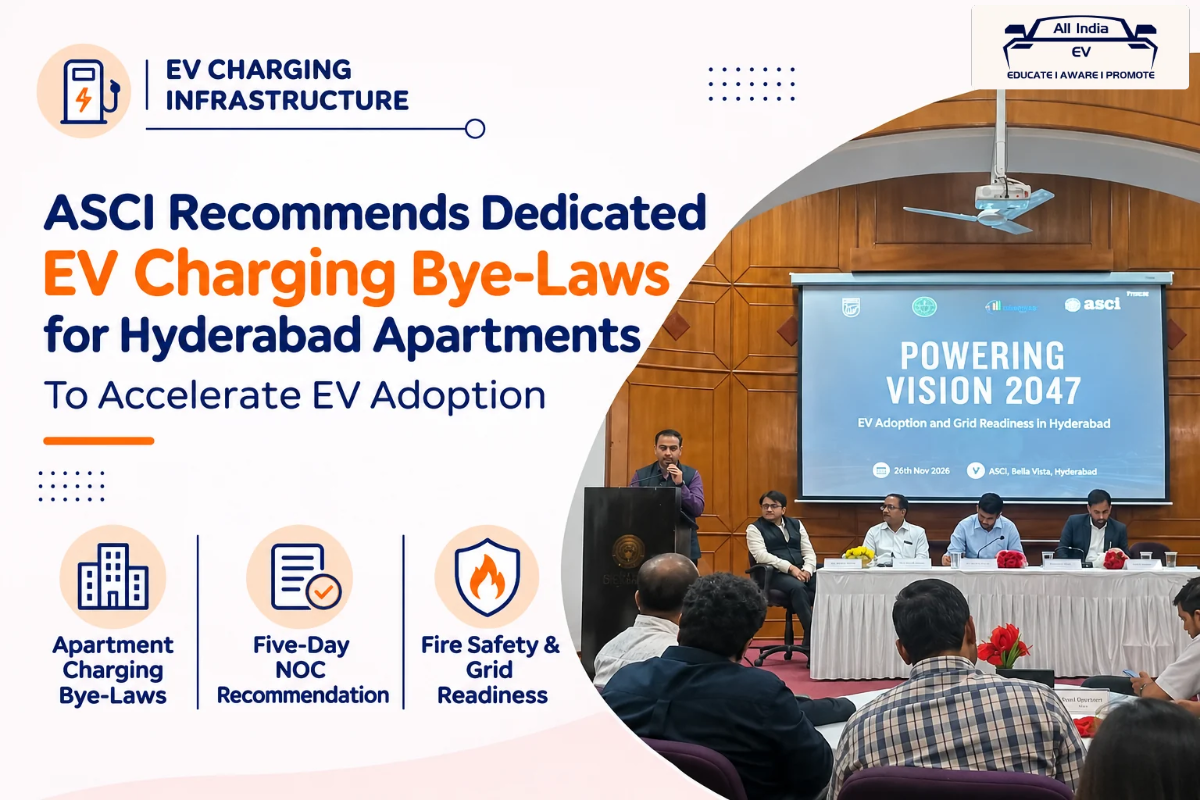
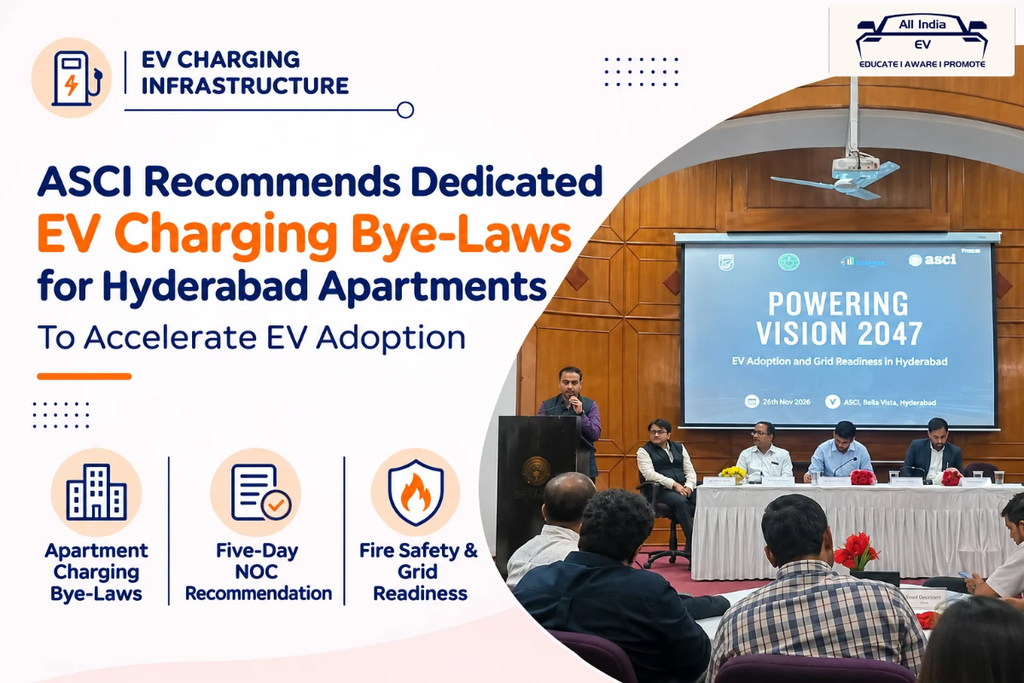
The Administrative Staff College of India (ASCI) has recommended introducing dedicated building bye-laws for electric vehicle (EV) charging installations in residential apartments across Hyderabad. The proposal aims to simplify charger installation procedures, improve charging accessibility and strengthen safety standards as electric vehicle adoption continues to increase across Telangana.
The recommendations were outlined in a joint report titled ‘Powering Vision 2047: EV Adoption and Grid Readiness in Hyderabad’, developed by ASCI and the Natural Resources Defense Council (NRDC) India. The report was launched at Bella Vista in Hyderabad on November 26, 2026.
The study was conducted by the Centre for Energy Studies (CES) at ASCI in collaboration with NRDC India. It examined Hyderabad’s growing EV adoption, future charging requirements and electricity distribution infrastructure needs up to FY 2034-35. The assessment also considered the geographical distribution of charging demand and the impact of increasing EV usage on the city’s electricity network.
Simplifying EV Charger Installations in Residential Buildings
One of the major recommendations is to amend existing building bye-laws to make EV charger installations easier in apartment complexes. Under the proposed framework, resident welfare associations (RWAs) and property owners would be required to issue no-objection certificates (NOCs) for installing EV chargers within five days.
The recommendation addresses a common challenge faced by electric vehicle owners living in apartment buildings, where obtaining permission from housing societies can delay or prevent the installation of private charging points.
The report also proposes establishing common EV charging facilities in residential complexes. These facilities would allow multiple residents to access charging infrastructure without requiring separate charging arrangements for every apartment.
Additionally, individual sub-metering has been recommended to ensure that electricity consumed for charging individual vehicles is billed separately. This would prevent EV charging expenses from being included in the common maintenance bills paid by all residents.
Focus on Fire Safety and Charging Infrastructure
Safety is another important aspect of the proposed recommendations. ASCI has highlighted the need for dedicated fire-safe charging arrangements, particularly in residential parking areas.
The report recommends allowing EV charging facilities on ground floors and in first-level basements, subject to appropriate safety arrangements. These installations should use suitable protective enclosures and certified electrical cables to minimise potential electrical and fire-related risks.
It also recommends restricting EV charging in automated and stacked parking areas, where safety and accessibility challenges could make charging installations more complicated.
These measures are intended to establish a safer residential charging environment while supporting the growing number of electric two-wheelers, three-wheelers and passenger vehicles in Hyderabad.
Managing Electricity Demand and Reducing Grid Pressure
The report also highlights the importance of managing electricity demand as residential EV charging increases. According to B.T. Srinivasan, General Secretary of the Confederation of All India Residents Welfare Associations (CoRWA), Hyderabad accounts for nearly 70% of Telangana’s new EV registrations.
He also indicated that residential locations are expected to contribute nearly 58% of future EV charging demand, making home charging infrastructure an important part of the city’s electric mobility ecosystem.
To manage electricity consumption, the report proposes introducing Time-of-Day (ToD) tariffs for domestic electricity connections. The objective is to encourage EV owners to shift charging activities away from peak electricity demand hours, particularly between 5 PM and 8 PM.
The study also recommends bulk procurement of affordable smart home chargers for resident welfare associations. This approach could reduce equipment costs and make residential charging infrastructure more accessible to apartment communities.
Pilot Project to Involve 15–20 Resident Welfare Associations
To translate the recommendations into practical implementation, the report proposes launching a pilot project involving 15 to 20 resident welfare associations across Hyderabad.
The initiative would help develop a standardised apartment charging model that addresses installation permissions, electricity billing, charging infrastructure management and fire safety requirements.
The proposed framework could eventually provide a model for other cities facing similar challenges in expanding EV charging facilities within high-density residential developments.
Strengthening Hyderabad’s EV Ecosystem
ASCI and NRDC India’s recommendations highlight the growing importance of residential charging infrastructure in India’s electric mobility transition. While public charging networks remain essential, convenient and affordable home charging will play a significant role in encouraging more people to adopt electric vehicles.
If implemented, the proposed building bye-laws could reduce administrative barriers for apartment residents, improve charging safety and support better electricity demand management.
The recommendations also underline the need for coordination between government authorities, electricity distribution companies, housing societies and EV charging providers.
For Hyderabad, developing a clear residential EV charging framework could become an important step towards building a reliable, accessible and grid-ready electric mobility ecosystem by 2047.