
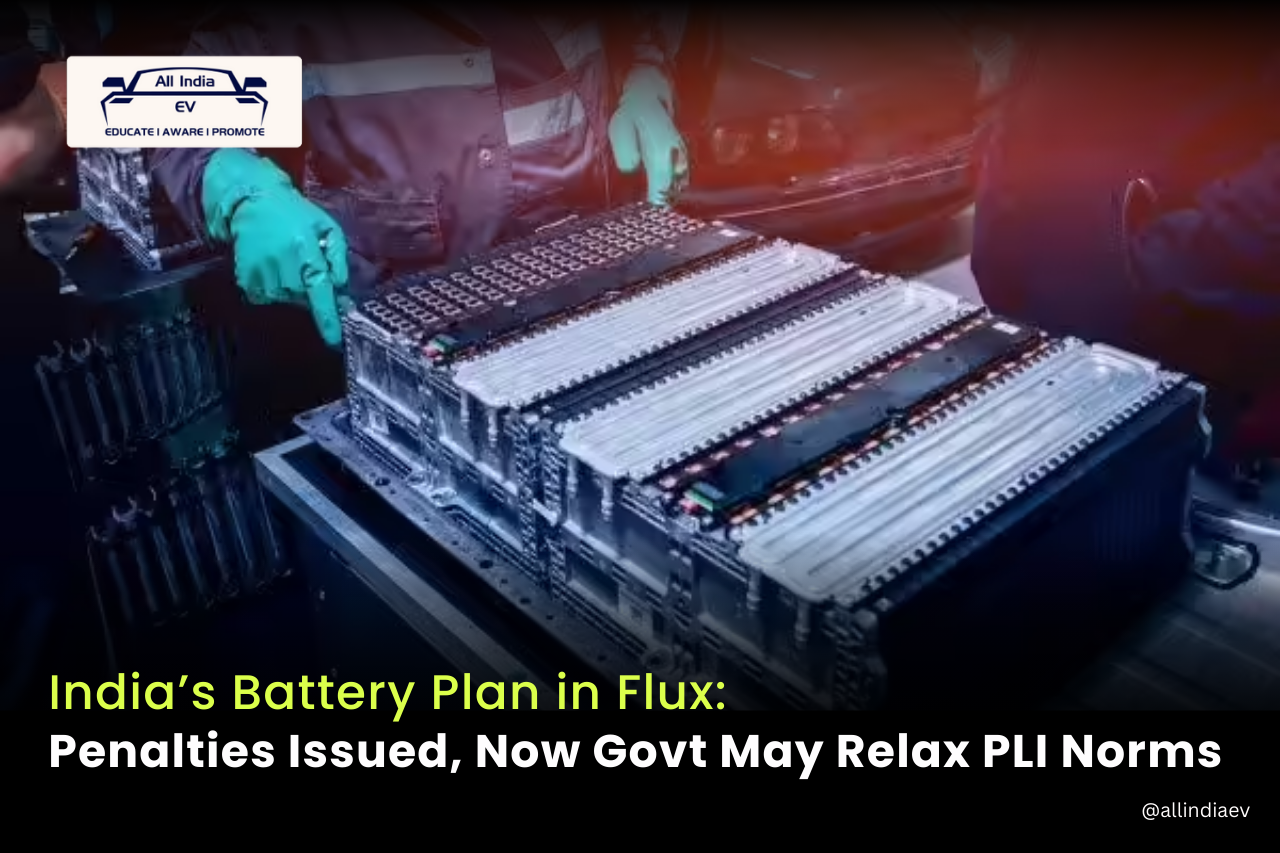


India’s high-profile effort to build large-scale domestic manufacturing capacity for advanced chemistry cells (ACCs)—a critical component for electric vehicles and energy storage—may undergo major changes as deadlines slip and approved companies struggle to meet targets. The Union Ministry of Heavy Industries is now evaluating extensions, easier localization rules, and temporary import relaxations under the ₹18,100-crore PLI-ACC scheme, according to two officials aware of internal discussions.
Announced in 2021, the scheme aimed to create 50 GWh of ACC manufacturing capacity by December 2024, positioning India as a global battery hub. However, progress has been limited. By June 2025, only 1.4 GWh of capacity—set up by Ola Cell Technologies—was operational, as confirmed by Union minister H.D. Kumaraswamy in a written response earlier this year.
Extensions and Softer Localisation Norms on the Table
One of the officials said the government recently issued show-cause notices to companies approved under the programme.
“Companies have sought an extension of around 18 months. Their request is being actively considered,” the person said, noting that a final decision is pending.
Another official added that the Centre is also weighing a proposal to temporarily allow cells to be imported at lower duties, giving companies breathing room until they develop indigenous cell chemistries and manufacturing capabilities.
The scheme currently requires companies to ensure at least 25% domestic value addition within two years, rising to 60% within five years, along with mandatory investments of ₹225 crore per GWh. Meeting these requirements amid global supply chain disruptions has proven difficult.
Capacity Allotment and Current Status
In 2022, the government awarded 30 GWh of capacity under the first round of PLI-ACC allocations:
- Ola Electric: 20 GWh
- Reliance New Energy (Reliance Industries subsidiary): 5 GWh
- Rajesh Exports: 5 GWh
In September 2024, an additional 10 GWh was allotted to Reliance.
More EV News

Despite the challenges, Minister Kumaraswamy maintains that India’s ACC ecosystem is steadily evolving.
“With support and handholding, Ola Cell Technologies has successfully installed 1.4 GWh capacity. Beyond PLI beneficiaries, over 10 companies have already started setting up cell plants totalling more than 100 GWh,” he said.
Emails sent to the Heavy Industries Ministry, Ola Electric, Reliance Industries and Rajesh Exports went unanswered.
The PLI-ACC scheme now joins several other PLI programmes facing delays. Earlier this year, the Centre extended the commissioning timeline under the ₹19,500-crore solar module PLI scheme after manufacturers sought more time.
Experts Cite Deeper Structural Challenges
Industry analysts argue that the delays go beyond project execution hurdles.
“China’s strict control on graphite exports has slowed down India’s battery capacity build-out,” said Debmalya Sen, President, India Energy Storage Alliance (IESA). Even basic cell manufacturing could take another two to three years to scale meaningfully, he added.
Sen also highlighted India’s customs duty structure:
“High BCD is important for supporting local manufacturing, but high duties across the entire supply chain raise costs and reduce competitiveness. Incentives are still essential.”
India’s dependence on imported batteries continues to deepen. According to Debi Prasad Dash, Co-founder and Executive Director of the Net Zero Energy Transition Association (NETRA):
“India imported 12 GWh of lithium-ion batteries in the past 12 months. With EV and stationary storage demand rising sharply, this number could grow three to five times next year.”
Dash warned that the delays among PLI-ACC beneficiaries—many already a year behind schedule—risk slowing down India’s broader EV and clean energy transition.
He urged the Centre to create a single-window facilitation system to resolve operational issues such as equipment imports, foreign partnerships and access to upstream materials.
Upstream Bottlenecks Slowing Down Gigafactories
The core challenge lies in the upstream supply chain, said Vikram Handa, Managing Director, Epsilon Advanced Materials, which manufactures anode and cathode materials.
“Without secure access to key materials, cell manufacturing cannot scale. If India wants gigafactories running at full capacity, upstream readiness and downstream investments must move together,” Handa asserted.
Upstream components such as anodes, cathodes, electrolytes and separators remain largely dependent on imports, making local gigafactory setups vulnerable to global disruptions.
A Crucial Crossroads for India’s Battery Ambitions
The government’s potential relaxation measures underscore the significance of the ACC mission for India’s long-term EV and energy storage goals. As battery demand surges—fueled by growing EV sales, renewable energy integration and industrial storage—the need for localised, large-scale, cost-competitive ACC production has become critical.
India’s EV transition hinges on the ability to produce reliable, affordable batteries domestically. Whether the government’s adjustments can realign the scheme’s trajectory will determine how quickly the country can reduce import dependence and emerge as a major global battery manufacturing hub.
Author’s Comment:
India’s ACC mission now stands at a defining moment. The government’s willingness to revisit deadlines and ease localisation norms reflects both the urgency and complexity of building a competitive domestic battery ecosystem. While temporary relaxations may help companies regain momentum, the real test lies in strengthening upstream supply chains and ensuring sustained investment across the value chain. How India navigates this transition will ultimately shape its ability to cut import dependence, scale gigafactories, and position itself as a serious global player in next-generation battery manufacturing.