


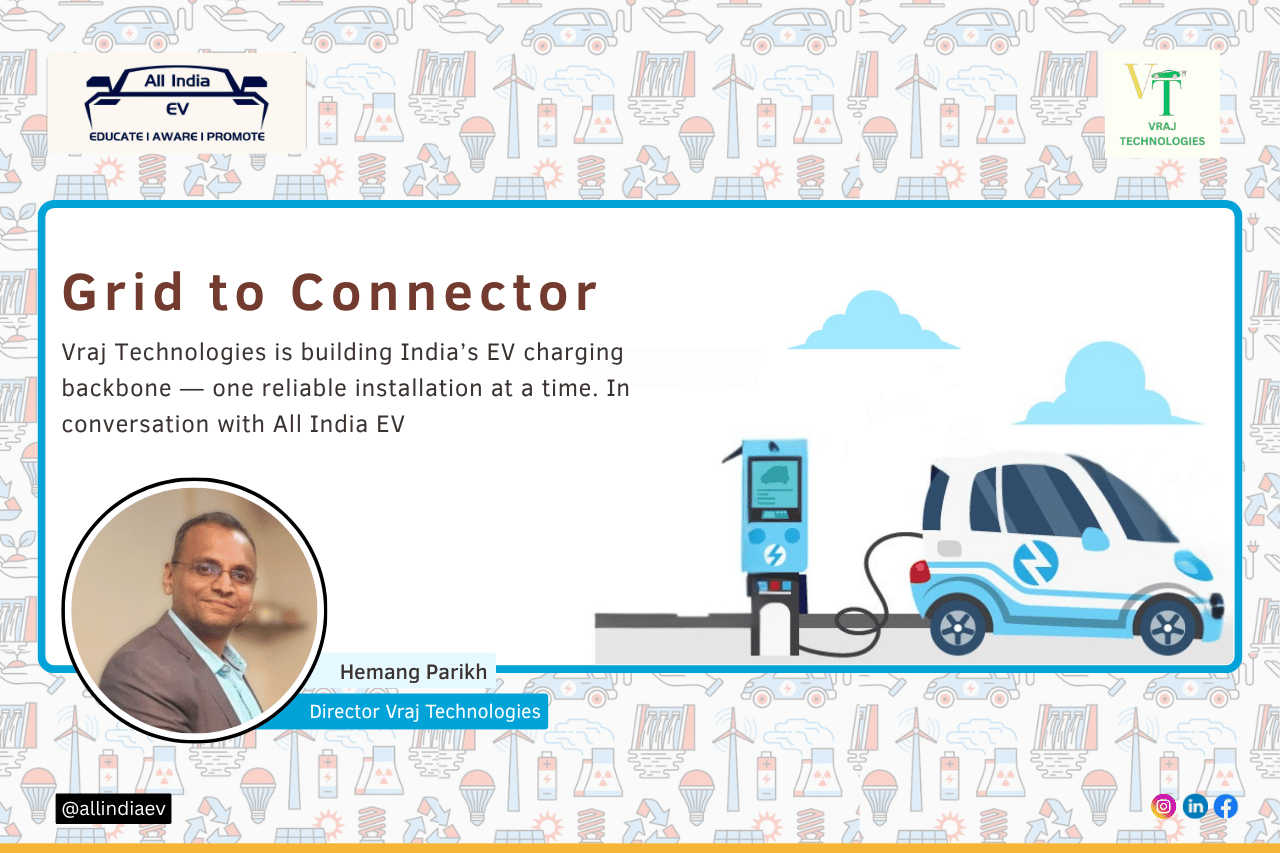
An EV charger is no longer an option — it is a necessity. The conversation has moved from ‘right time’ to ‘right technology, right spot, right features.
When Vraj Technologies entered the EV charging market in 2021, the questions being asked were existential, is this the right time? Is there a market?
Four years later, those questions have been replaced entirely by a more sophisticated conversation: which technology, which site, which features?
That shift, from scepticism to execution, is precisely the story that Vraj Technologies represents. As an end-to-end infrastructure provider managing everything from DISCOM liaisoning and power distribution to charger hardware, CMS, and payment integration, the company has quietly built a track record spanning state highways, corporate campuses, logistics operators, and institutional clients.
In this conversation, the founding team shares how Vraj thinks about reliability, scale, and the technologies that will define India’s next charging infrastructure wave.
Founded in 2021, Vraj Technologies is a Navi Mumbai-based end-to-end EV charging infrastructure company specialising in the complete deployment stack, from DISCOM liaisoning and power distribution design to EV charger supply, installation, commissioning, and cloud-based Charger Management Software (CMS).
Tell us about your journey into EV charging infrastructure. What inspired you to build expertise in this niche, and how has that evolved from Day 1 to now?
Coming from an electronics engineering background and being attuned to emerging technologies, we identified EV charging as a natural focus area, one that aligned with our broader goal of offering sustainable solutions to customers.
More EV News
Vraj Technologies was founded on that premise in 2021.
When we entered the market, this was still a very limited space with a very limited customer base. The defining question everyone was asking was: is it the right time to invest?
Today, that question has disappeared entirely. An EV charger is no longer an option, it is a necessity. And the conversation with customers has moved on: the discussion is now about the type of technology, the right spot, the right feature set, and how to make the charging experience truly smooth.
What was the defining moment when you realized EV charging infrastructure would be a strategic focus area for your career and business?
When we started way back in 2021, EV industry in India was still in nascent stage, and we wanted to be one of the Pioneers in this Industry.
We started approaching various Potential customers and, in the process, we got connected with one of the Government customer who was looking for EV Charging solutions.
When we started discussions with them and as we went in details we realised that Indian Government is going to put lots of focus on EV Industry in near future and that’s what exactly happened with government releasing various schemes to boost EV industry.
This happened in a short time after we concluded that Government order. This re emphasised our vision about future growth of EV Charging industry in India.
How would you describe Vraj Technologies’ mission and core value proposition in the EV charging ecosystem? What makes your offerings unique compared to others in the market?
Our Missions is very clear, Offer Reliable and Safe EV Charging solutions to our customers.
Our Core value proposition is to provide an End to end solution right from Grid to Final charger connector.
This includes Discom Liaisoning, Design of Power distribution systems, setting up complete electrical and civil infrastructure for ev charger, Supply, installation and commissioning of EV Charger and offering user friendly charger management software.
For an end customer we act as One point of contact for the complete need of EV Charging infrastructure.
- Right from day one we have been very consistent in choosing our vendors.
We offer one of the most reliable and proven charger hardware to our clients which ensures minimum down time. Time and again this is proven on the field and this differentiates us from our competitors.
Could you walk us through one or two projects you’re most proud of, maybe a particularly challenging installation or a high‑impact deployment?
In year 2024, we were discussing with one the private customer for installation of 120kW charger on the state highway.
During those times the charger utilization was a big question mark however we could convince our vision of having ultra-fast chargers on the state highways and convinced him to invest in the EV Industry and today when we look back we see this spot as one of the highest utilization spot in our network.
This project proved the trust which our customer placed on us in terms of Technology offered by us, Our on the field execution capability and seamless CMS solution which ensures highest uptime and resulting in healthy revenue for our clients.
Also we are now building a Ultra-Fast DC charging station for one of the School in Navi Mumbai which will provide a green transport to the students of those school.
We take this project as one of the most important bench mark in our journey where in we are providing our proven technology for the transportation of future of our country.
India’s EV charging infrastructure is growing fast; what technologies do you see leading the next wave of innovation?
The technologies that will define the next phase of India’s charging infrastructure are not incremental improvements, they represent a step change in scale and capability. Five areas stand out:
The most important technologies in the EV Charging industry will be :
- Ultra-fast chargers starting from 180kW and can go up to 350kW
- Mega Charging Hubs at prime locations like Airports, Railway stations
- Load balancing not only with in the charger but also with multiple charging stations within a charging hub
- Seamless user experience in terms of CMS, Payment gateways and Trip Planner.
- Interoperability of Multiple networked charging stations across the regions
Vehicle‑to‑grid (V2G) and bidirectional charging are often talked about as future game changers. From a charging network perspective, what’s the real potential for V2G in India and what technical, policy, or business barriers remain?
India’s EV ecosystem provided the required infrastructure is in place.
- Real Potential : V2G can optimize India’s grid by managing renewable intermittency, reducing infrastructure costs.
For charging networks like ours at Vraj, it means new revenue from grid services, starting with fleets (e-buses, taxis) before residential usages.
- Technical Barriers: India’s grid lacks widespread bidirectional infrastructure, with most stations are unidirectional. Also the bidirectional chargers are costing 2-3x more.
- Another limitation is Battery degradation from frequent charging / discharging cycle. Interoperability issues between EVs, chargers, and utilities also hinder the rollout of V2G technology.
How will UEI and UPI integration shape EV charging adoption in India?
of multiple apps, driving mass EV adoption in India by making charging as simple as a daily digital transaction. At Vraj Technologies we view seamless billing as a critical enabler, reducing user friction and boosting network utilization.
Any EV user will have at least 5 to 6 apps from multiple CPOs and it is really inconvenient for the user to park the money in these 5 to 6 apps. By enabling the UPI gateway, the overall EV Eco system will gain lots of advantage.
We at Vraj Technologies aim to provide seamless EV experience to our end customers who are coming for charging their vehicles at our networked EV Charging stations.
Also, this reduces the pain for the CPOs to refund the amounts which are left unutilized in the user wallet. By enabling UPI interface, we can increase the productivity and efficiency of our teams.
The conversation with customers has moved from ‘Is this the right time?’ to ‘What is the right technology, the right spot, the right features’ — and that shift tells you everything about where India’s EV infrastructure is headed.
We are not in the product sales business. We are building infrastructure for EV users — and that demands long-term thinking, not transactional shortcuts.
Read More: Catch up on All India EV’s related coverage on India’s evolving commercial EV subsidies and battery swapping policies at All India EV