

Let’s be clear upfront: Exicom is used here as an example because it already has global operating exposure. The implications below apply to Indian EV charger manufacturers at scale, not just one company.
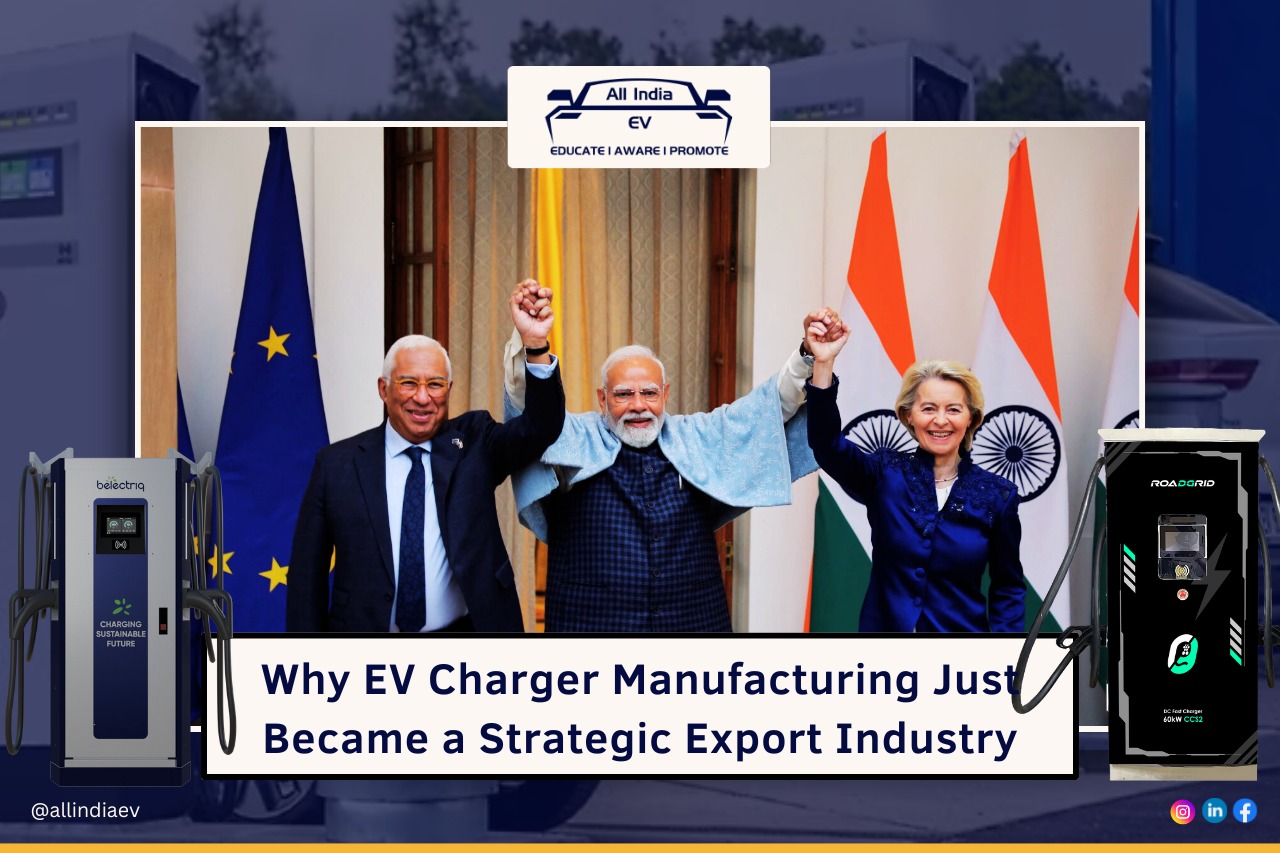
The India–EU Free Trade Agreement, formally concluded on January 27, 2026, quietly rewrites the economics of exporting EV charging infrastructure from India. This is not a diplomatic headline. It is a cost-structure reset.
For companies that already manufacture in India and sell into Europe, the FTA moves EV chargers from “hard-to-scale export” to strategic industrial asset.
1. Tariff elimination: from handicap to advantage
EV chargers fall under Machinery and Electrical Equipment. Pre-FTA, Indian exporters faced EU import duties ranging from ~4% to ~26% approx., depending on product classification and country of origin.
What changes post-FTA:
- These tariffs move toward zero-duty access under phased liberalisation.
- India now competes on manufacturing efficiency, not tariff arbitrage.
Why this matters operationally:
More EV News

- A 10–20% landed-cost swing is the difference between being shortlisted and being ignored in European tenders.
- This directly improves India’s competitiveness against non-FTA suppliers, including Chinese exporters operating without preferential access.
For Exicom-like players, Indian manufacturing stops being “cost-effective but distant” and becomes commercially rational for Europe.
2. Tritium changes role: from acquisition to integration engine
Exicom’s acquisition of Tritium, with operations across ~47 countries approx., already provided a European beachhead.
The FTA changes how that asset can be used.
Post-FTA integration logic:
- Indian facilities can supply high-volume subassemblies, power electronics, and even full charger SKUs to support European demand.
- Duty friction drops, making India-to-Europe internal supply chains viable, not just symbolic.
Why Europe cares:
- The EU is actively trying to reduce single-geo dependency, especially on China, for grid-adjacent infrastructure.
- Indian manufacturers now fit the “trusted partner” narrative for charging networks, utilities, and fleet operators.
This is not about exporting cheap boxes. It’s about being embedded in Europe’s charging value chain.
3. Standards were the real barrier, not tariffs
Historically, tariffs were not the hardest part. EU compliance was.
EV chargers must meet stringent:
- electrical safety norms
- cybersecurity and communication standards
- interoperability and grid-integration requirements
What the FTA adds:
- Formal technical cooperation clauses
- Greater recognition of domestic accredited conformity assessment bodies
- Faster pathways for regulatory validation
For companies like Exicom, already aligned with European interoperability frameworks such as Hubject, this matters.
It converts compliance from a bespoke, country-by-country grind into a more predictable, rules-based process under the FTA’s green and digital chapters.
That predictability is what investors and EPC partners care about.
4. CBAM anxiety fades for EV charging hardware
The EU’s Carbon Border Adjustment Mechanism caused anxiety across Indian industry in 2024–25.
Key distinction:
- CBAM targets carbon-intensive goods like steel, cement, aluminium, and chemicals.
- EV chargers are low-carbon, enabling infrastructure, not emissions-heavy exports.
FTA-linked reassurance:
- India secured assurances that any flexibilities extended to other partners under CBAM would also apply to India.
- Green technologies, including EV charging equipment, are explicitly prioritised for trade liberalisation.
Result: charger manufacturers face far fewer climate-linked trade frictions than legacy industrial exporters.
What actually changes for Indian EV charger manufacturers
| Dimension | Before FTA | After FTA (2026) |
| EU tariffs | ~4–26% approx. | Moving toward ~0% |
| Cost position | Structurally disadvantaged | Price-competitive |
| Role in Europe | Exporter / challenger | Integrated supplier |
| Compliance | Fragmented, slow | More standardised |
| Strategic value | Optional | Infrastructure-relevant |
The uncomfortable but necessary conclusion
This FTA does not guarantee success.
It does something more important:
- It removes the structural excuses.
From 2026 onward, if Indian EV charger manufacturers fail to scale in Europe, the reasons will be internal:
- manufacturing consistency
- reliability at volume
- after-sales support
- cybersecurity and software maturity
- long-term warranties and balance-sheet credibility
The India–EU FTA turns EV charging from a policy aspiration into an execution test.
And that’s exactly where serious industrial stories begin.