

Move Aims to Tie EV Energy Use With Fuel Efficiency Targets, Sparking Industry Debate and Policy Attention
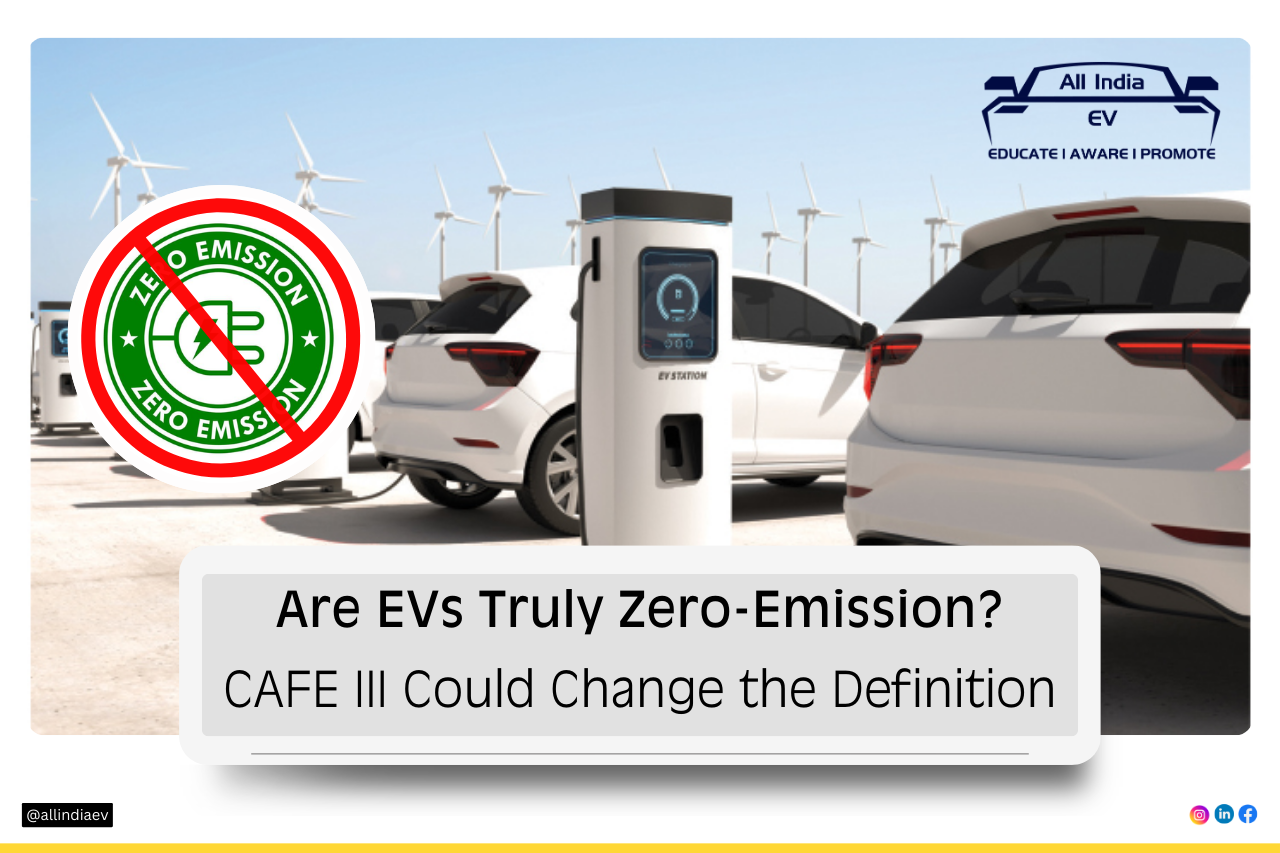
In a significant policy shift, the Indian government is steering towards a dramatic change in how electric vehicles (EVs) are classified under the upcoming Corporate Average Fuel Efficiency (CAFE) III norms with electric cars potentially losing their long-standing zero-emission tag under the revamped energy and emissions framework.
Under a draft proposal prepared by the Bureau of Energy Efficiency (BEE) and being reviewed by the Prime Minister’s Office (PMO), electric vehicles while still emitting no tailpipe pollutants could be counted as contributing to overall emissions if their energy consumption is factored into corporate fuel efficiency calculations.
Why the Change? Calculating EV Energy Use Under CAFE III
Traditionally, EVs have been regarded as “zero-emission” vehicles because they do not release pollutants from exhaust pipes a key reason behind government incentives and policy support for electrification. However, the draft CAFE III norms propose that automakers must now include the energy consumption of EVs in fleet emissions calculations by converting electrical power usage into an equivalent fuel metric.
Officials familiar with the draft say EVs’ electrical energy will be converted using established physics (where 1 kilowatt-hour equals 3.6 megajoules) and then translated into a petrol-equivalent figure (litres per 100 km). This would allow EVs to be counted alongside petrol and diesel vehicles when tallying an automaker’s overall energy footprint.
A senior official explained the rationale behind this shift: “This mandate on electric car makers will encourage more energy-efficient EVs,” adding that it would compel manufacturers to develop vehicles that travel longer distances on less energy. The official also clarified that while EVs do not emit pollutants from the tailpipe, they nonetheless consume energy and energy conservation remains a priority under India’s energy policy.
Implications for Automakers and Super Credits
The new rules have ignited debate across the automotive sector. Under the existing CAFE framework, EVs and range-extender hybrid vehicles earn “super credits” higher compliance points than internal combustion engine (ICE) vehicles helping manufacturers offset higher emissions from their conventional lineup.
More EV News
In practical terms, this mechanism has allowed companies with relatively low EV sales to leverage these credits to balance out fuel-inefficient ICE vehicles in their fleets. However, critics of the current approach argue that treating EVs as zero-emission for compliance calculations under the Energy Conservation Act may be legally and scientifically inappropriate, and could disincentivize real improvements in overall vehicle efficiency.
Under the proposed revisions, EV sellers would still receive super credits often three points per EV while ICE vehicles would earn just one point. But because EV energy consumption would count toward a company’s total energy footprint, the value of such credits could eventually diminish, placing new pressure on manufacturers to reduce consumption across all segments.
Energy Mix and Broader Environmental Debate
This policy review arrives at a time when India’s electricity generation mix continues to rely heavily on fossil fuels: the nation produced over 1,056 billion units of electricity from coal in the current fiscal year, far surpassing renewable generation from solar and wind sources.
Energy analysts note that counting EVs as zero-emission only makes sense when the electricity used to charge them comes from clean, renewable sources such as solar, wind, or hydroelectric power. Indian grid realities where a substantial portion of power originates from coal complicate this narrative, prompting regulators to seek a more nuanced approach. Studies on EV emissions globally stress that overall environmental impact depends not only on tailpipe emissions but also on the sustainability of the electricity grid powering these vehicles.
Industry and Policy Responses
While the government’s intent to tighten CAFE III norms reflects its commitment to reducing fossil fuel dependence and boosting energy efficiency, automakers are closely monitoring how these changes could affect product planning, compliance costs, and future strategy.
Industry representatives argue that a clear, stable regulatory framework is essential as EV adoption scales up with EV penetration in passenger vehicle sales expected to climb from about 4 per cent in 2025 to 13–15 per cent by 2030.
As India’s automotive and energy policymaking continues to evolve, the final version of CAFE III will be watched closely as a bellwether of how the country balances emissions ambitions with the practical realities of electrification and energy consumption.