

Policy Stability and Manufacturing Incentives Top the Wishlist as Battery, EV, and Clean Energy Leaders Outline Vision for 2026-27
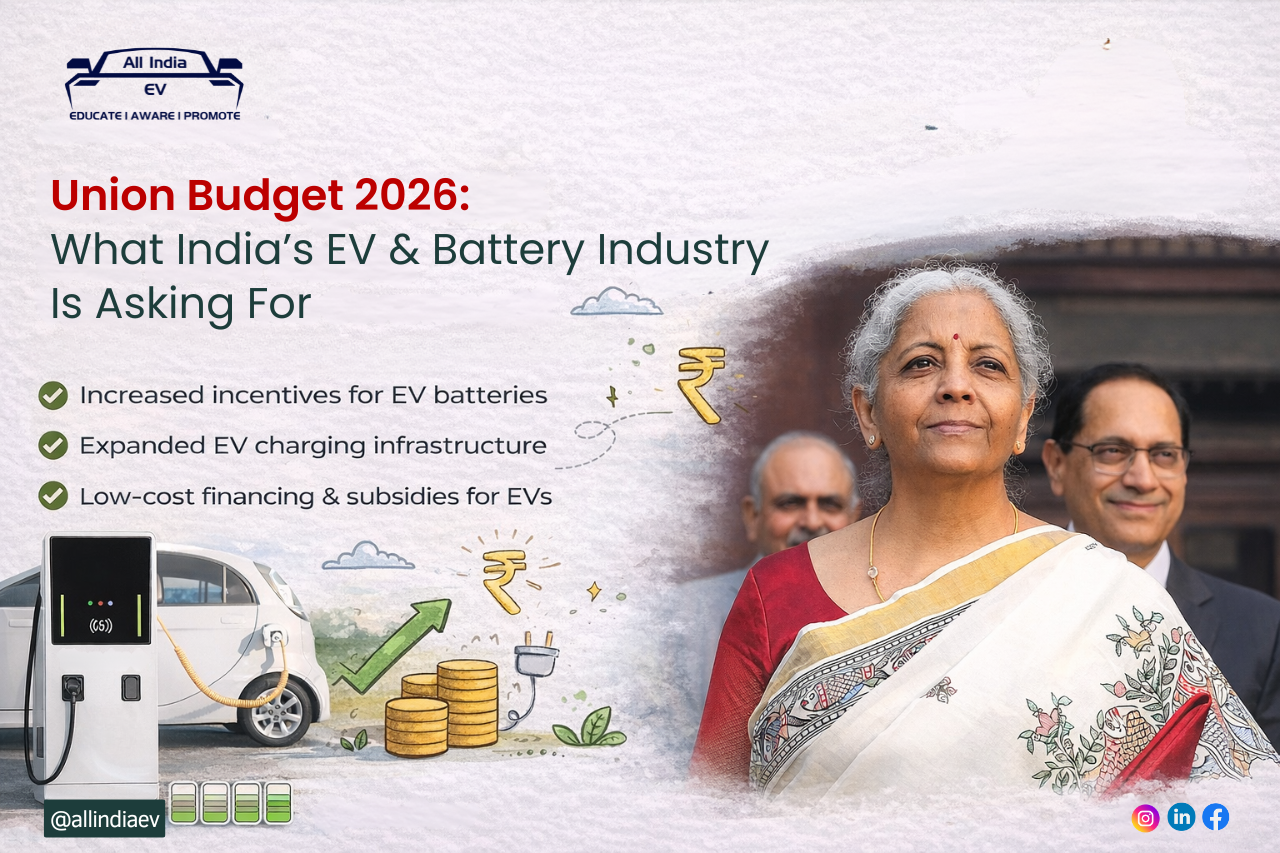
As the Union Budget 2026-27 approaches, India’s electric vehicle ecosystem and clean energy sectors are hopeful for transformative policy measures. Industry leaders across battery manufacturing, charging infrastructure, and renewable energy are united in their call for sustained government backing to accelerate the nation’s green transition.
Union Budget 2026: Time to Pivot from EV Adoption to Strong EV Economics
The Need for Long-Term Policy Certainty
Dr. Suresh D, Group CTO at Spark Minda, emphasized that the EV sector requires more than just vehicles it needs a comprehensive vision. He highlighted three critical pillars: policy clarity to encourage capital investment, incentives to make EVs accessible while driving innovation, and robust infrastructure including charging networks and supply chains. According to Dr. Suresh, this budget presents an opportunity for India to emerge as a global leader rather than merely a participant in the EV revolution.
Building a Self-Reliant Battery Supply Chain
Vikram Handa from Epsilon Advanced Materials pointed to the critical need for better alignment between cell manufacturers and material suppliers. He advocated for targeted capital expenditure subsidies for upstream battery components like anodes and cathodes, which would reduce investment risks and decrease reliance on imports from countries like China. Such measures could establish India as a globally competitive player in the advanced cell chemistry supply chain.
Strengthening the Circular Battery Economy
Gaurav Dolwani, who leads LICO Materials, stressed the importance of developing India’s battery recycling infrastructure. His recommendations include expanding and coordinating the PLI and FAME schemes more effectively, and standardizing the GST rate on batteries used in Energy Storage Systems and e-mobility from the current 18% to just 5%. He called for clear regulations on battery lifecycle tracking, guaranteed offtake arrangements, and incentives for incorporating recycled materials into new battery production.
Infrastructure Investment for Sustained Growth
Benny Parihar from EVERTA noted that while EV and charging infrastructure adoption is gaining momentum, long-term stability depends on consistent policies spanning multiple years. Given the capital-intensive nature of manufacturing DC fast chargers, he urged the government to clarify the future of the PM E-Drive scheme beyond 2026. He also recommended implementing Production Linked Incentives or volume-based incentive programs for DC chargers and related high-voltage components, alongside priority sector lending and reduced duties on essential imported inputs.
Grid Resilience and Energy Storage Solutions
Debmalya Sen, representing the India Energy Storage Alliance, highlighted India’s impressive progress in renewable energy solar capacity has reached 132 GW with total renewable capacity exceeding 250 GW by 2025. However, he identified grid integration, storage capabilities, and sustainability as the next frontier. Sen advocated for promoting local manufacturing of Battery Energy Storage Systems to enhance grid stability, supported by long-term financial incentives and clear tender pipelines. He also emphasized the need for developing recycling infrastructure to create a circular economy and reduce import dependence.
More EV News

Integrated Approach to EV Ecosystem Development
Akshay Shekhar from Kazam called for alignment between EV expansion and power sector preparedness. He noted that under FAME II, which allocated ₹11,500 crore between FY2019-24, over 1.6 million EVs were supported, with three-wheeler allocations exhausted before the scheme ended demonstrating strong commercial adoption. Shekhar recommended renewing FAME II while increasing allocations for charging infrastructure, accelerating smart meter deployment, and implementing a national Battery Aadhaar framework for traceability and safety. He also proposed integrating the PM Surya Yojna with EV charging and enabling vehicle-to-grid capabilities to position EVs as distributed energy assets.
The Path Forward
Industry stakeholders are in agreement: Budget 2026-27 must prioritize policy continuity, domestic manufacturing support, infrastructure development, and targeted financial assistance. With coordinated action across mobility, power generation, and urban planning, India has the potential to establish itself as a global powerhouse in batteries, electric vehicles, and clean energy technology.
The upcoming budget represents more than just an annual financial exercise it’s an opportunity to lay the foundation for India’s sustainable and economically vibrant future in green mobility and energy independence.