


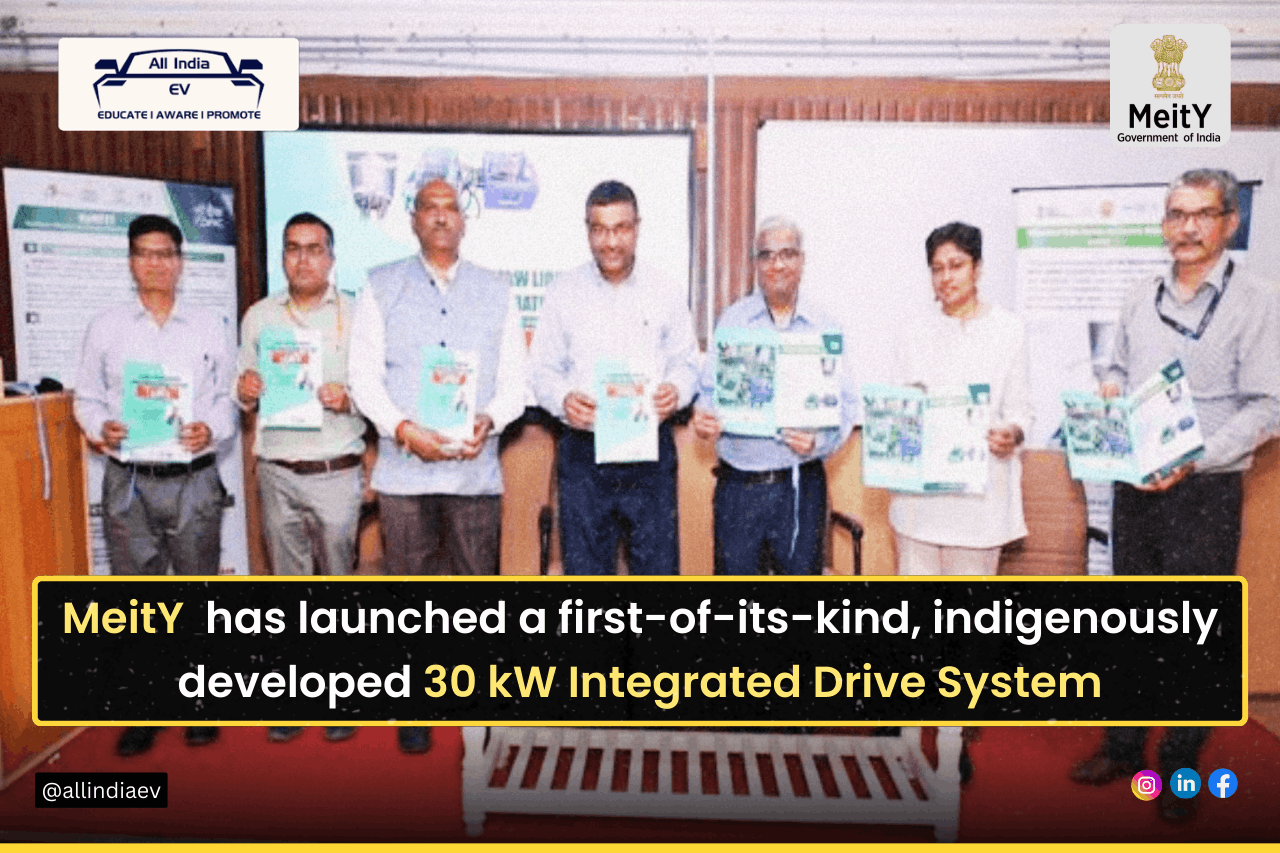
MeitY launches indigenous integrated drive system to boost EV adoption, marking a significant step in strengthening India’s domestic electric vehicle technology ecosystem. The newly developed 30 kW Wide Band Gap (WBG)-based Integrated Drive System (IDS) has been designed specifically for electric vehicle applications and aims to reduce dependence on imported EV powertrain components.
The system was launched by the Ministry of Electronics and Information Technology (MeitY) at the Indian Institute of Technology Madras in Chennai. It has been developed through a collaborative effort between the Centre for Development of Advanced Computing (C-DAC), IIT Madras, and automotive component manufacturer Lucas TVS under the National Mission on Power Electronics Technology (NaMPET).
Unlike conventional EV architectures where the motor and inverter operate as separate components, the new IDS integrates both into a single compact high-power-density unit. This integrated design improves efficiency, reduces system size and weight, and simplifies EV powertrain design.
The 30 kW power class system is particularly suited for India’s rapidly expanding electric passenger vehicle segment, including compact electric cars and fleet mobility platforms. Officials noted that a significant portion of advanced EV powertrain systems and semiconductor-based drive electronics used in the industry are currently imported.
By developing this technology domestically, the government aims to strengthen India’s capabilities in power electronics manufacturing while supporting local production aligned with initiatives such as the Production Linked Incentive (PLI) schemes. The system has already been designed, fabricated, and validated in partnership with industry and is now ready for commercialization and large-scale deployment.
Officials believe the indigenous drive system can help create new opportunities for manufacturers in areas such as power electronics, thermal management systems, and EV control hardware while strengthening the overall EV supply chain.
More EV News
How This Will Help the Indian EV Market
The launch of an indigenous integrated drive system could play a crucial role in addressing one of the most important gaps in India’s EV ecosystem: local powertrain technology.
Currently, many advanced EV components such as drive electronics, semiconductor modules, and integrated motor systems are sourced from global suppliers. This increases vehicle costs and exposes the industry to supply chain risks. By developing a domestic solution, India can reduce reliance on imported powertrain technologies and gradually build a stronger EV manufacturing base.
Another major benefit is cost reduction. Localizing high-value components like integrated drive systems can help EV manufacturers reduce production costs over time. When key components are produced domestically, logistics costs fall and supply chains become more predictable. This can eventually translate into more affordable electric vehicles for Indian consumers.
The initiative could also stimulate innovation within India’s electronics and automotive sectors. MSMEs and component manufacturers working in power electronics, thermal systems, and control technologies could find new opportunities as EV production scales. This strengthens the broader industrial ecosystem supporting electric mobility.
Finally, the development signals a long-term strategic shift. India is not only adopting EVs but also attempting to build core EV technologies domestically, from batteries to power electronics. If such innovations reach commercial scale, they could improve India’s competitiveness in the global EV supply chain while supporting the country’s transition toward cleaner transportation.