

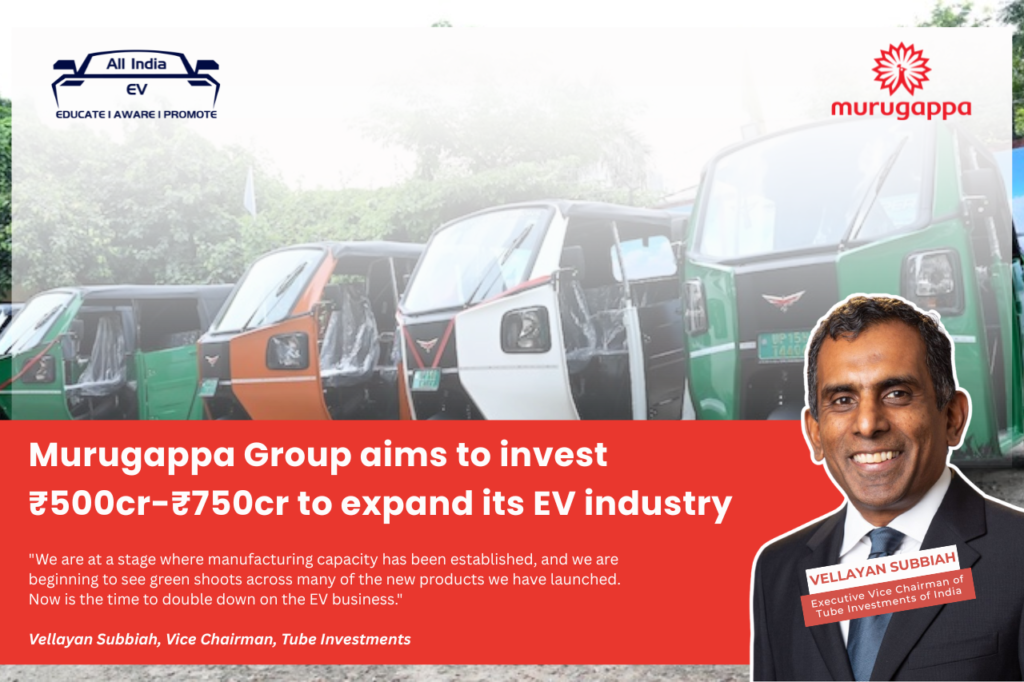
Late-cycle capital rotates from pilots to production-scale discipline
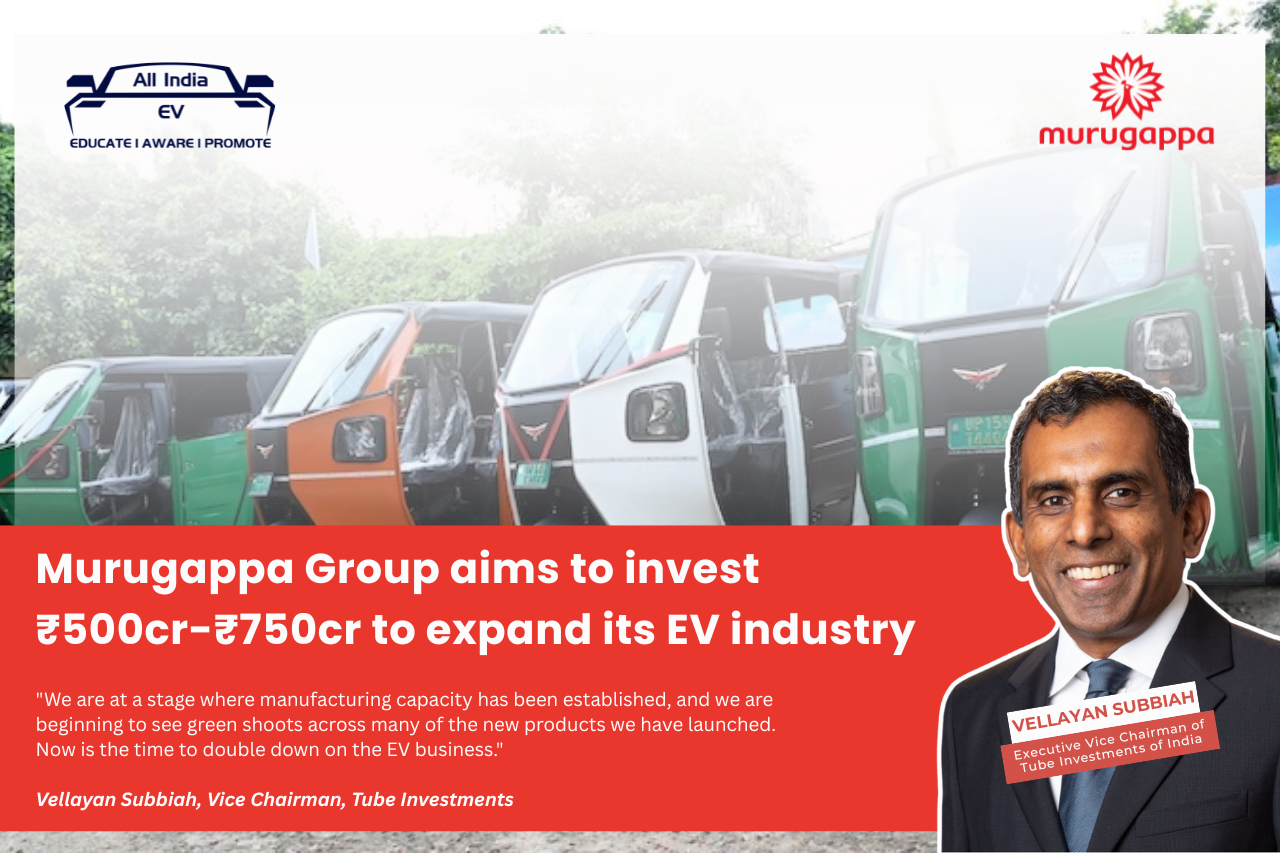
India’s EV narrative is shifting from announcements to execution. Murugappa Group’s proposed ₹500 crore investment is not a victory lap it’s a wager that disciplined manufacturing, supply-chain control, and cost-down engineering can convert policy tailwinds into durable unit economics. What changed structurally is the market’s demand for scale-ready operations, not prototypes.
Deal Facts
- Round size: ₹500 crore committed investment
- Stage: Growth/scale-up capital into EV manufacturing (group-level investment)
- Investors: Murugappa Group (strategic corporate investor)
- Valuation: Not disclosed matters because valuation anchors expectations on capital efficiency and exit paths
- Use of funds: Accelerate electric vehicle production across group companies and capabilities (manufacturing, localisation, supply chain)
- Timeline: Announced February 2026; deployment schedule Not disclosed matters for ramp planning and capex-to-output lag
- Operating metrics: Not disclosed production capacity, utilisation, order backlog, and cost per unit not shared
- Assets involved: EV components and vehicle platforms within the Murugappa ecosystem (specific subsidiaries and SKUs Not disclosed)
What the Money Must Achieve
- Product: Lock two to three EV platforms or component families with clear BOM targets and 18–24 month cost-down roadmaps (chemistry, power electronics, thermal management).
- Operations: Commission or upgrade lines with >85% OEE at steady state; establish supplier quality gates to reduce field failures and warranty leakage.
- Scale: Localise critical sub-assemblies (motors, controllers, packs) to de-risk FX exposure and compress lead times; secure volume contracts for cells or power semiconductors.
- Compliance: Bake AIS, homologation, battery safety, and evolving recycling/EPR norms into design-for-compliance to avoid retrofit costs.
- GTM: Anchor offtake with OEMs, fleet operators, and public-sector buyers; convert MoUs into binding volume commitments with penalty clauses.
Unit Economics Reality Check
What must be true for this to work.
Manufacturing EVs or core EV components only scales when utilisation rises faster than fixed costs. The capital must drive throughput to keep per-unit depreciation low. Gross margins need headroom to absorb price compression as competitors chase volume. Customer acquisition costs (especially in B2B OEM supply) must amortise over multi-year supply agreements, with payback within one to two production cycles. The operational flywheel procurement leverage, yield improvement, warranty reduction has to compound quickly, or cash burn becomes structural.
What usually breaks in India.
Ops fragility shows up in supplier quality variance, inconsistent power availability, and slow compliance cycles. Service and spares logistics lag production ramps, spiking downtime for fleet customers and eroding trust. Working capital stretches as receivables from large buyers lengthen while inventory builds ahead of uncertain offtake. Regulatory compliance battery safety, recycling, localisation thresholds changes mid-flight, forcing redesigns. These frictions quietly tax margins long before the income statement admits it.
Risks & Failure Modes
- Under-utilised capacity: Capex lands before offtake, pushing unit costs above market-clearing prices.
- Input volatility: Cells, power electronics, and rare-earth exposure compress margins if hedging and localisation lag.
- Technology lock-in: Early platform choices age poorly as OEMs shift specs (voltage architectures, chemistries).
- Compliance drag: Evolving safety and recycling rules trigger redesigns and retooling.
- Channel risk: Dependence on a narrow set of OEM or fleet buyers concentrates revenue risk.
Who Wins / Who Gets Squeezed
Who wins
- Tier-1 suppliers with localisation depth: Those who can co-design and co-invest with OEMs capture margin and volume stability.
- Fleet operators with predictable demand: Long-term contracts de-risk utilisation and accelerate learning curves.
Who gets squeezed
- Low-scale assemblers: Without volume or IP, they face price wars and rising compliance costs.
- Import-dependent players: FX risk and customs friction erode margins as localisation thresholds tighten.
Next 90 Days: What to Track
- [Founder] Finalise platform choices and BOM cost targets; publish an internal cost-down roadmap with quarterly gates.
- [Investor] Demand a capex-to-output plan with utilisation milestones and contingency triggers for underperformance.
- [Customer] Look for binding offtake agreements converting pilot orders into multi-quarter volumes.
- [CPO/OEM] Validate supplier readiness audits and dual-source plans for cells, controllers, and magnets.
- [Supplier] Lock long-term pricing bands and quality KPIs tied to yield and warranty thresholds.
- [Policy] Track clarity on recycling/EPR enforcement timelines and any updates to safety/homologation norms that affect design freeze.
Conversation Starters
- Where will utilisation come from in the first two quarters post-commissioning?
- Which components must be localised first to protect gross margins?
- What design choices today reduce regulatory retrofit risk tomorrow?