


“India’s EV Future Shaped by Precision Local Manufacturing, Driving Innovation Beyond Sales Through Domestic Battery and Electronics Production”
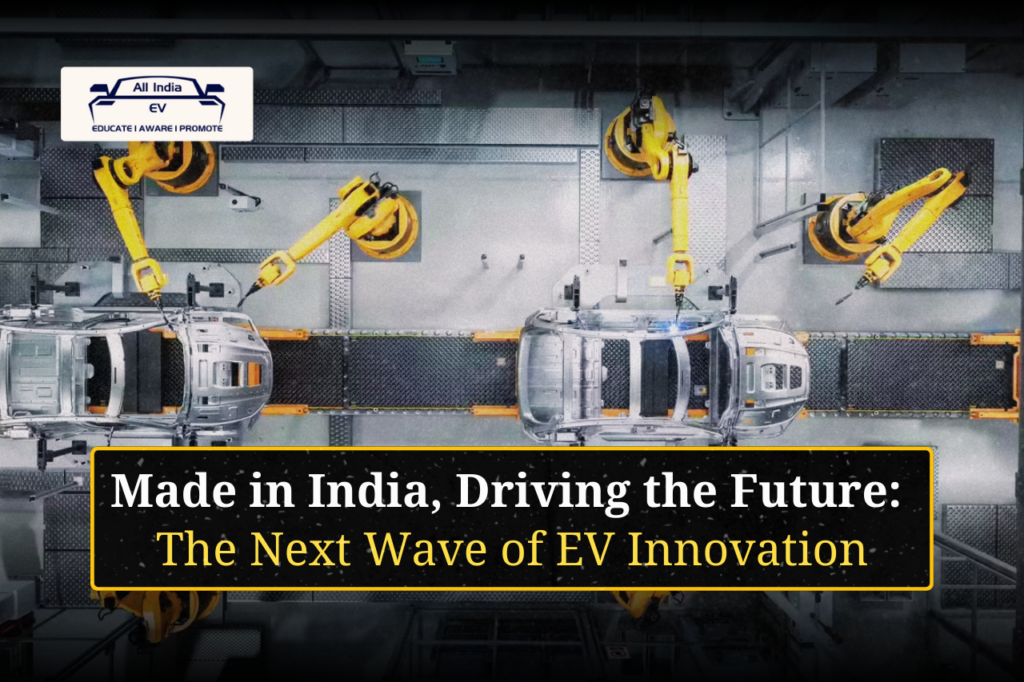
India’s electric vehicle (EV) transition is often measured through rising sales figures, expanding charging infrastructure, and ambitious adoption targets. However, industry experts say the most transformative shift in India’s EV journey is now unfolding away from showrooms and charging stations—on factory floors. The next phase of EV innovation in India is expected to be powered not by imported technologies or headline product launches, but by precision-driven local manufacturing tailored to Indian operating conditions.
As EV adoption accelerates across segments, localisation is emerging as more than a cost-reduction strategy. It is increasingly being viewed as a core innovation engine, reshaping how electric vehicles are designed, engineered, and scaled for domestic demand.
Strategic Importance of Localisation
Local manufacturing has long been embedded in India’s automotive ecosystem, but electric mobility raises the stakes significantly. Unlike internal combustion engine (ICE) vehicles, EV platforms involve tighter integration of hardware and software, shorter development cycles, and higher dependence on electronics and power systems.
Industry observers note that close proximity between original equipment manufacturers (OEMs) and suppliers enables faster iteration, improved quality control, and more efficient inventory management. Near-shore development also supports rapid product localisation, allowing manufacturers to respond quickly to Indian challenges such as high ambient temperatures, dusty environments, voltage fluctuations, and stop-start urban driving conditions.
Recent global disruptions have reinforced this shift. Pandemic-induced shutdowns and geopolitical tensions exposed vulnerabilities in extended supply chains. For EV manufacturers, reliance on imported components increases operational and cost risks. Precision localisation is therefore being seen as a way to de-risk supply chains while improving product relevance.
Policy Support Strengthens the Backbone
Government policy has played a decisive role in anchoring India’s manufacturing push. Initiatives that began under the Make in India programme have evolved into a structured industrial roadmap for electric mobility.
More EV News

The Phased Manufacturing Programme (PMP) linked to FAME II incentives encouraged gradual localisation of EV components, while Production Linked Incentive (PLI) schemes for automobiles, advanced chemistry cells (ACC), and electronics manufacturing have provided scale and long-term visibility to investors.
India’s EV ambitions remain aggressive. By 2030, the country aims to achieve 30 percent EV penetration in private cars, 70 percent in commercial vehicles, 40 percent in buses, and 80 percent in two- and three-wheelers. Meeting these targets would place nearly 80 million electric vehicles on Indian roads, most of which are expected to be domestically manufactured.
Recent Union Budgets have reinforced this intent through customs duty exemptions on capital equipment for lithium-ion battery manufacturing. Infrastructure commitments have also expanded, with plans to deploy around 72,000 public chargers by FY26 and over ₹1,000 crore sanctioned in 2025 to improve charging accessibility and localisation.
Manufacturing Economics of EVs
A closer look at the EV bill of materials highlights where localisation can deliver the greatest value. Batteries account for 30–40 percent of an EV’s total cost, making them the single largest cost component. While India has limited control over critical raw materials such as lithium and rare earth elements, battery cells themselves account for nearly 75 percent of battery costs—and are currently largely imported.
India’s projected lithium cell demand is estimated to reach 100–260 GWh by 2030, far exceeding current domestic capacity. Under the ACC PLI scheme, the government aims to support 50 GWh of cell manufacturing capacity within five years, with a strong emphasis on domestic value addition.
Industry experts say success in this segment will depend less on commodity-scale production and more on process excellence, yield optimisation, and quality control. Effective localisation of battery cells could significantly reshape cost structures while enabling innovation in chemistries better suited to Indian climates and usage patterns.
Electronics and Motor Manufacturing Gain Momentum
Beyond batteries, electronics and electrical systems represent the second major value pool in EVs, contributing roughly 15–20 percent of vehicle costs. This includes motors, power electronics, inverters, onboard chargers, and vehicle control units.
India has begun to carve out a niche in electric motor innovation, particularly in brushless DC (BLDC) technology used widely in two- and three-wheelers. Startups and established Tier-1 suppliers are investing in local motor design, controller integration, and thermal management systems.
Unlike conventional manufacturing, precision EV manufacturing focuses on efficiency tuning, durability, and cost optimisation rather than replicating global designs. Similar opportunities are emerging in inverters, chargers, and vehicle electronics, where close coordination between hardware and software teams is critical.
Scale Converts Manufacturing into an Innovation Flywheel
Rising EV volumes are accelerating this transformation. EV sales in India grew nearly 17 percent in FY25, reaching close to two million units. Electric passenger vehicle sales crossed 100,000 units, two-wheelers exceeded 1.15 million units, and electric three-wheelers approached 700,000 units.
Despite softer global EV demand, Indian automakers are preparing to launch nearly a dozen new electric passenger vehicles in 2025, many targeting higher segments. As scale improves, local suppliers are gaining confidence to invest in automation, testing facilities, and advanced materials.
Over time, these precision manufacturing capabilities are expected to spill over into adjacent sectors such as electronics, energy storage, and mobility services.
Manufacturing at the Heart of India’s EV Future
Industry leaders increasingly agree that India’s EV success will not be determined solely by consumer incentives or charging networks. Instead, it will be shaped by the depth and precision of its local manufacturing ecosystem.
As India defines its electric mobility future, factory floors—where engineering expertise meets local context—are emerging as the real engines of innovation. Precision local manufacturing is no longer just supporting the EV transition; it is actively defining how India will compete and lead in electric mobility on its own terms.
Comment by the Author
India’s EV transition is entering a more mature phase where competitiveness will be decided less by adoption headlines and more by manufacturing depth. Precision-led localisation is quietly becoming India’s strongest lever—reducing supply chain risks, improving product relevance, and turning factory floors into centres of innovation.
If sustained with policy clarity and industry collaboration, local manufacturing will not just support India’s EV ambitions, but define its leadership in the global electric mobility landscape.