

India’s electric bus push is now less about whether to electrify and more about how well the buses hold up once they are running. A city bus does long days, frequent stops, and a lot of heat. That puts the battery at the center of the economics.
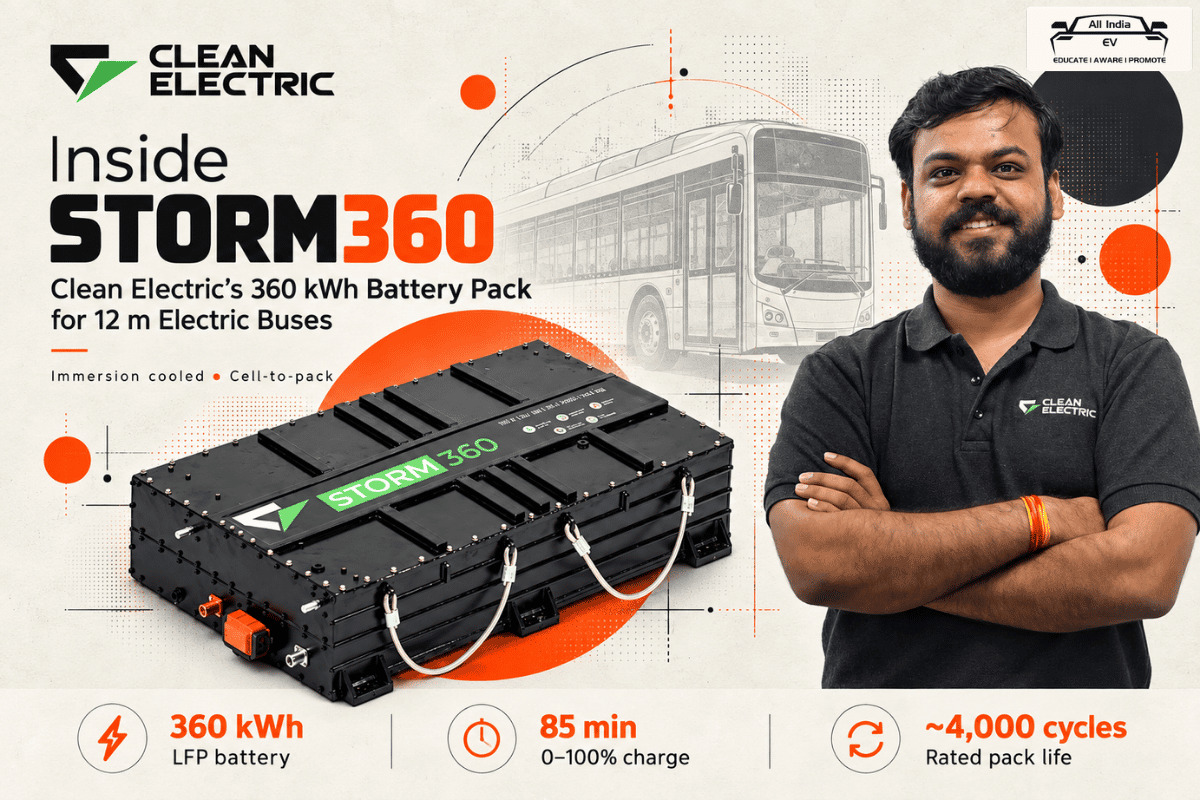
Pune-based Clean Electric has entered this space with STORM360, a battery system built for 12 m buses. Here is what it offers and why the design choices matter for fleet operators.
The numbers that you need to know…
STORM360 is a 360 kWh (628 Ah) pack at 575 V nominal, with a voltage range of 540-640 V. It is built from ten 36 kWh modules and uses LFP (lithium iron phosphate) chemistry with 314 Ah prismatic cells.
| Parameter | STORM360 |
| Energy | 360 kWh / 628 Ah |
| Nominal voltage | 575 V (540-640 V range) |
| Chemistry | LFP, prismatic (314 Ah cells) |
| Cooling | Immersion cooled |
| Architecture | Cell-to-pack, 10 × 36 kWh modules |
| Charge / discharge rate | 440 A (~0.7C) |
| Charging time | 85 min (0-100% SOC) |
| Cycle life | ~4,000 cycles |
| Energy density | 150 Wh/kg and 270 Wh/L |
| Weight | ~2,400 kg |
Four design choices worth understanding
1. Immersion cooling
Instead of relying on cold plates, immersion cooling brings coolant into direct contact with the cells. The idea is more uniform temperatures across the pack, especially during fast charging and heavy discharge. Uniform temperature matters for battery life, because hot spots age cells faster. In Indian operating conditions, thermal management is a core requirement rather than a bonus feature.
2. Cell-to-pack architecture
By reducing the intermediate structural layers between cells and the finished pack, cell-to-pack designs put more active material into the same space. STORM360 reaches 150 Wh/kg and 270 Wh/L. For a bus, that means less of its weight and floor space goes to the battery for a given range, leaving more room for what the vehicle is meant to carry: passengers.
3. LFP chemistry
LFP is widely favored for commercial vehicles because of its thermal stability and long cycle life, which suit vehicles that charge and discharge every day. STORM360 pairs it with large-format 314 Ah cells.
4. Modular by design
The whole system is built around one 36 kWh module (115.4 V nominal, 36S configuration, ~241 kg). Combining modules gives different pack sizes:
| Bus type | Battery size | Modules | Configuration | Voltage range |
| 9 m STU bus | 217 kWh | 6 | 6S1P | 650-750 V |
| 12 m STU bus | 360 kWh | 10 | 5S2P | 540-640 V |
| Coach bus | 434 kWh | 12 | 6S2P | 650-750 V |
For OEMs and operators, one validated building block across three vehicle categories can simplify engineering, spares, and service.
Charging and life: the two numbers fleets care about
Charging time is 85 minutes for a full 0-100% charge at the rated 440 A (~0.7C). For depot-charged fleets, that fits comfortably within typical layover and overnight windows.
Cycle life is rated at ~4,000 cycles, measured at 0.7C charge / 0.7C discharge and 80% depth of discharge, which are realistic duty conditions. Separately, cell-level testing at 1C/1C and 25°C has completed 1,500+ cycles, and the cells are expected to reach 5,000+ cycles. It is worth reading the two figures together: the ~4,000 figure is the pack-level rating, and the 5,000+ figure is a cell-level expectation.
Built-in safety and intelligence
A large battery is only as good as the system watching over it. STORM360’s master-slave BMS communicates with the vehicle control unit over CAN 2.0 and includes:
- Protections: pack and cell over/under-voltage, charge and discharge over/under-temperature, over-current, short-circuit detection, open-wire detection, sensor failure detection, and plausibility checks on critical parameters
- Functions: string balancing during charging, cycle counting, isolation monitoring, pack temperature monitoring, charge/discharge energy tracking (kWh), BMS failure and CAN-loss detection, and state of health (SoH) estimation with 2% accuracy
Why it matters for Indian fleets
State transport undertakings and private operators are being asked to deliver more uptime, longer asset life, and lower cost per kilometre. A pack that charges in under an hour and a half, uses a chemistry suited to daily cycling, and scales across bus sizes speaks directly to those goals. Real-world performance will ultimately be proven on the road, but the design priorities are clearly aligned with how Indian city fleets actually operate.
Key takeaways
- STORM360 is a 360 kWh, 575 V, immersion-cooled LFP pack for 12 m e-buses
- 85-minute full charge at ~0.7C (440 A)
- ~4,000 cycles rated at 0.7C/0.7C, 80% DoD
- 150 Wh/kg and 270 Wh/L through cell-to-pack design
- Modular 36 kWh building block scales to 9 m buses (217 kWh) and coaches (434 kWh)
Want to learn more? Visit cleanelectric.in or write to contact@cleanelectric.co.in.