

India’s electric vehicle technology race is beginning to move beyond battery capacity, range and charging speed.
- What Is Omega Seiki Adding to Its EVs?
- From Battery Management to Battery Intelligence
- The Bigger Opportunity Is Vehicle Uptime
- Battery Data Could Also Change EV Financing
- The Used EV Market Needs a Battery Health Standard
- OEMs Also Gain Real-World Battery Data
- EV Technology Is Moving From Hardware to Data
The next layer is about understanding what is happening inside the battery after the vehicle enters real-world operation.
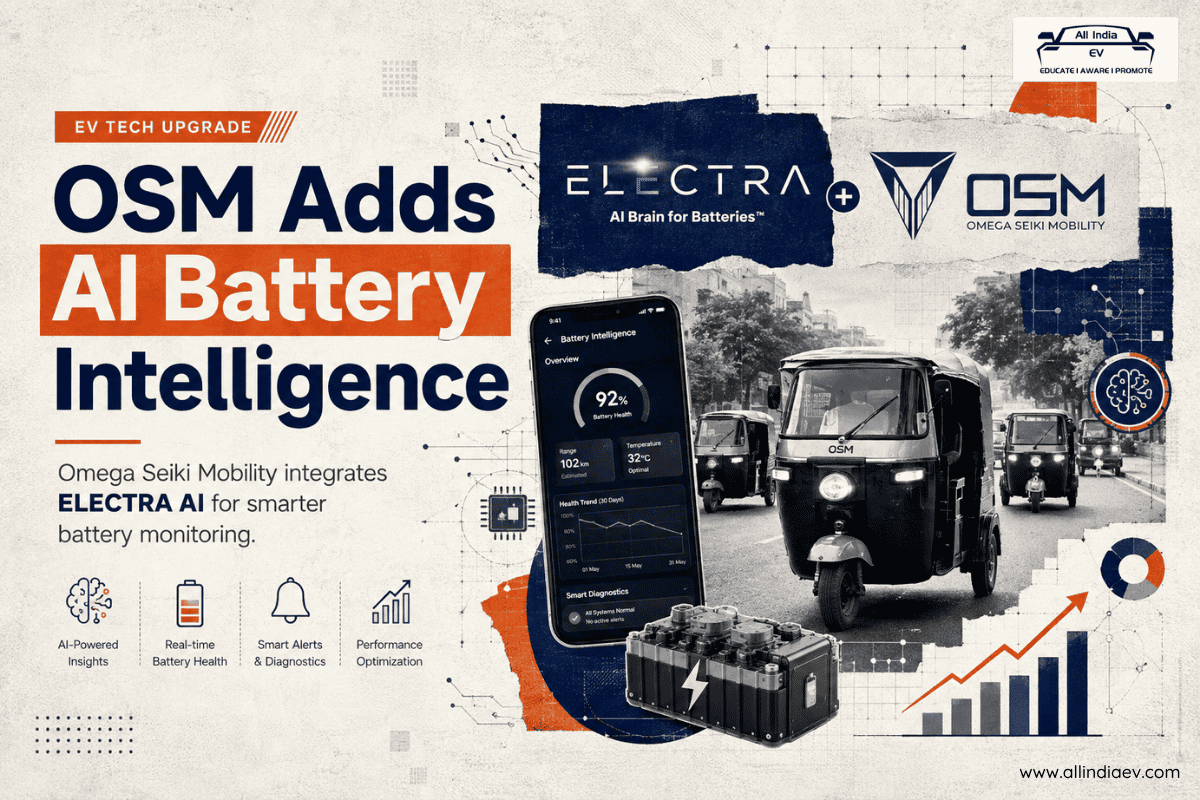
Omega Seiki Mobility (OSM) has announced a strategic partnership with ELECTRA AI to integrate advanced battery health intelligence across its electric vehicle ecosystem. The planned integration will introduce real-time battery monitoring, predictive analytics and State of Health insights across OSM’s EV portfolio.
For a commercial EV manufacturer, this is more than another dashboard feature.
Battery health affects vehicle uptime, maintenance costs, warranty exposure, financing decisions and eventually the resale value of the vehicle. By adding a deeper intelligence layer around the battery, OSM is effectively attempting to make the battery a more measurable asset throughout its operating life.
What Is Omega Seiki Adding to Its EVs?
Under the partnership, OSM plans to use ELECTRA AI’s battery intelligence platform across its growing electric vehicle ecosystem.
The technology is expected to provide three core capabilities:
- Real-time battery monitoring
- Predictive battery analytics
- Battery State of Health (SoH) insights
The system is designed to continuously provide deeper visibility into battery condition and performance instead of relying primarily on periodic diagnostics after a fault develops.
That difference is particularly important in commercial electric vehicles.
A private EV experiencing unexpected battery degradation creates inconvenience. A commercial EV going off the road can directly affect fleet revenue.
Battery intelligence therefore has the potential to shift maintenance from a largely reactive process toward a more predictive one.
From Battery Management to Battery Intelligence
Modern EV batteries already operate with a Battery Management System, or BMS.
The BMS manages essential functions including cell voltage, temperature, charging and discharging limits and protection against unsafe operating conditions.
Battery intelligence adds another layer.
Instead of only controlling the battery, advanced analytics can use operating data to understand how the battery is ageing, whether abnormal behaviour is emerging and how its usable performance could change over time.
ELECTRA AI’s platform is expected to give OSM insights that support proactive maintenance, vehicle performance optimisation, battery-life management, warranty decisions and product development using real-world operating data.
That creates a feedback loop:
Vehicle operates → battery generates data → analytics identify behaviour → OEM and fleet operator act on the information.
For an electric commercial vehicle manufacturer, this could become particularly valuable as the fleet population grows.
The Bigger Opportunity Is Vehicle Uptime
Commercial EV economics work differently from passenger-car ownership.
A fleet operator does not simply ask whether the vehicle can travel 150 km or 200 km on a charge.
The more important questions are:
- How consistently can it deliver that range?
- How fast is the battery degrading?
- Is a potential failure developing?
- When should maintenance be scheduled?
- How much useful battery life remains?
- Can the vehicle reliably complete another operating cycle?
OSM says the battery intelligence integration is intended to improve fleet productivity and reduce unplanned downtime by providing greater operational visibility.
That can have a direct impact on total cost of ownership.
If a fleet operator can identify abnormal battery behaviour before it results in vehicle downtime, maintenance can potentially be planned around operations instead of operations being disrupted by maintenance.
Battery Data Could Also Change EV Financing
Perhaps the more interesting part of the announcement sits outside vehicle engineering.
Battery health data can potentially give lenders more information about the underlying value of an electric vehicle.
This is particularly relevant because the battery represents one of the most valuable components in an EV, while its condition can vary considerably depending on age, charging behaviour, temperature exposure, utilisation and operating conditions.
OSM Founder and Chairman Uday Narang has positioned battery health transparency as an important requirement for developing India’s secondary EV market.
The company believes better visibility into battery condition could help buyers, fleet operators and financiers make more informed decisions about an EV’s remaining value.
This could eventually become important for commercial EV lending.
Today, a financier assessing an electric commercial vehicle has to estimate how the asset will depreciate over a loan period.
If credible battery State of Health data becomes available throughout the asset’s life, lenders could potentially assess residual value with greater confidence.
That opens up an interesting possibility:
battery intelligence could become financial infrastructure for EVs, not merely vehicle technology.
The Used EV Market Needs a Battery Health Standard
The same problem exists when an EV enters the second-hand market.
Mileage alone cannot fully describe the condition of an electric vehicle.
Two EVs with identical odometer readings may have batteries in substantially different conditions depending on how they were charged, operated and maintained.
This makes battery health one of the most important missing data points in used-EV transactions.
ELECTRA AI’s technology is intended to give stakeholders visibility into battery State of Health and, according to reporting around the partnership, Remaining Useful Life analytics can also help indicate how battery performance may evolve.
If such data becomes sufficiently accurate, standardised and trusted, used EV valuation could gradually move away from assumptions toward measurable battery condition.
For commercial EVs, where utilisation can be significantly higher than private vehicles, that could be especially valuable.
OEMs Also Gain Real-World Battery Data
There is another beneficiary: Omega Seiki itself.
Thousands of vehicles operating across different routes, payloads, temperatures and charging patterns create a large real-world battery dataset.
That information can help manufacturers understand how batteries behave outside controlled testing conditions.
Patterns identified across a fleet could potentially inform:
- Battery-pack design
- Thermal-management strategies
- Charging recommendations
- Warranty policies
- Maintenance schedules
- Future vehicle development
OSM has specifically highlighted data-driven product development and stronger warranty management as potential applications of the battery intelligence platform.
This turns deployed vehicles into an ongoing source of engineering intelligence.
EV Technology Is Moving From Hardware to Data
The Omega Seiki-ELECTRA AI partnership also highlights a wider transition in electric mobility.
The first phase of EV competition revolved heavily around physical specifications:
Battery capacity. Range. Motor output. Charging speed.
Those factors remain important, but the next phase will increasingly involve what manufacturers can understand and optimise through software and data.
Battery intelligence sits directly at that intersection.
It can potentially connect the OEM, vehicle operator, service network, lender, insurer and eventual second-hand buyer around a common understanding of battery condition.
For Omega Seiki Mobility, the partnership therefore represents more than an incremental software addition.
If successfully deployed across its vehicle ecosystem, it could give OSM a continuously evolving picture of how its batteries are performing in the field while providing fleet operators and financiers with information that has historically been difficult to obtain.
And that may become increasingly important as India’s EV market matures.
The question will no longer be only how large the battery is.
It will also be how healthy the battery is, how quickly it is ageing and how confidently its remaining value can be measured.