

JV Talks May Conclude by March to Support NEVs, Energy Storage, and Renewable Integration
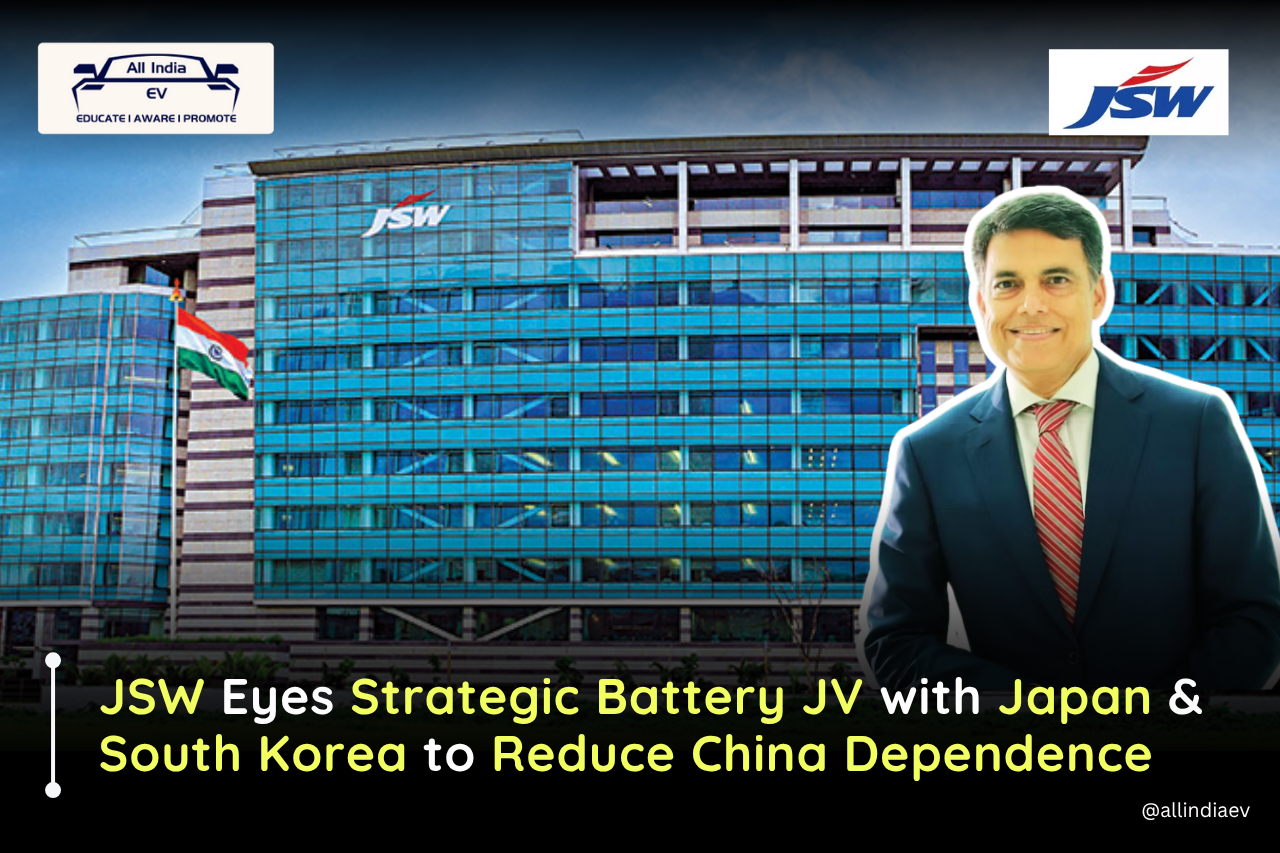
In a strategic move to strengthen India’s electric vehicle (EV) and energy ecosystem, JSW Group is in advanced discussions with Japanese and South Korean manufacturers to form a joint venture (JV) for battery cell manufacturing in India. The initiative aims to reduce dependence on China and build a secure domestic supply chain for its new energy vehicle (NEV) and energy storage businesses, according to people familiar with the development.
Pushing for Supply Chain Independence
Sources revealed that talks are likely to conclude by March 2025, with the JV expected to play a critical role in India’s growing EV ecosystem. “India has started producing several battery components locally, but cell manufacturing remains the missing link,” one of the sources said, highlighting that China’s recent export restrictions on critical cell and anode technologies have further emphasized the urgency of developing indigenous capacity.
“That’s why JSW is holding parallel talks with companies in Japan and South Korea, both of whom are open to establishing manufacturing bases in India,” the source added.
Multi-Sector Focus
The proposed joint venture will serve multiple verticals across the JSW ecosystem, including:
- New Energy Vehicles (NEVs) such as plug-in hybrids and strong hybrids.
- Grid-scale energy storage for renewable power projects.
- Integration with renewable energy operations for optimized power use.
The new entity could be housed under an existing group company or a new promoter-led structure, depending on strategic synergies across JSW’s diversified businesses.
Building on Global Partnerships
JSW has a history of successful collaborations with Japanese and Korean partners, such as JFE Steel and Toshiba, which have strengthened its technological and industrial footprint. “The group is in advanced discussions to bring core battery cell technology from either Japan or Korea,” another source said, emphasizing that this will be an equity-based partnership, not just a technical collaboration or licensing deal.
More EV News

Strengthening India’s EV Ambitions
JSW’s entry into battery cell manufacturing aligns with India’s broader goal of reducing reliance on imported battery cells — a major cost component of EVs. Currently, China dominates over 70% of the global battery supply chain, making diversification crucial for Indian manufacturers.
The new JV is expected to serve as a cornerstone of JSW’s integrated EV value chain, ensuring supply security, technological self-reliance, and cost efficiency.
EV Expansion Plans
JSW’s electric mobility strategy is gaining momentum through its multiple ventures:
- JSW MG Motor India, a joint venture between China’s SAIC Motor and JSW Group, plans to expand its EV lineup and strengthen its position as India’s second-largest electric carmaker, after Tata Motors.
- JSW Motors, a wholly-owned subsidiary, is preparing to launch its own NEVs through licensing pacts with overseas automakers.
A new manufacturing facility at Sambhaji Nagar, Maharashtra, is under development and will produce electric cars, battery packs, and eventually, battery cells.
Major Investment and Roadmap
JSW Motors plans to invest $3 billion over the next five years in its NEV program. The company’s first electric vehicle is expected to launch in the second half of FY26, said Rajan Nayak, CEO of JSW Motors, in recent media interactions.
Strategic Significance
The battery cell JV will anchor JSW’s long-term EV and clean energy ambitions, offering both technological ownership and supply chain resilience. By collaborating with Japanese and Korean technology leaders, JSW aims to bring world-class battery innovation to India, fueling both mobility and energy storage sectors.
As global EV demand accelerates, JSW’s strategic partnerships could position India as a key player in the battery manufacturing landscape, supporting the country’s transition toward energy security, sustainability, and reduced import dependence.
Author’s Comment:
This move underscores a pivotal shift in India’s EV narrative — from being an assembly-driven market to a technology-owning ecosystem.
JSW’s planned collaboration with Japanese and Korean firms not only reduces China dependency but also strengthens India’s role in the global EV supply chain.
If executed effectively, it could serve as a blueprint for other Indian conglomerates aiming to localize high-value EV components and propel the nation toward its 2030 clean mobility goals.