
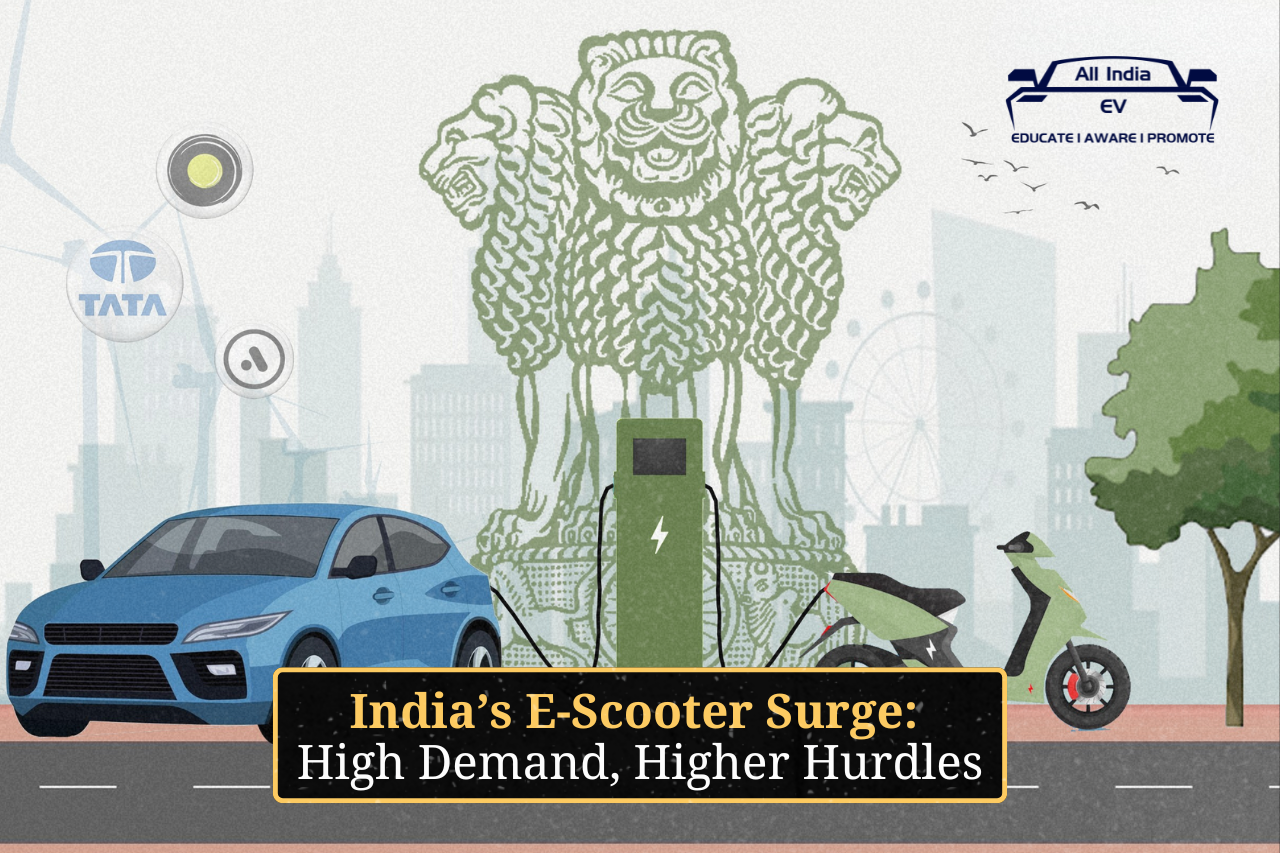

India’s electric two-wheeler industry — once the country’s fastest-growing clean-mobility story — has entered a defining phase. From supply-chain disruptions to policy shifts, from rare-earth challenges to intense competition between legacy giants and new-age startups, the last quarter has been a real-world stress test for India’s EV ambitions.
- A Sector at Turning Point: India’s EV Temperature Check
- Ather Energy: Strong Growth, Bigger Market Share, But Still Burning Cash
- Ola Electric: A Mixed Quarter Despite EBITDA Turning Positive
- TVS Motor: The New Market Leader — Quiet, Consistent, and Dominant
- Bajaj Auto: Strong Overall, EV Growth Momentum but Limited Data
- Ola Electric: A Bold Claim — “We Don’t Need Rare Earths Anymore”
- Ather Energy: A More Cautious, Measured Strategy
- TVS & Bajaj: Acknowledging Impact, Keeping Details Under Wraps
- The PLI Divide: A Massive Boost for Some, Exclusion for Others
- Bajaj Auto: The Biggest Winner
- Ola Electric: Certified, but PLI not yet impacting P&L
- TVS Motor: Strong PLI Gains
- Ather: Shock Exclusion
- Charging: A Fragmented, Incompatible Landscape
- Service Networks: A Critical Weak Link for New-Age EV Startups
As the world’s largest two-wheeler market, India’s mobility story is built on scooters and motorcycles. For rural India, two-wheeler demand has long been a proxy for economic health. Naturally, when the EV transition began, the sector’s first big wave came from electric scooters.
And in just four years, from 2020 to 2024, India went from near-zero adoption to becoming the world’s second-largest electric two-wheeler market, crossing 8% penetration. But the last few months show that the road ahead is far more complex than it first appeared.
This news report breaks down how Ola Electric, Ather Energy, TVS Motor, and Bajaj Auto have navigated India’s EV terrain over the last quarter — and what lies ahead for India’s fast-moving but increasingly competitive clean-mobility sector.
A Sector at Turning Point: India’s EV Temperature Check
Two-wheelers continue to power India’s daily mobility. More than hundreds of millions rely on scooters and motorcycles for work, commute, and livelihood. As petrol prices surged over the years and urban congestion worsened, EVs offered an attractive alternative — and consumers responded.
But the last quarter shows the industry balancing between high-speed growth and new speed-breakers.
The biggest forces shaping the quarter were:
More EV News
- China’s restrictions on rare-earth magnet exports
- Breakthrough claims in motor technology
- A major GST realignment
- Uneven benefits from the PLI scheme
- Widening gaps in charging and service infrastructure
This combination has created a new battlefield where survival depends on scale, supply-chain strength, and operational excellence — not just innovation or branding.
Quarterly Scorecard: Winners, Losers & Movers
The earnings season offered a clear, data-backed picture of which players are adapting — and which are struggling.
Ather Energy: Strong Growth, Bigger Market Share, But Still Burning Cash
Ather sold ~65,600 units, recording a 67% YoY growth, and notched revenue worth ₹941 crore this quarter. Its market share increased from 12.1% to 17.4%, strengthening its position as India’s No. 2 EV two-wheeler company.
Profitability remains distant, but Ather improved its EBITDA margin from -21% to -10%, indicating tightening financial discipline. However, a lack of PLI support (more on that later) forced Ather to defer some incentives and delay product launches.
| Quarter | Market Share (%) | EC Count |
| Q1’25 | 7.6% | 218 |
| Q2’25 | 12.1% | — (not shown clearly, likely ~250) |
| Q3’25 | 12.3% | 265 |
| Q4’25 | 13.6% | — (not shown clearly, approx ~300) |
| Q1’26 | 14.3% | 424 |
| Q2’26 | 17.4% | 524 |
Ola Electric: A Mixed Quarter Despite EBITDA Turning Positive
Ola sold 52,666 units — almost half of what it sold in the same quarter last year, leading to a notable loss in market share.
Yet, for the first time in its history, Ola recorded a positive EBITDA of 0.3%, aided largely by sharp cost rationalisation across operations.
Once synonymous with India’s electric scooter revolution along with Ather, Ola’s slowing volumes show the market’s shift toward companies that pair aggressive play with operational discipline.
| Quarter | GM % | GM % excl. PLI | GM % excl. PLI & PM-E Drive |
| Q2 FY25 | 18.5% | 13.0% | 5.8% |
| Q3 FY25 | 18.6% | 7.9% | -1.2% |
| Q4 FY25 | 13.7% | 3.7% | 3.7% |
| Q1 FY26 | 25.7% | 23.8% | 22.0% |
| Q2 FY26 | 30.7% | 28.7% | 27.4% |
TVS Motor: The New Market Leader — Quiet, Consistent, and Dominant
Among all players, TVS Motor Company delivered the best quarter, strengthening its leadership in EVs while simultaneously breaking records across its broader portfolio.
- Record operating revenue: ₹11,095 crore
- Profit-before-tax: ₹1,226 crore
- Total vehicles sold: ~15 lakh
- EV scooters sold: 80,000 (5.3% of total)
This means just 5% of TVS’s business outperformed the quarterly volumes of both Ola and Ather individually. With a diversified vehicle mix and deep offline networks, TVS appears best positioned to scale EVs without destabilising its larger business.
Bajaj Auto: Strong Overall, EV Growth Momentum but Limited Data
Bajaj did not break down its EV sales numbers, but the company highlighted that EVs are its fastest-growing category.
Overall performance was stellar:
- Total vehicles sold: 12.94 lakh
- EBITDA margins: 20.5% (all-time high)
- Revenue: ₹14,922 crore (all-time high)
However, Bajaj admitted the rare-earth shortage directly affected the Chetak lineup. Still, it recovered faster than expected, showcasing supply-chain resilience.
The Rare Earth Magnet Crunch: China’s Chokehold Hits India’s EV Ambitions
Rare earth magnets are the beating heart of EV motors. China currently dominates global production and refining — a reality that came sharply into focus when export restrictions and tightened controls disrupted supplies.
Each company responded differently to this crisis.
Ola Electric: A Bold Claim — “We Don’t Need Rare Earths Anymore”
Ola announced a new traction motor that eliminates rare-earth dependency entirely, using ferrite magnets instead of neodymium-based rare earths.
Ferrite magnets are:
- Cheaper
- Abundantly available
- Less powerful and less heat-resistant
The challenge lies in delivering the same performance.
Ola claims it achieved that by optimising magnetic circuits and redesigning motor architecture, enabling ferrite motors to match rare-earth equivalents in 7 kW and 11 kW power classes. If this holds up in real-world conditions — high heat, heavy loads, rough terrain — it could be a breakthrough.
But experts note this is a highly ambitious claim. Long-term performance will determine its credibility.
Ather Energy: A More Cautious, Measured Strategy
Ather shifted from “heavy” rare-earth magnets like dysprosium and terbium toward “light” rare earths. This reduces dependency on China but may affect peak performance under high temperatures.
The company was transparent in calling this a short-term stopgap while long-term alternatives are under research.
Ather also deferred ₹26.2 crore of incentives due to supply-chain disruptions.
TVS & Bajaj: Acknowledging Impact, Keeping Details Under Wraps
Neither disclosed technical specifics.
- Bajaj admitted magnet shortages directly hurt the Chetak lineup.
- TVS remarked the industry could have delivered “much, much bigger numbers” if magnets were available.
Policy Shake-up: PLI and GST Shape New Industry Winners
Government policy has become a decisive factor in quarterly performance — creating clear beneficiaries and casualties.
The PLI Divide: A Massive Boost for Some, Exclusion for Others
India’s PLI scheme offers 13–18% cashback on EV sales to companies meeting strict localisation and investment criteria.
Here’s how the quarter played out:
Bajaj Auto: The Biggest Winner
- Potential claim: ₹630 crore
- All 13 Chetak models approved
- Direct boost to margin and competitiveness
Ola Electric: Certified, but PLI not yet impacting P&L
- Secured PLI certification for entire Gen 3 scooter lineup till 2028
- Filed claim for ₹380 crore, based on FY25 revenues
- But this had minimal impact on this quarter’s profitability
TVS Motor: Strong PLI Gains
- Eligible claim: ~₹330 crore for FY25
- Led to a 0.5% margin improvement
Ather: Shock Exclusion
Despite being India’s second-largest EV maker, Ather did not qualify for the PLI scheme, impacting its financial strength and delaying product rollouts.
In a competitive sector, this is a major disadvantage.
GST Cuts Change Price Dynamics — But EV Demand Stays Strong
In September, GST on petrol two-wheelers under 350cc dropped from 28% to 18%.
GST on EVs remained at 5%.
This widened the price gap but nudged petrol vehicles slightly closer to EVs. The fear: Would this slow EV adoption during the festive surge?
It didn’t.
October recorded an all-time-high of 1.44 lakh EV scooter sales.
Company leaders say the long-term TCO (total cost of ownership) advantage still makes EVs attractive. However, in the short term, companies like Ather expect defensive pricing and discounts to maintain momentum.
Infrastructure: The Growing Ceiling Above EV Adoption
As volumes increase, India’s EV story faces two big bottlenecks:
- Charging infrastructure
- Service networks
Charging: A Fragmented, Incompatible Landscape
Most EV owners charge their scooters at home. But commercial and fleet users need reliable public fast-charging, which remains fragmented.
Every major company runs its own proprietary network:
- Ather Grid
- Ola Hypercharger
- Chetak Charge
- TVS Charging Network
But none of these systems work with each other.
A Bajaj Chetak cannot use an Ola Hypercharger.
An Ola scooter cannot use the Ather Grid.
This “walled garden” approach slows industry-wide infrastructure scale.
Battery swapping is another possibility — but scooter OEMs use different battery shapes, capacities, and connectors, making standardisation difficult. No major pilot exists yet for 2-wheelers.
Service Networks: A Critical Weak Link for New-Age EV Startups
After-sales service has emerged as an urgent problem — particularly for Ola.
Ola acknowledged:
- Large backlog
- Parts shortage
- Limited technicians
- Post-monsoon spikes worse than rivals
To fix this, Ola launched HyperService, which allows third-party garages to repair Ola scooters with access to genuine parts.
But legacy companies hold a tremendous advantage.
- Bajaj: 390 Chetak-exclusive stores + 4,000 retail points
- TVS: Decades-old nationwide network
- Ola, Ather: Building from scratch
In EVs, where repairs require specialised training and diagnostic tools, service depth is emerging as a true competitive moat.
The Road Ahead: India’s EV Market Matures
The biggest shift this quarter is not in numbers — but in the nature of competition.
India’s EV two-wheeler market is no longer in its “sunrise” stage. Consumers now expect:
- Reliability
- Service access
- Standardised charging
- Reasonable pricing
- Supply-chain stability
Legacy players like TVS and Bajaj are using their scale, networks, and operational efficiency to surge ahead. Startups, meanwhile, must adapt to survive in a more disciplined, less forgiving market.
Bottom Line
India’s EV two-wheeler transition has reached a critical juncture. The last quarter delivered both record highs and sharp reminders of the sector’s vulnerabilities.
What remains clear is this:
The Indian consumer has embraced EVs. Demand is no longer the problem.
The challenges now lie in the supply chain, infrastructure build-out, pricing strategy, and service readiness.
As India moves toward deeper electrification, the winners will be companies that combine:
- Technological innovation
- Supply-chain resilience
- Robust service networks
- Operational discipline
- Ability to scale without compromising quality
The EV race is entering its next phase — not just fast, but sustainable, consistent, and deeply competitive.