
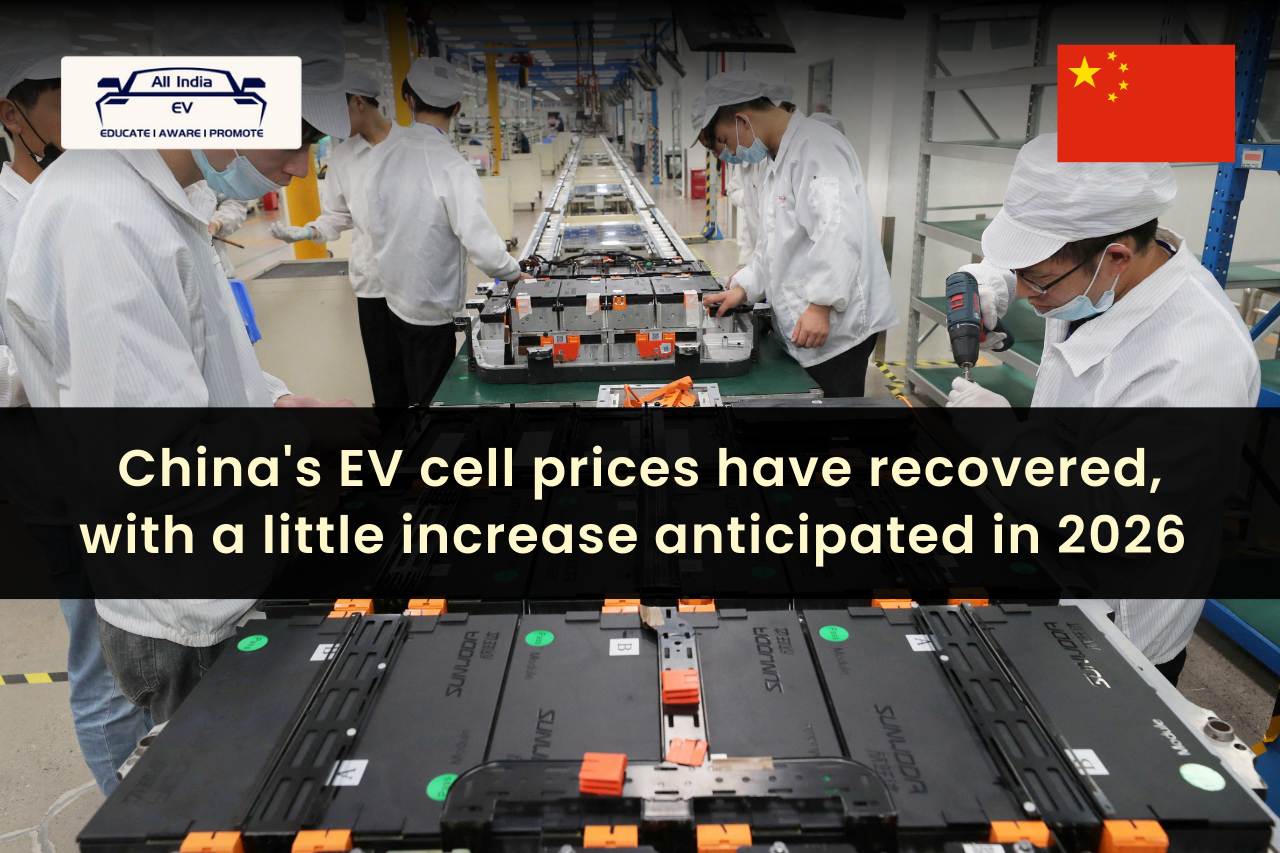

China’s electric vehicle (EV) battery market showed renewed strength in November 2025, with EV cell prices rebounding despite the seasonal off-peak period, according to TrendForce’s latest Lithium Battery Industry Chain Monthly Price Report. The development is significant for the global EV ecosystem, including India, as China remains the world’s largest battery manufacturing hub and a key supplier to international markets.
TrendForce noted that automakers continued aggressive year-end inventory stocking, keeping EV battery demand strong even during the usual slowdown. At the same time, sharp increases in upstream raw material prices—including cathode materials, electrolytes, copper foil, and aluminum foil—pushed overall battery production costs higher, leading to a rise in EV cell prices.
Among all chemistries, cobalt-rich NCM (Nickel Cobalt Manganese) cells recorded the steepest price increase. In November, average NCM square cell prices rose to CNY 0.48/Wh, up 6.7% month-on-month, while NCM pouch cells increased to CNY 0.50/Wh, marking a 4.2% MoM rise. In contrast, square LFP (Lithium Iron Phosphate) cell prices remained stable at CNY 0.34/Wh, reflecting stronger supply discipline in the LFP segment.
While EV battery demand may soften slightly in December as most automakers complete advance stocking, TrendForce emphasized that persistent upstream material inflation will continue to exert upward pressure on cell prices. As a result, EV battery pricing is expected to remain firm in the near term.
ESS Battery Market Shows Strong Momentum
The Energy Storage System (ESS) battery segment also maintained strong performance. ESS cell prices remained stable in November, supported by better-than-expected demand in the second half of 2025. Leading manufacturers have already raised their 2026 shipment targets, signaling confidence in continued market expansion.
A key trend highlighted was the rapid commercialization of large-capacity ESS cells above 500 Ah. CATL has already shipped 587 Ah cells at gigawatt-hour scale, and TrendForce expects 500+ Ah products to account for a growing share of total ESS shipments in 2026.
Despite full order books and high capacity utilization helping stabilize prices, rising raw material costs are increasing procurement pressure, pointing to a mild upward trend in ESS cell prices over the coming quarters.
More EV News

Raw Material Inflation Drives Market Outlook
TrendForce reported that both EV and ESS sectors saw strong momentum in 2H25, with especially rapid expansion in ESS deployments. This growth has driven sharp increases in lithium, cobalt, copper, and other critical battery metals.
Notably, cobalt prices have risen over 140% from their annual low, driven by export policy changes in the Democratic Republic of the Congo, pushing NCM cathode prices higher. Additionally, LiPF₆ and vinylene carbonate (VC) prices surged over 230% and 260% respectively between July and November.
Looking ahead, TrendForce expects healthy demand across EV and ESS markets in 2026. With battery material suppliers announcing price hikes already locked into new-year contracts, the firm forecasts a modest but sustained increase in EV cell prices next year—a trend closely watched by India’s fast-growing EV manufacturing and energy storage sectors.
| Product | Type/Model | Application | Average Price (Nov.) | Monthly Price Change |
| LiB (Battery Cell) | NMC 523 square ternary | EV | 0.48 CNY/Wh | +6.7% |
| LiB (Battery Cell) | Square LFP | EV | 0.34 CNY/Wh | 0.0% |
| LiB (Battery Cell) | NMC 523 pouch ternary | EV | 0.50 CNY/Wh | +4.2% |
| LiB (Battery Cell) | Square LFP | ESS | 0.32 CNY/Wh | 0.0% |
| LiB (Battery Cell) | LCO | Consumer | 7.40 CNY/Ah | +4.5% |
Comment by Author:
The rebound in China’s EV battery prices amid rising raw material costs underscores the ongoing challenges and opportunities for the global EV and ESS markets. With cobalt, lithium, and other critical materials driving production costs higher, TrendForce expects a modest but steady increase in EV cell prices in 2026.
This trend will be closely watched by India’s rapidly growing EV and energy storage sectors, as it may influence supply chains, pricing strategies, and market expansion in the coming year.