


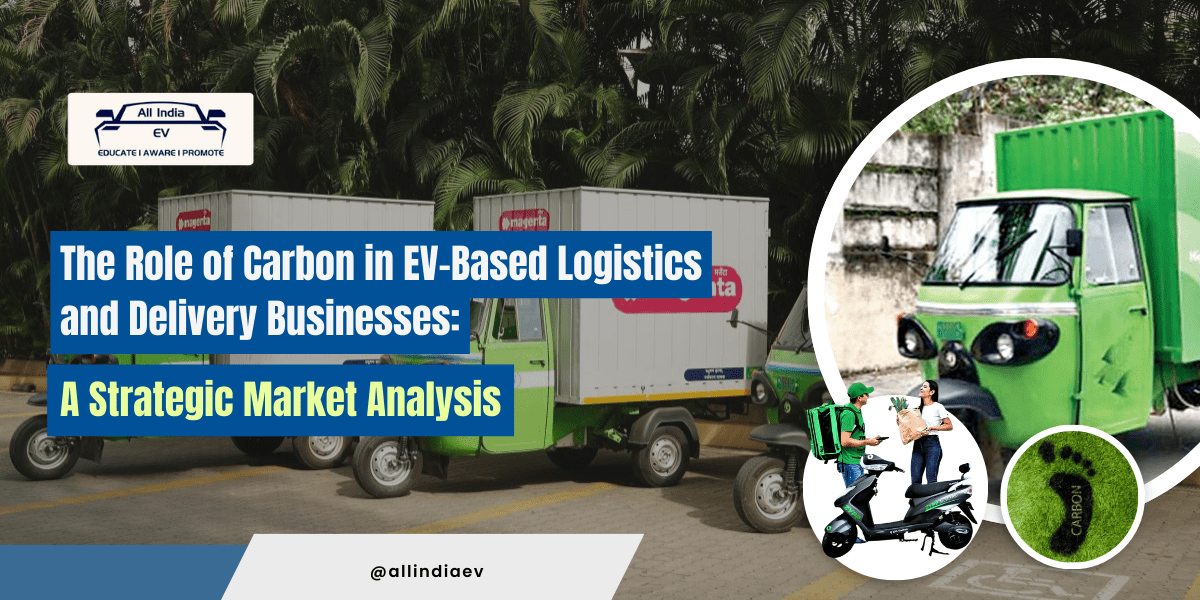
The logistics and delivery industry is rapidly transitioning to electric vehicles (EVs) as part of its sustainability initiatives. With this shift comes the growing importance of carbon credits in EV industry. These carbon credits not only help in reducing emissions but also offer financial opportunities for businesses. This article explores how EV-based logistics and delivery companies can leverage carbon credits for both environmental and financial gains, while outlining key market trends, potential opportunities, and challenges.
Overview of the Carbon Credit Market
Carbon credits are tradable certificates representing the reduction or offset of one ton of CO₂ or its equivalent greenhouse gases. These credits can be sold or traded in carbon markets, providing financial incentives for companies to reduce emissions. Businesses that lower their carbon footprint, such as EV-based logistics companies, can generate and sell carbon credits, effectively monetizing their sustainability efforts.
The carbon credit market is divided into two types:
Compliance Market: Created by government-regulated emission trading schemes (ETS), such as the European Union Emissions Trading System (EU ETS). Companies operating under these regulations must purchase carbon credits to comply with their emission caps.
Voluntary Market: Here, businesses that are not legally bound by emission caps can purchase carbon credits to voluntarily offset their carbon emissions. This market is particularly driven by companies seeking to enhance their corporate social responsibility (CSR) profiles or improve their sustainability ratings.
EV-based logistics companies can participate in both markets by reducing emissions and selling the resulting credits, thereby generating a new revenue stream.
Carbon Credits in EV Industry: Unlocking Financial and Environmental Value
Monetizing Reduced Emissions
More EV News

One of the most immediate benefits for EV-based logistics businesses lies in monetizing their reduced carbon emissions. Since electric vehicles have no direct emissions compared to internal combustion engine (ICE) vehicles, companies can generate a significant volume of carbon credits. These credits can then be sold to other industries, particularly those in the compliance market, that struggle to meet their emissions reduction targets.
For instance, the transportation sector is traditionally one of the largest emitters of CO₂, and EV logistics companies can reduce these emissions by up to 70% compared to conventional vehicles. This reduction translates directly into carbon credits, which are valued based on market demand.
Incentivizing EV Adoption
Government incentives for EV adoption often complement carbon credit opportunities. Logistics companies shifting to EV fleets are often eligible for subsidies, tax credits, and reduced tolls. These financial benefits can be augmented by the sale of carbon credits. By combining both, businesses can offset the high upfront costs of EVs and associated infrastructure investments such as charging stations.
Enhanced Market Competitiveness
Participation in carbon markets can significantly enhance a logistics company’s brand reputation, especially among environmentally conscious clients. Companies that can demonstrate carbon-neutral or even carbon-negative operations are increasingly attractive to large corporations, many of which are under pressure from stakeholders to meet stringent sustainability goals. By integrating carbon credits into their financial strategies, EV-based logistics firms can market themselves as industry leaders in sustainability, capturing a premium segment of the market.
Reduced Operational Costs
By adopting EVs, logistics businesses not only benefit from the revenue generated through carbon credits but also reduce operational costs in the long run. EVs have lower fuel costs compared to traditional diesel or gasoline-powered vehicles, and maintenance costs are also lower due to fewer moving parts. This reduction in operational expenses, coupled with the income from carbon credits, results in an overall boost to profitability.
The Financial Mechanics of Carbon Credits in EV-Based Logistics

The value of carbon credits is determined by market factors, including supply and demand, government policies, and global carbon reduction targets. Prices can range from a few dollars per ton of CO₂ to over $50 per ton, depending on the market conditions. EV-based logistics firms can maximize their financial benefits by optimizing their operations and aligning with regions that offer the most favorable carbon credit prices.
Steps to Financial Integration of Carbon Credits
➡️ Measurement of Carbon Reductions: The first step involves measuring the carbon emissions avoided by using EVs instead of ICE vehicles. Specialized software tools or third-party verifiers can be employed to accurately calculate the emissions savings.
➡️ Certification and Verification: Once the carbon savings have been quantified, businesses must have their reductions verified by an accredited body to convert them into tradable carbon credits. This ensures that the emissions reductions are legitimate and can be trusted by buyers in the carbon market.
➡️ Participation in Carbon Markets: After certification, businesses can either sell their credits directly in the compliance market or offer them on voluntary carbon markets to buyers such as corporations seeking to offset their emissions.
➡️ Long-Term Strategy: Carbon credits can also be banked for future use or sale when market prices are more favorable. This provides flexibility and the potential for higher future revenues if carbon prices rise due to stricter environmental regulations or greater demand.
Key Financial Benefits
➡️ Revenue Generation: Logistics companies can earn significant additional revenue by selling carbon credits generated from EV use.
➡️ Risk Mitigation: By adopting a long-term carbon credit strategy, companies can hedge against fluctuating fuel prices and future carbon regulations, which may penalize high emitters.
➡️ Capital Investment: The revenues from carbon credits can be reinvested into further electrification of fleets, expanding charging infrastructure, or adopting renewable energy solutions to power operations, thus fostering a self-sustaining cycle of sustainability investment.
Future Outlook and Trends
The global logistics and delivery sector is poised to play a central role in achieving global carbon reduction targets, with EVs at the forefront of this transformation. As the regulatory environment becomes increasingly stringent on emissions, the demand for carbon credits is expected to rise, potentially driving up prices and increasing the financial incentives for EV adoption.
Technological advancements such as vehicle-to-grid (V2G) systems, which allow EVs to feed power back into the grid, could further enhance the carbon-saving potential of EV-based logistics. Such innovations, combined with the increasing digitization of carbon markets, will likely streamline the process of generating, verifying, and trading carbon credits, making it more accessible to businesses of all sizes.
Moving ahead…
Electric vehicle-based logistics and delivery companies stand to benefit immensely from the carbon credit market, both financially and environmentally. By reducing emissions and capitalizing on carbon credits, these businesses can unlock new revenue streams, reduce operational costs, and position themselves as leaders in the global shift towards sustainable business practices. However, success will require careful planning, investment in infrastructure, and navigating the complexities of carbon markets. As the carbon credit market continues to grow, those that strategically leverage their low-emission operations stand to gain the most in this evolving industry landscape.