


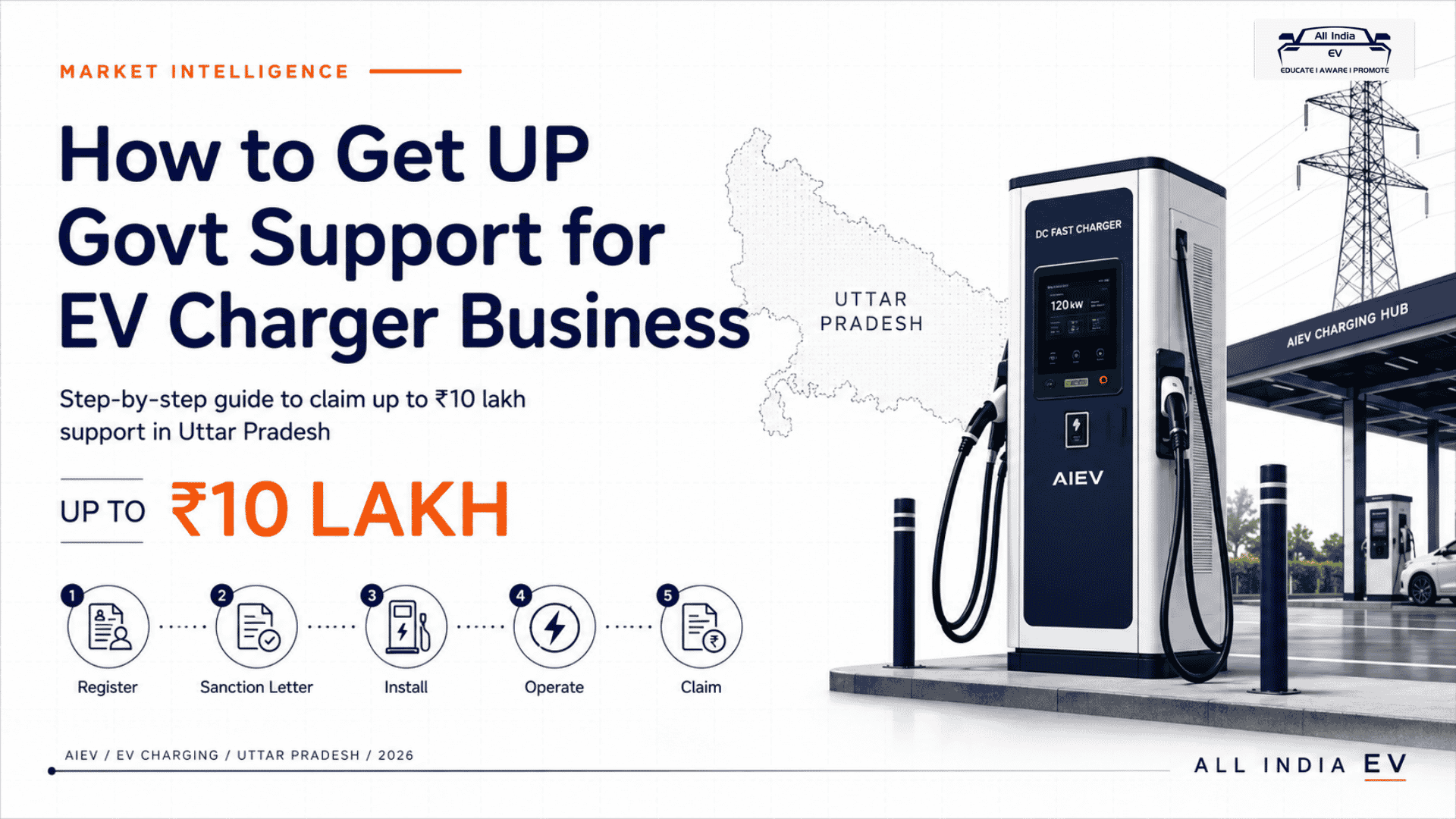
Uttar Pradesh does not officially call this a VGF scheme. The government route is a one-time capital subsidy under the Uttar Pradesh Electric Vehicle Manufacturing and Mobility Policy 2022. In business terms, it serves a similar purpose by reducing the upfront cost of charging infrastructure. As of July 2026, Invest UP continues to list the incentive.
- Step 1: Check whether your project is eligible
- Step 2: Form the business entity and secure the location
- Step 3: Prepare a proper DPR
- Step 4: Work out your eligible investment carefully
- Step 5: Start the DISCOM power-connection process
- Step 6: Register on the Nivesh Mitra portal
- Step 7: Apply for the Sanction Letter
- Step 8: Respond quickly to government queries
- Step 9: Government departments examine the project
- Step 10: Receive the Sanction Letter
- Step 11: Install and commercially commission the station
- Step 12: File the Stage-1 disbursal application
- Step 13: Operate the station for 12 months
- Step 14: Government verifies the actual investment and the site
- Step 15: Final approval and subsidy transfer
How much support can you get?
The structure is:
20% of eligible fixed capital investment
Maximum subsidy: ₹10 lakh per charging station
Minimum investment: ₹25 lakh, excluding land cost
Available to the first 2,000 eligible charging stations
So the maths works like this:
| Eligible investment | 20% subsidy |
|---|---|
| ₹25 lakh | ₹5 lakh |
| ₹30 lakh | ₹6 lakh |
| ₹40 lakh | ₹8 lakh |
| ₹50 lakh or more | ₹10 lakh maximum |
To claim the full ₹10 lakh, you would generally need at least ₹50 lakh of eligible fixed capital investment.
A 2025 amendment expanded eligible costs to include upstream electrical infrastructure. Invest UP-hosted material says eligible investment can cover chargers, utilities, building and civil works, and upstream infrastructure including both up-to-the-meter and behind-the-meter equipment, while land remains excluded.
In simple words, your project economics may include more than the shiny charger standing in the parking lot. The electrical plumbing behind it matters too. ⚡
Click here to know about Maharashtra EV Charger Subsidy under VGF
The actual process
Step 1: Check whether your project is eligible
Before spending money, make sure the project fits the charging-service-unit definition.
Your project should have:
- A minimum eligible investment of ₹25 lakh excluding land.
- Land under ownership or a valid lease arrangement.
- A genuine EV charging service operation.
- A dedicated and verifiable electricity connection for the charging activity.
- Compliance with applicable Ministry of Power and other government charging-infrastructure requirements.
Most important practical point: do not assume that buying a ₹30 lakh charger automatically makes you eligible. Invest UP examines the complete project, its investment structure, land rights, electrical infrastructure, compliance and commercial operations.
Step 2: Form the business entity and secure the location
You need a legally identifiable applicant.
Depending on the structure, this may be:
- Company
- Partnership or LLP
- Proprietary or other eligible entity
Keep the entity registration documents ready. The official application form also asks for the project location, entity constitution, registration details, promoter information, authorised signatory and beneficiary bank details.
The site should be either:
Owned by the applicant, or
Held through a proper lease arrangement.
My practical advice: do not sign an expensive long-term lease merely because the site has highway visibility. First check power availability, transformer capacity, road access, parking, vehicle movement and charging demand. A beautiful location with no feasible power connection is a very expensive photograph.
Step 3: Prepare a proper DPR
This is one of the most important stages.
The subsidy application requires a CA-certified Detailed Project Report and financial documentation. The official process asks for:
- DPR in the prescribed format
- Estimated investment break-up, CA-certified
- Means of financing, CA-certified
Your DPR should practically cover:
- Location and land arrangement
- Charger configuration and power rating
- Number of charging guns or points
- Expected sanctioned load
- Transformer or upstream electrical infrastructure
- HT/LT panels and cabling
- Civil and parking works
- Software or CMS architecture
- Total eligible fixed capital investment
- Financing structure
- Project completion date
- Expected commercial-operation date
- Revenue and utilisation assumptions
The application form specifically seeks proposed investment, estimated load, power-connection status, employment, project-completion date and proposed commercial-operation date.
Step 4: Work out your eligible investment carefully
This is where many applicants can lose subsidy value.
Create a separate, itemised project-cost sheet showing:
Likely eligible heads
- EV chargers
- Electrical equipment
- Transformer and upstream infrastructure
- HT/LT panels
- Cabling and utilities
- Tools and related equipment
- Permitted building and civil works
Not eligible
- Land cost
The 2025 policy change was particularly important because upstream electrical infrastructure was brought into the eligible investment framework, helping projects reach the ₹25 lakh minimum threshold.
Keep every quotation, invoice, payment proof and asset record organised from Day 1. Subsidy paperwork has a long memory.
Step 5: Start the DISCOM power-connection process
You will need to establish:
- Required connected and sanctioned load
- Connection feasibility
- Transformer requirement
- Metering arrangement
- Relevant electrical approvals
The Sanction Letter application asks for estimated load and power-connection status. Later, the disbursal application requires evidence of the actual power connection, including sanctioned and connected load.
So power planning should run in parallel with the subsidy application, not after the charger arrives.
Step 6: Register on the Nivesh Mitra portal
The official route starts on the Uttar Pradesh Nivesh Mitra Single Window System.
The formal subsidy procedure says the applicant must first register online on Nivesh Mitra. A Unique ID is generated for each application.
The broad portal journey is:
Register account → Activate account → Fill Common Application Form → Check approvals → Apply for required NOCs → Apply for incentives
Nivesh Mitra officially describes this as an end-to-end online process and includes an Incentive Management System.
Inside the approval and incentive workflow, your project will need to be mapped to the relevant EV-policy category and Charging Service Unit incentive.
Step 7: Apply for the Sanction Letter
This is a critical stage.
You are not simply applying for ₹10 lakh reimbursement after building the station. The policy has a two-part journey:
First: Sanction Letter
Later: Incentive disbursal
For the Sanction Letter application, the official checklist includes:
- CA-certified DPR
- CA-certified estimated investment break-up
- CA-certified means of financing
- Entity incorporation or registration documents
- MoA/AoA, partnership deed or equivalent documents, as applicable
- PAN and Aadhaar of directors/promoters as applicable
- Board or authorisation resolution
- Self-declaration
- Other documents sought during scrutiny
This stage matters enormously because the first-come-first-served position is linked to projects receiving a Sanction Letter, not merely to the date someone bought a charger.
Do not follow a “charger pehle kharid lo, subsidy baad mein dekh lenge” strategy. That flips the risk in the wrong direction.
Step 8: Respond quickly to government queries
Invest UP’s Policy Implementation Unit reviews the application.
The official timeline says:
- Invest UP may raise a query within 7 working days.
- The applicant should respond within 7 working days.
- Further queries can continue until the application is considered complete.
- An Acknowledgement Certificate should be issued within 30 working days of receipt of the application, subject to resolution of queries.
If issues are not resolved within the prescribed framework, the application may have to be re-filed.
So keep one person responsible for portal notifications. A seven-day government query sitting unread in an inbox is an avoidable own goal.
Step 9: Government departments examine the project
Once the application is complete, the review is not limited to Invest UP.
The process can involve inputs from:
- Relevant DISCOM
- Transport Department
- Housing Department
- Urban Development Department
- Fire Department
- Pollution-control authorities
- District Industries authorities
- Other relevant agencies
The review specifically examines compliance with applicable charging-infrastructure norms and the status of required approvals.
The application then moves through the Scrutiny Committee and the Empowered Committee for Service Units, or EC-S, for final approval.
Step 10: Receive the Sanction Letter
After EC-S approval, Invest UP is supposed to issue the Sanction Letter within 15 working days from the approval date.
This is the document that formally connects your project to the incentive framework.
At this point, make sure the actual project remains aligned with the sanctioned:
- Location
- Investment structure
- Charger configuration
- Project category
- Cost structure
Material changes to the project or Sanction Letter conditions may require fresh examination by Invest UP and the relevant committee.
Step 11: Install and commercially commission the station
Now complete the project according to the approved structure.
You need to:
- Procure and install the chargers
- Complete electrical infrastructure
- Get the power connection energised
- Complete civil and parking works
- Obtain fire-safety documentation
- Meet applicable government charging norms
- Start commercial charging operations
The official procedure defines commencement of commercial operations for a service unit by reference to the first electricity bill in the name of the service unit, with verification involving the relevant DISCOM and district industry authorities.
This detail is easy to underestimate. Your electricity-account documentation must be clean.
Now comes the money-claim process
Step 12: File the Stage-1 disbursal application
The subsidy is not paid immediately when you install the charger.
The official system has two disbursal stages.
The Stage-1 application must be filed online within 90 working days of commencement of commercial operations.
Stage-1 documentation includes:
- CA-certified actual investment break-up
- CA-certified means of financing
- Charging-infrastructure compliance documents
- Power-connection documents
- Details of sanctioned and connected load
This is where the government starts comparing your beautiful DPR spreadsheet with the slightly less poetic world of actual invoices.
Step 13: Operate the station for 12 months
The policy says the capital subsidy becomes admissible after 12 months of commercial operations.
The Stage-2 application is filed after:
12 months from commencement of commercial operations, or the relevant financial-year point prescribed by the rules, whichever is later.
You will need records such as:
- Electricity bills
- Self-declaration
- Fire Safety Certificate
- Charging-infrastructure compliance certificate
- Any additional documents requested
Step 14: Government verifies the actual investment and the site
Before disbursal, Invest UP can arrange:
- CA verification of the capital investment
- Physical verification of installed assets
- Engineer or valuer inspection
- Coordination with the DISCOM
- Coordination with district industry authorities
Therefore, keep a complete subsidy audit folder containing:
Purchase order → Invoice → Bank payment → GST record → Asset register → Installation proof → Serial number → Site photograph
That chain should be unbroken.
Step 15: Final approval and subsidy transfer
After the Scrutiny Committee and EC-S approve the disbursal:
- The Infrastructure and Industrial Development Department issues the required Government Order.
- Invest UP transfers the sanctioned incentive directly to the applicant’s bank account.
- The implementation guidelines say disbursal should be made within 30 working days from the relevant approval.
The complete journey in one line
Choose project → secure site → make DPR → structure ₹25 lakh+ eligible investment → plan DISCOM connection → register on Nivesh Mitra → apply for Sanction Letter → clear scrutiny → receive Sanction Letter → install → start commercial operations → file Stage-1 within 90 working days → operate for 12 months → file Stage-2 → physical and financial verification → EC-S approval → direct subsidy payment