

New Testing Protocols for Electric Agricultural Tractors Introduced: BIS Sets Dedicated Safety and Performance Standards to Boost Confidence Among Manufacturers and Farmers
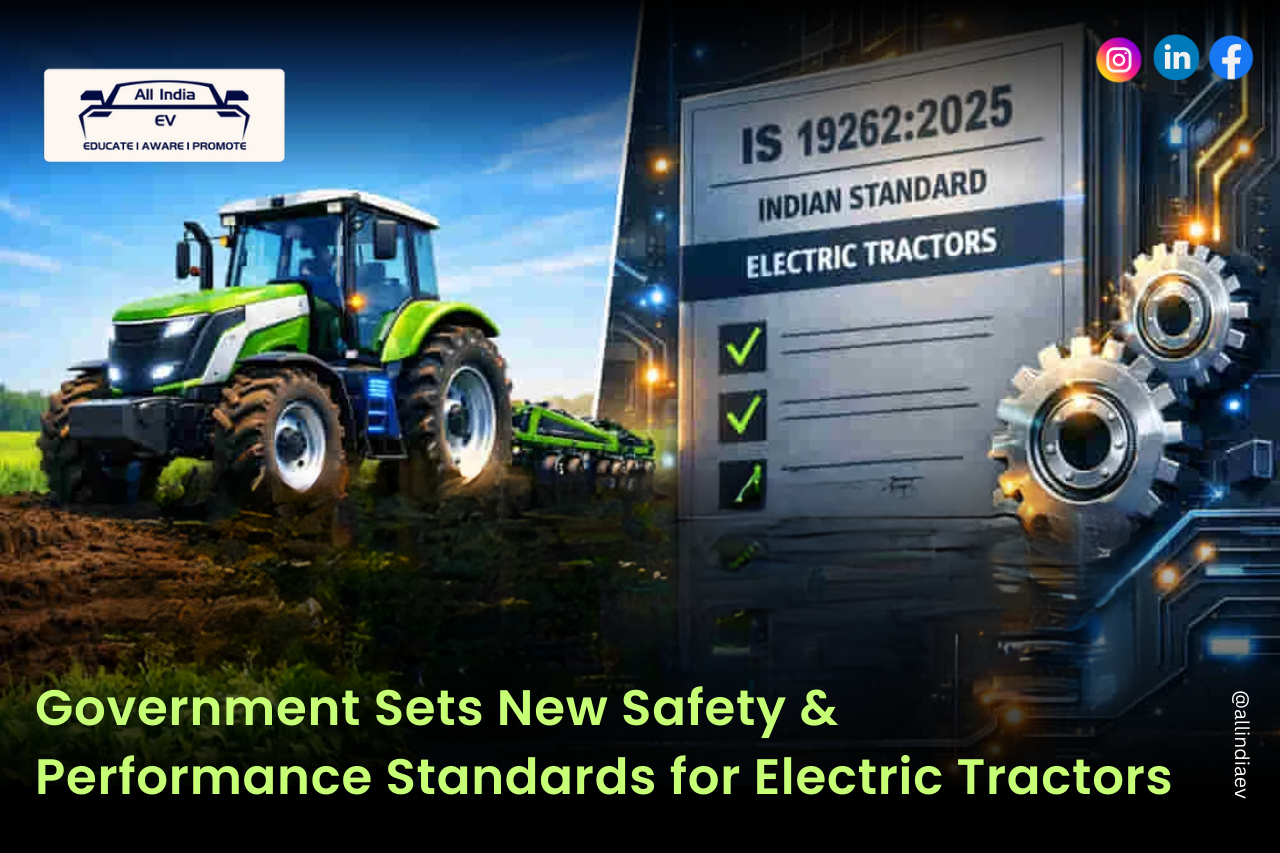
In a landmark move for India’s electric mobility and agricultural mechanisation ecosystem, the government has notified the country’s first dedicated testing standard for electric farm tractors. The development marks a critical step toward creating a uniform, science-backed framework to evaluate the safety, performance, and reliability of battery-powered tractors as they slowly enter India’s vast agricultural market.
According to a statement issued by the Ministry of Consumer Affairs, the new standard establishes structured and uniform testing procedures covering core performance parameters. These include power take-off output, drawbar power, belt and pulley performance, vibration levels, specification verification, and inspection of major components and assemblies—all tailored specifically to farm-use conditions.
Closing a Critical Regulatory Gap
From the perspective of India EV, the introduction of this standard addresses a long-standing regulatory vacuum. Until now, electric tractors were being tested either under conventional diesel tractor test codes or modified electric vehicle (EV) standards, neither of which fully reflected the real-world operating cycles, load patterns, and terrain challenges of Indian farms.
This mismatch created uncertainty not only for manufacturers and testing agencies but also for farmers evaluating early electric tractor offerings. The Bureau of Indian Standards (BIS) has now bridged this gap by releasing a dedicated, agriculture-specific protocol, the first of its kind in the country.
Importantly, while the new standard draws technical inputs from existing agricultural tractor test codes and automotive EV regulations, it has been specifically adapted for electric powertrains used in farming applications, ensuring relevance and accuracy.
Enabling Credibility for Electric Tractors
Electric farm tractors are increasingly being positioned as a cleaner alternative to diesel, offering benefits such as zero tailpipe emissions, reduced noise, and lower operating and maintenance costs. However, without comparable and credible test data, these claims have been difficult to validate at scale.
More EV News

India EV believes the new BIS standard plays a crucial role in bringing transparency and trust to this emerging segment. By generating scientifically robust and comparable performance data, the framework strengthens confidence among farmers, financiers, regulators, and policymakers alike.
Nidhi Khare, Secretary, Department of Consumer Affairs, underscored this point, stating that the standard is designed to ensure that emerging technologies in farm mechanisation are supported by credible and uniform testing systems. She added that agriculture-specific protocols are essential as electric tractors begin entering the market, even though the standard remains voluntary at this stage.
Collaborative Development Process
The standard was formulated by BIS following a request from the Ministry of Agriculture, with inputs from a wide range of stakeholders. These included tractor manufacturers, testing and certification bodies, agricultural research institutions, and farmer organisations, notably ICAR institutes and farm machinery testing centres.
From an industry standpoint, this consultative approach strengthens the standard’s practicality and acceptance, while laying the groundwork for future conformity assessment and regulatory frameworks for electric tractors in India.
Adoption Still in Early Stages
Despite the policy progress, electric tractor adoption in India remains extremely limited. As reported earlier, only 26 electric tractors were sold during the current fiscal year, compared with nearly 500,000 diesel tractors sold in the same period. A major bottleneck continues to be the lack of charging infrastructure in rural areas, along with higher upfront costs.
However, industry data suggests momentum is slowly building. Around 220 electric tractors have been registered in 2025, even in the absence of national incentives. These vehicles already comply with mandatory Central Motor Vehicles Rules (CMVR) safety norms under AIS-168.
Experts caution, however, that future policy alignment will be key. While the new BIS test code strengthens standardisation, making it mandatory for incentive eligibility could increase certification timelines and costs, potentially impacting affordability for farmers.
The Road Ahead
The introduction of a dedicated testing standard is a foundational milestone—but not the final step. Harmonisation between standards, incentives, and inter-ministerial policies will be essential to accelerate adoption and ensure that farmers can access the benefits of electric tractors faster and at scale.
Electric tractors may still be a niche today, even in incentive-offering states like Punjab, Haryana, Maharashtra, Telangana, Andhra Pradesh, and Madhya Pradesh, but with the right ecosystem support, they could become a vital pillar of India’s clean, sustainable agricultural future.
Comment by Author
The notification of India’s first dedicated testing standard for electric tractors is a timely and necessary intervention to bring credibility to clean agri-mobility. While adoption remains nascent, this science-backed framework lays the groundwork for trust, comparability, and policy alignment across stakeholders.
To translate standards into scale, the next phase must focus on harmonising incentives, infrastructure, and certification timelines. With coordinated execution, electric tractors can move from niche pilots to a practical, sustainable solution for Indian farmers.