
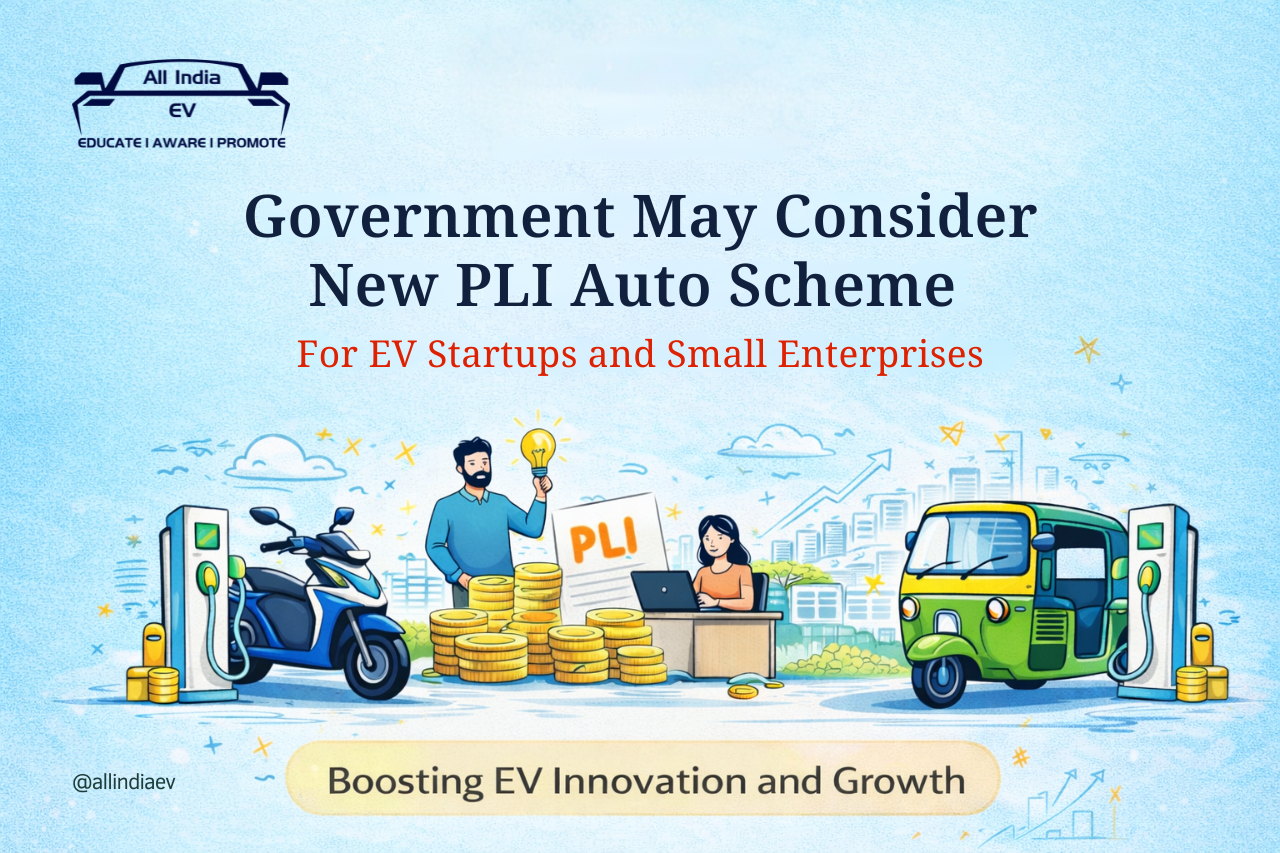

Startups like Ather Energy argue current incentive structures favour incumbents such as Hero, Bajaj, Ola Electric, and TVS, with officials urging industry consensus before proposing a new scheme.
The government is not reopening the existing Production-Linked Incentive (PLI) scheme for automobiles. But it may be laying the groundwork for something more politically and structurally complex: a separate PLI architecture for startups and small manufacturers.
That possibility surfaced after electric two-wheeler (e2w) startups publicly questioned a core assumption embedded in the current scheme that scale must precede incentives. A senior government official indicated that while the current PLI framework is locked, a new scheme could be considered if the industry builds consensus and submits a structured proposal.
This is not a bureaucratic footnote. It is a signal that India’s EV industrial policy is reaching its first real stress test.
The Design Choice the Industry Is Now Contesting
The current Auto PLI scheme was never designed to be neutral. Its eligibility thresholds are explicit filters:
- Minimum ₹10,000 crore global group turnover for OEMs
- ₹3,000 crore investment in fixed assets
- 50% domestic value addition (DVA) as a qualifying condition
- Incentives ranging from 13–16% of determined sale value
These criteria automatically privilege incumbents Tata Motors, Mahindra & Mahindra, Ola Electric, Hero MotoCorp, Bajaj Auto, and TVS Motor Company—while structurally excluding startups.
That exclusion is not accidental. The scheme was framed to accelerate industrial depth tooling, localisation, supplier ecosystems not to subsidise experimentation.
More EV News

But that design choice is now being contested by companies like Ather Energy, which argue that innovation-led OEMs are being penalised precisely because they do not yet resemble legacy manufacturers.
Why the Government Won’t Reopen the Existing Scheme
The official response was blunt: the current PLI scheme cannot be amended midstream. It has Cabinet approval, defined timelines, and committed fiscal outlays.
“No new applications are possible,” the official said, adding that any change would require reopening Cabinet approvals—an option the government is unwilling to pursue.
Instead, the door left open is procedural rather than immediate: if startups and small manufacturers believe they require a dedicated incentive structure, they must submit a collective representation to either Department for Promotion of Industry and Internal Trade or the Ministry of Micro, Small and Medium Enterprises.
This matters. It shifts the debate from grievance to governance.
Follow the Money: What the Current PLI Is Actually Doing
The performance data explains why the government is reluctant to disturb the scheme.
In FY25 alone:
- Tata Motors received ₹142 crore
- Mahindra & Mahindra ₹105 crore
- Ola Electric ₹74 crore
Cumulatively in the current fiscal:
- Tata Motors: ₹403 crore
- Bajaj Auto: ₹626 crore
- M&M: ₹284 crore
- TVS: ₹321 crore
- Ola Electric: ₹367 crore
From a policymaker’s lens, the scheme is functioning exactly as intended:
- 94 product variants certified under Champion OEMs
- 37 variants under Component Champions
- Incentives disbursed across 10.42 lakh e2w, 2.38 lakh e3w, ~80,000 e4w, and ~1,400 e-buses
The PLI is not about fairness across company age. It is about speed, volume, and localisation at scale.
The Deeper Question: Can One Policy Serve Two Industrial Logics?
What startups are really asking is not access to this PLI but recognition that India’s EV ecosystem now contains two fundamentally different actors:
- Scale-first incumbents optimising supply chains, capital efficiency, and localisation.
- Innovation-first startups building IP, architectures, and differentiated products without balance sheets large enough to clear PLI thresholds.
Trying to force both into a single incentive design was always going to create friction.
A separate PLI or PLI-like mechanism—for startups would implicitly acknowledge that innovation and manufacturing scale mature on different timelines. But it would also raise uncomfortable questions:
- How do you prevent fragmentation of incentives?
- How do you measure outcomes beyond volumes?
- At what point does a “startup” graduate out of protection?
These are not trivial trade-offs. They go to the heart of how India wants to sequence innovation, capital, and industrial depth in EVs.
What Happens Next
The signal from government is cautious but clear: bring a serious proposal, not a complaint.
If the startup ecosystem can articulate a framework that aligns incentives with measurable outcomes—local IP creation, supplier development, technology transfer—then a second PLI conversation may begin.
Until then, the current scheme will continue to reward exactly what it was designed to reward: incumbents who can already manufacture at scale, localise deeply, and move volumes fast.
The real question is not whether startups were excluded.
It is whether India is now ready to run two EV industrial strategies in parallel—and manage the complexity that comes with it.