
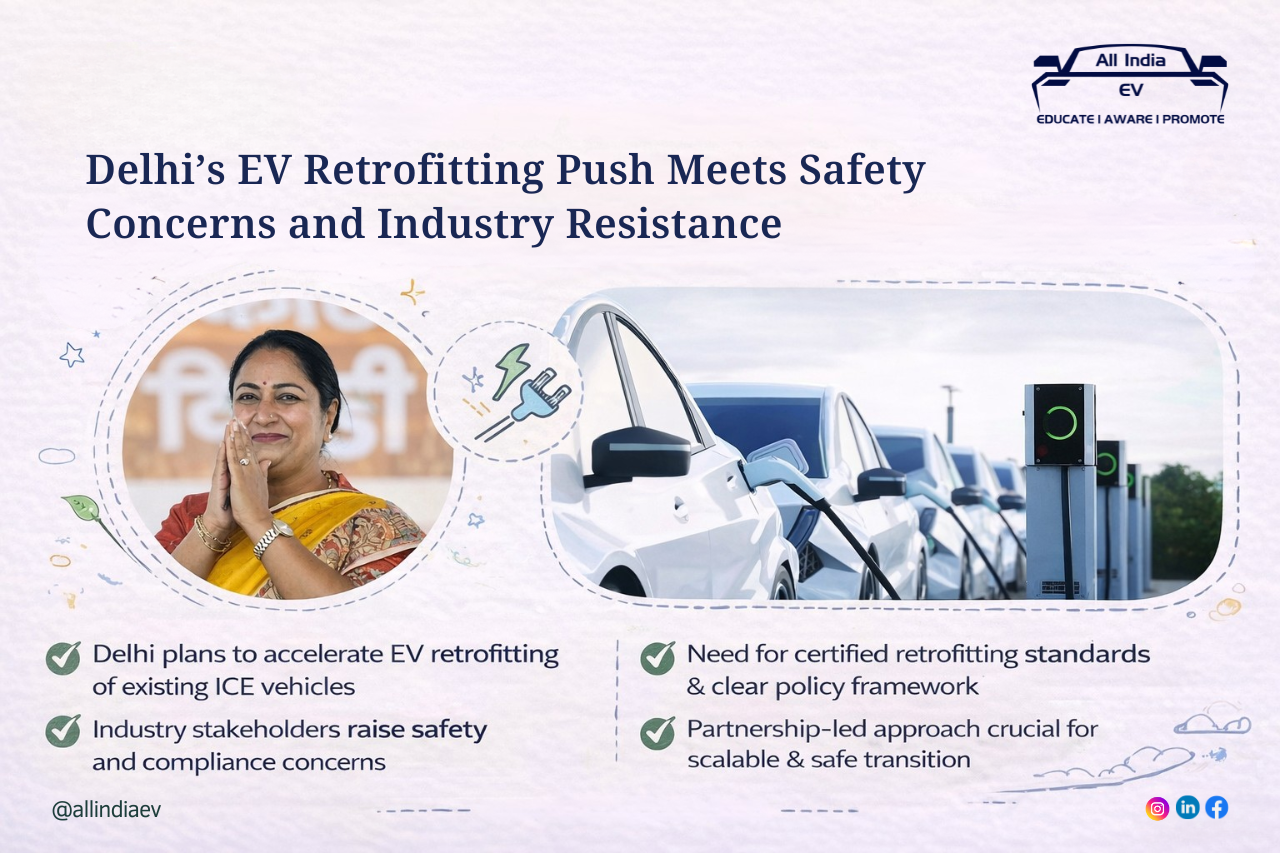

“Delhi’s EV retrofitting incentives to reduce pollution have split the auto sector, with carmakers raising safety and viability concerns as startups seek policy support to scale.“
New Delhi: The Delhi government’s move to incentivise electric vehicle (EV) retrofitting has sparked a sharp debate within India’s automobile industry, with major carmakers raising safety and technical concerns even as startups and independent retrofitters see a business opportunity.
Under the new policy, the first 1,000 vehicles converted from internal combustion engines to electric powertrains will receive an incentive of ₹50,000. The initiative aims to curb vehicular pollution by extending the usable life of older vehicles while transitioning them to cleaner mobility in one of the world’s most polluted cities.
However, leading automobile manufacturers remain unconvinced. Industry executives, speaking on condition of anonymity, said EV retrofitting is fundamentally different from earlier fuel transitions such as CNG or LPG, and raises complex safety, engineering and liability issues.
Safety and Engineering Risks Flagged
Globally, only a handful of automakers, including Toyota Motor Corp, have shown limited openness to EV retrofitting. Most manufacturers argue that replacing an engine with batteries and electric drivetrains alters a vehicle’s structural integrity, weight distribution, software architecture and crash safety.
Major EV players such as Tata Motors Ltd, Mahindra & Mahindra Ltd and JSW MG Motor India declined to comment on detailed queries.
A senior car company official said, “In CNG or LPG conversions, the vehicle architecture remains unchanged. In EV retrofitting, battery placement and software integration fundamentally alter drivability and safety. This requires platform-level engineering, which is not possible in a retrofit.”
More EV News

Auto industry veteran Rajeev Chaba said retrofitting carries risks that require deeper evaluation. “Battery integration, range, performance and safety cannot be fully optimised in a retrofitted vehicle,” he noted.
Startups See Opportunity Amid Policy Gaps
Despite resistance from large manufacturers, independent retrofitters believe EV conversions could help vehicles remain road-legal amid Delhi’s ban on petrol vehicles over 15 years and diesel vehicles over 10 years.
Delhi NCR-based Folks Motor said the segment lacks formal policy recognition. “There is no clear GST or regulatory framework. Without that, volumes cannot scale,” said managing director Nikhil Khurana, adding that several states including Delhi, Maharashtra and Telangana offer limited incentives.
Pune-based Suma Japanese Technologies is among the few firms with regulatory approvals, having secured 24 certifications from the Automotive Research Association of India (ARAI).
“New EVs attract 5% GST, while retrofitted EVs are taxed at 18%, making conversions commercially unviable,” said managing director Jayapal G.
While passenger car retrofitting remains slow, conversions are gaining traction in commercial vehicles, where safety norms are less stringent and cost savings are clearer—highlighting the broader tension in India’s clean mobility transition between reuse and purpose-built electric platforms.