
All India EVAll India EVAll India EV
Notification
Font ResizerAa
  • Home
  • EV News
  • EV Launch
  • Market Insights
  • Investments & Funding
  • Guest Articles
  • EV Engineering
  • Contact
Reading: Delhi’s EV Retrofitting Push Meets Safety and Business Concerns Across Auto Industry
Share
All India EVAll India EV
Font ResizerAa
  • Home
  • EV News
  • EV Launch
  • Market Insights
  • Guest Articles
  • EV Engineering
  • Contact
Search
  • Home
    • Home 1
    • Home 2
    • Home 3
    • Home 4
    • Home 5
  • Home
  • Categories
    • Electric
  • Categories
  • Shows
    • Rap
  • More Foxiz
    • Blog Index
    • Contact
  • Bookmarks
    • Customize Interests
    • My Bookmarks
  • More Foxiz
    • Blog Index
    • Sitemap
Have an existing account? Sign In
Follow US
EV Retrofitting
Home » Blog » Delhi’s EV Retrofitting Push Meets Safety and Business Concerns Across Auto Industry
EV News

Delhi’s EV Retrofitting Push Meets Safety and Business Concerns Across Auto Industry

Sunita
By
Sunita
Last updated: 19 January 2026
Share
4 Min Read
SHARE

“Delhi’s EV retrofitting incentives to reduce pollution have split the auto sector, with carmakers raising safety and viability concerns as startups seek policy support to scale.“

Contents
  • Safety and Engineering Risks Flagged
  • Startups See Opportunity Amid Policy Gaps

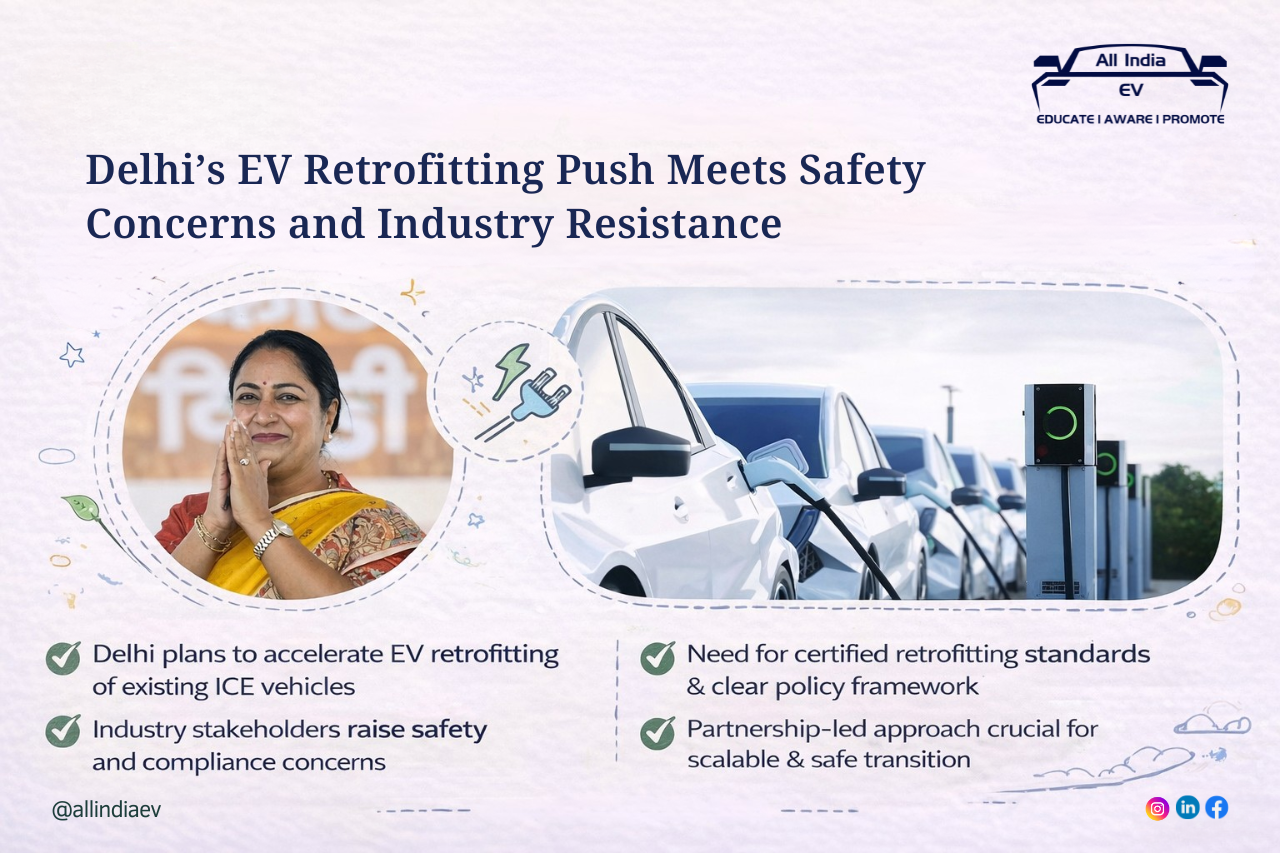
New Delhi: The Delhi government’s move to incentivise electric vehicle (EV) retrofitting has sparked a sharp debate within India’s automobile industry, with major carmakers raising safety and technical concerns even as startups and independent retrofitters see a business opportunity.

Under the new policy, the first 1,000 vehicles converted from internal combustion engines to electric powertrains will receive an incentive of ₹50,000. The initiative aims to curb vehicular pollution by extending the usable life of older vehicles while transitioning them to cleaner mobility in one of the world’s most polluted cities.

However, leading automobile manufacturers remain unconvinced. Industry executives, speaking on condition of anonymity, said EV retrofitting is fundamentally different from earlier fuel transitions such as CNG or LPG, and raises complex safety, engineering and liability issues.


Safety and Engineering Risks Flagged

Globally, only a handful of automakers, including Toyota Motor Corp, have shown limited openness to EV retrofitting. Most manufacturers argue that replacing an engine with batteries and electric drivetrains alters a vehicle’s structural integrity, weight distribution, software architecture and crash safety.

Major EV players such as Tata Motors Ltd, Mahindra & Mahindra Ltd and JSW MG Motor India declined to comment on detailed queries.

A senior car company official said, “In CNG or LPG conversions, the vehicle architecture remains unchanged. In EV retrofitting, battery placement and software integration fundamentally alter drivability and safety. This requires platform-level engineering, which is not possible in a retrofit.”

More EV News
What: India’s finance ministry has directed public sector banks, insurers, and financial institutions to reduce operational spending and accelerate adoption of electric vehicles across official fleets. The move is part of a wider austerity push linked to rising global economic uncertainty and fuel-related risks. The Number: The directive impacts major public institutions including State Bank of India, Bank of Baroda, and Life Insurance Corporation of India, covering millions of employees and thousands of operational vehicles nationwide. The Impact: The policy signals a new phase of institutional fleet electrification in India, where EV adoption is now being tied directly to fiscal discipline, fuel import management, and public-sector operational efficiency. The Core News India’s finance ministry has formally instructed state-run financial institutions to implement strict expenditure controls while simultaneously accelerating EV adoption for official transport operations. The directive from the Department of Financial Services asks organisations to replace petrol and diesel vehicles used at head offices and branch operations with electric vehicles “as far as possible.” The order comes amid growing concern over the economic impact of prolonged geopolitical instability in West Asia, which threatens to increase crude oil prices, widen India’s import bill, and pressure the rupee. Alongside the EV transition mandate, the government has also pushed virtual meetings, reduced foreign travel, and tighter administrative spending controls across public-sector institutions. For India’s EV ecosystem, the directive is strategically important because it expands demand visibility beyond state transport undertakings and government departments into the financial sector itself. PSU banks and insurers operate one of the country’s largest distributed office networks, including regional offices, branch fleets, field operations, and administrative mobility services. Even a phased transition could create a sizeable procurement pipeline for electric passenger vehicles, charging infrastructure providers, and fleet management companies. Breaking Down the Update • The Department of Financial Services issued the austerity and EV adoption directive to PSU banks, insurers, and financial institutions. • The government wants petrol and diesel vehicles used in official operations to be progressively replaced by EVs wherever operationally feasible. • The policy push follows Prime Minister Narendra Modi’s appeal for fuel conservation and controlled discretionary spending amid global energy uncertainty. • The directive also mandates greater use of video conferencing to reduce travel-related operational expenditure. • The move could indirectly support domestic EV OEMs, leasing firms, and charging infrastructure operators through institutional procurement demand. • The banking and insurance sector may emerge as a new enterprise fleet electrification category in India’s EV transition roadmap. How PSU banks EV adoption will help Indian EV Market The expansion of PSU banks EV adoption could create a strong institutional demand layer for India’s electric mobility sector. Public sector banks and insurers operate thousands of branch offices across urban, semi-urban, and rural India. Their transition to EV fleets can generate predictable procurement volumes for domestic automakers, especially in the electric sedan, compact SUV, and commercial mobility segments. Beyond vehicle sales, the policy may also accelerate deployment of workplace charging infrastructure at bank headquarters, zonal offices, and regional branches. This can support charger utilisation economics while helping normalise EV infrastructure in tier-2 and tier-3 cities. Another important impact is signalling. When large state-linked financial institutions adopt EVs as operational assets rather than pilot projects, it improves confidence across the broader enterprise mobility market. Private banks, NBFCs, and insurance firms could eventually follow similar fleet transition models to reduce long-term fuel and maintenance costs. PSU banks EV adoption also aligns with India’s larger energy security strategy. Lower petroleum consumption in institutional fleets directly supports efforts to reduce crude import dependence while stabilising operational expenditure during periods of volatile global oil prices. Conclusion & Next Steps The government’s push toward PSU banks EV adoption reflects a broader shift where EV deployment is increasingly being linked with macroeconomic resilience rather than only sustainability targets. Execution, however, will depend on procurement timelines, charging infrastructure readiness, and operational suitability across
India directs state-run banks, insurance firms to cut costs, shift to EVs
Renault Nears Agreement with Collaborators for Battery Recycling, Executive Reveals
F MEC & Finayo’s Rs 25 Crore Push for India’s EV Financing Revolution
EV Charging Stations in India 2025: State-Wise Trends, Growth Drivers & Key Challenges
See how Amara Raja & Piaggio will empower the EV Cell Edge

Auto industry veteran Rajeev Chaba said retrofitting carries risks that require deeper evaluation. “Battery integration, range, performance and safety cannot be fully optimised in a retrofitted vehicle,” he noted.


Startups See Opportunity Amid Policy Gaps

Despite resistance from large manufacturers, independent retrofitters believe EV conversions could help vehicles remain road-legal amid Delhi’s ban on petrol vehicles over 15 years and diesel vehicles over 10 years.

Delhi NCR-based Folks Motor said the segment lacks formal policy recognition. “There is no clear GST or regulatory framework. Without that, volumes cannot scale,” said managing director Nikhil Khurana, adding that several states including Delhi, Maharashtra and Telangana offer limited incentives.


Pune-based Suma Japanese Technologies is among the few firms with regulatory approvals, having secured 24 certifications from the Automotive Research Association of India (ARAI).

“New EVs attract 5% GST, while retrofitted EVs are taxed at 18%, making conversions commercially unviable,” said managing director Jayapal G.

While passenger car retrofitting remains slow, conversions are gaining traction in commercial vehicles, where safety norms are less stringent and cost savings are clearer—highlighting the broader tension in India’s clean mobility transition between reuse and purpose-built electric platforms.


Join All India EV Community

Click here for more such EV Updates

Loading
Karnataka Electricity Regulatory Commission relief sparks EV infra boom at petrol pumps
Yuma Energy Expands Reach, Surges Past One Million Swaps
Yuma Energy partners with MMRC for battery swapping stations on Mumbai Metro Line 3
Volektra and Jendamark India Sign MoU to Industrialise Rare-Earth-Free Electric Motor Tech
TapFin Obtains $4 Million in Funding from Elevar Equity to Accelerate Sustainable Progress in India

Sign Up For Daily Newsletter

Be keep up! Get the latest breaking news delivered straight to your inbox.
Loading
By signing up, you agree to our Terms of Use and acknowledge the data practices in our Privacy Policy. You may unsubscribe at any time.
Share This Article
Facebook Whatsapp Whatsapp LinkedIn Copy Link Print
Leave a Comment

Leave a Reply Cancel reply

Your email address will not be published. Required fields are marked *

Follow US
XFollow
InstagramFollow
YoutubeSubscribe
LinkedInFollow
FADA data reveals 81% surge in EV passenger vehicle retail
12 June 2026
BYD DM-i Plug-In Hybrid Technology For India Promises 1,200km+ Range
12 June 2026
GM to offer EV owners ability to sell power to US electricity grid
12 June 2026
All India EV: Edition 50
What all happened in May 2026?
Click Here
All India EV

Daily EV Industry updates for you…

Categories

  • EV News
  • EV Launch
  • Investments & Funding
  • Market Insights
  • Guest Articles
  • EV Engineering

Quick Links

  • Community
  • Content Services
  • Branding Services
  • My EV Charger
  • Substack

© Developed and Managed by “The Energy Log”

Welcome Back!

Sign in to your account

Username or Email Address
Password

Lost your password?

Not a member? Sign Up