
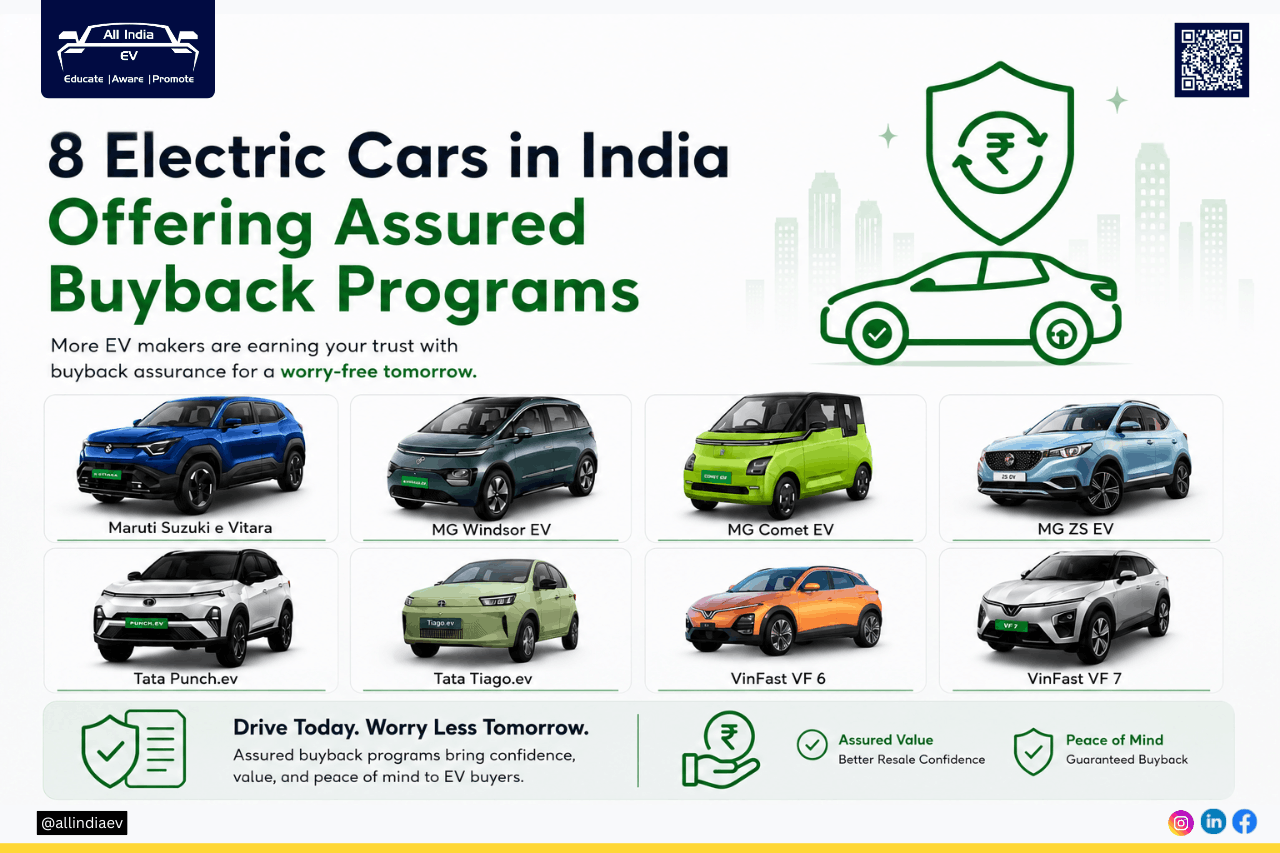

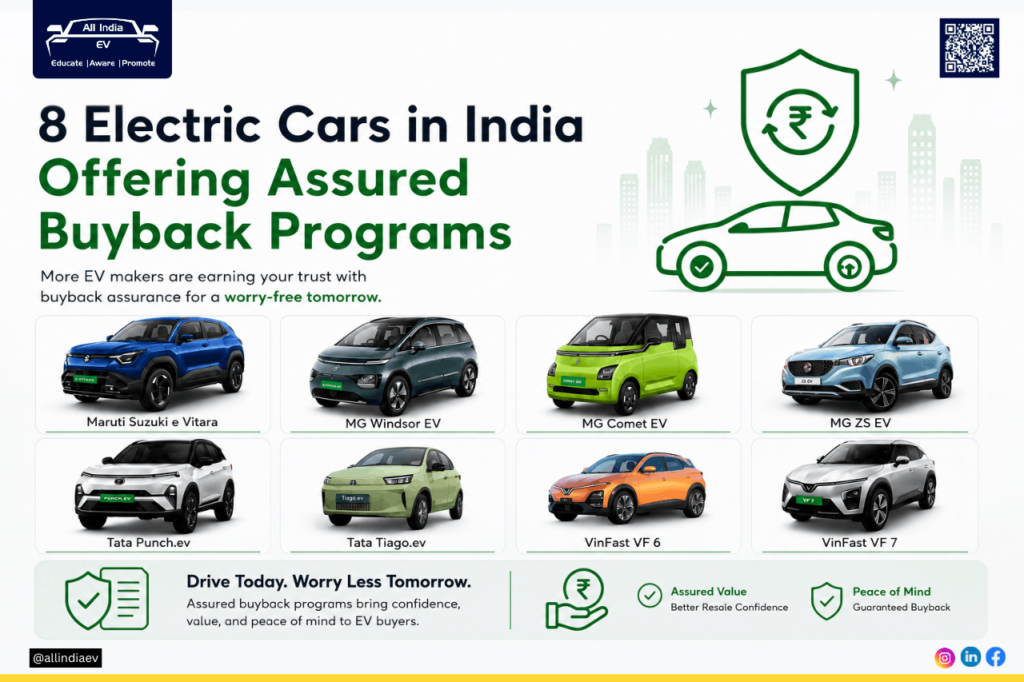
What: Automakers operating in India’s EV market are increasingly introducing assured buyback programs to address concerns around electric vehicle resale values. Brands including Maruti Suzuki, MG Motor, VinFast, and Tata Motors are now offering guaranteed future value schemes across select EV models.
The Number: Buyback values currently range from 40% to 75% of the vehicle’s value, depending on the manufacturer, ownership tenure, mileage conditions, and program terms. VinFast currently offers the highest announced buyback value of up to 75%.
The Impact: Assured buyback schemes are emerging as a strategic tool to reduce depreciation concerns, improve ownership confidence, and accelerate EV adoption among first-time electric vehicle buyers in India.

The Core News
The assured EV buyback schemes in India segment are becoming an important differentiator as automakers compete for market share in the country’s rapidly evolving electric vehicle industry. While battery technology continues to improve and charging infrastructure expands, resale value uncertainty remains one of the biggest barriers preventing many buyers from switching from internal combustion engine vehicles to EVs. Automakers are now responding by guaranteeing a minimum future resale value through structured buyback programs.
More EV News
Among the latest entrants, Maruti Suzuki has launched its e-Vitara with an assured buyback offering that guarantees up to 60% value retention after three years under specified usage conditions. MG Motor continues to expand its Value Promise program across models such as the Windsor EV, Comet EV, and ZS EV, with buyback assurances ranging from 40% to 60% over ownership periods extending up to five years. The company has also expanded the program to commercial EV users, reflecting growing fleet electrification demand.
Meanwhile, VinFast has entered the Indian market with one of the industry’s most aggressive value assurance programs. Its VF 6 and VF 7 electric SUVs offer buyback values of up to 75%, significantly higher than most current market offerings. Tata Motors has also linked buyback benefits to its Battery-as-a-Service (BaaS) models, including the Tiago. ev and Punch. ev, creating lower upfront ownership costs while providing a structured resale pathway. These developments indicate that automakers increasingly view resale assurance as a critical component of EV ownership rather than an optional customer incentive.
Breaking Down the Update
• Maruti Suzuki e-Vitara offers up to 60% buyback value after three years under defined usage limits.
• MG Motor’s Value Promise program provides 40%–60% resale assurance for up to five years.
• VinFast VF 6 and VF 7 offer buyback values of up to 75%, among the highest in India.
• Tata Tiago. EV and Punch. EV offer buyback benefits through Battery-as-a-Service ownership models.
• Commercial EV fleet operators are now being included in certain buyback programs.
• Automakers are using resale guarantees to reduce buyer hesitation and support EV adoption.
How do assured EV buyback schemes in India help the Indian EV Market?
The growth of assured EV buyback schemes in India has the potential to address one of the most persistent challenges facing electric mobility adoption—uncertainty around residual value. Many prospective EV buyers remain concerned about how quickly battery technology evolves and whether their vehicle will retain value in the used car market after several years.
By guaranteeing a predefined resale value, automakers provide customers with greater financial visibility and lower ownership risk. This is particularly important for first-time EV buyers who may be comparing electric vehicles against conventional petrol and diesel alternatives. Predictable resale outcomes also make financing calculations easier and improve total cost of ownership projections.
For fleet operators, buyback programs create clearer asset lifecycle planning and reduce depreciation-related risks. This can accelerate electrification across ride-hailing, delivery, and commercial mobility segments.
As competition intensifies among EV manufacturers, assured buyback programs may become a standard feature rather than a premium offering. If adoption increases across more vehicle categories, assured EV buyback schemes in India could significantly improve consumer confidence and contribute to faster electric vehicle penetration nationwide.
Conclusion & Next Steps
The assured EV buyback schemes in India trend highlights how automakers are moving beyond vehicle sales and focusing on the complete ownership experience. The effectiveness of these programs will ultimately depend on execution, transparency of terms, and actual resale outcomes. As EV adoption grows, guaranteed residual value mechanisms could become a key factor influencing purchase decisions across both private and commercial segments.
Read More: Catch up on All India EV’s related coverage on India’s evolving commercial EV subsidies and battery swapping policies at All India EV