
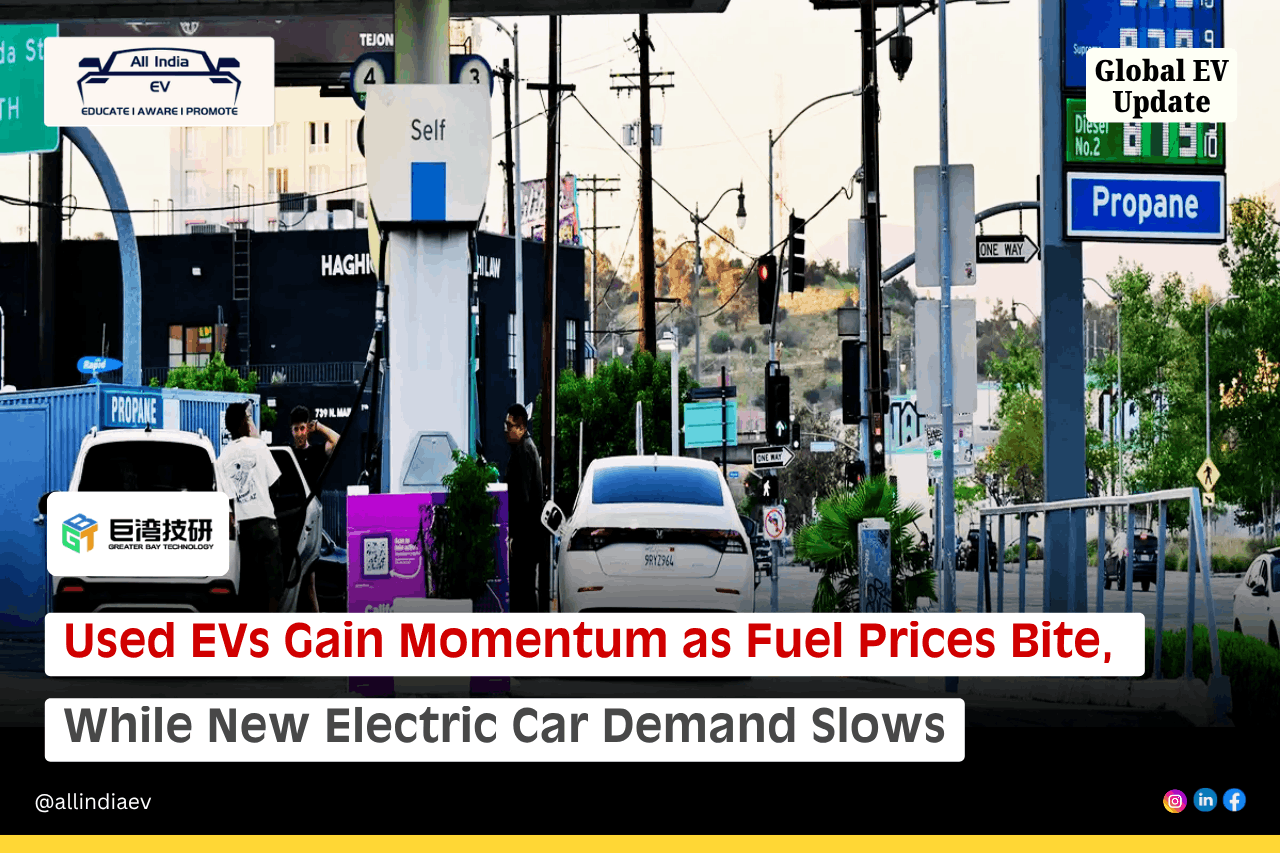

What: Used EV sales charge up on high gas prices, even as new EV demand declines, creating a split market dynamic in the U.S.
The Number: Used EV sales rose 20%+ YoY in Q1 2026, while new EV sales declined significantly (up to ~28% YoY drop in some datasets).
The Impact: Consumers are shifting toward affordability and lower running costs, reshaping EV adoption from premium-led to value-driven.

The Core News
Used EV sales charge up on high gas prices, even as new EV demand declines, highlighting a clear divergence in consumer behavior across the U.S. EV market. While overall EV momentum has weakened due to policy rollbacks and high upfront costs, the secondary EV market is gaining traction as fuel prices surge and affordability becomes a priority.
The shift is largely being driven by economics. High gasoline prices—linked to global supply disruptions—are pushing consumers to reconsider total cost of ownership. At the same time, a growing supply of off-lease electric vehicles has flooded the used market, bringing prices down sharply. Buyers can now access relatively new EVs at prices comparable to conventional used cars, often below $25,000.
In contrast, new EV demand is under pressure. The rollback of federal incentives, high interest rates, and elevated vehicle prices have slowed fresh purchases. Automakers are also recalibrating production strategies, with some shifting focus back to hybrids and ICE vehicles amid uncertain demand recovery. The result is a bifurcated EV market—strong growth in used inventory absorption but declining momentum at the top end.
Breaking Down the Update
• Used EV sales increased over 20% YoY in Q1 2026
• New EV sales declined sharply, with ~25–30% YoY drop reported
• High fuel prices are a primary demand trigger
• Large volumes of off-lease EVs entering the market are reducing prices
• Used EVs now compete directly with ICE vehicles on pricing
• Automakers are slowing EV expansion due to demand uncertainty
More EV News

Way Forward…
Used EV sales charge up on high gas prices, even as new EV demand declines, signaling a structural shift in EV adoption patterns. The near-term market will likely remain price-sensitive, with growth driven by the used segment rather than new vehicle launches. The key variable to watch is policy—any return of incentives or financing support could rebalance demand. Until then, affordability—not innovation—will define EV market expansion.
Read More: Catch up on All India EV’s related coverage on India’s evolving commercial EV subsidies and battery swapping policies at All India EV