
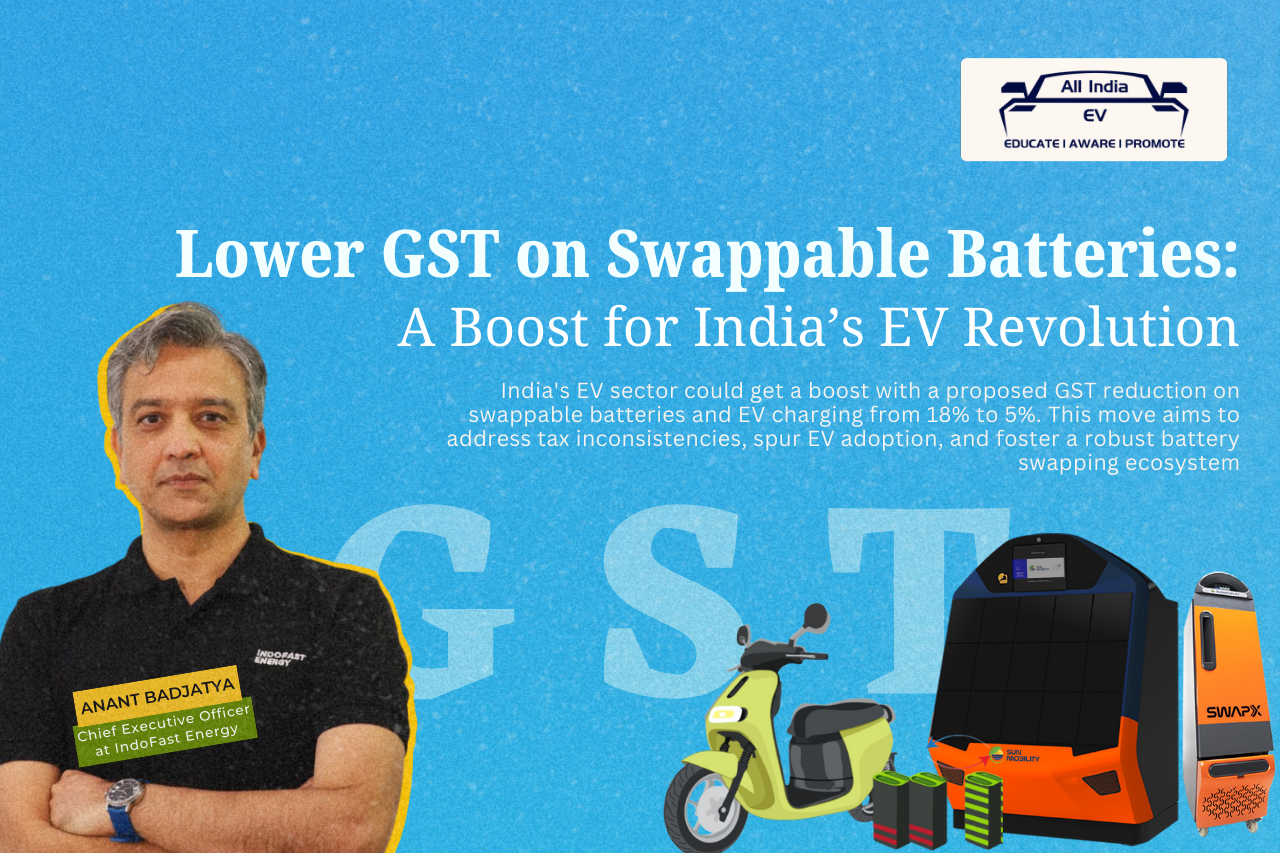


India’s EV sector could get a boost with a proposed GST reduction on swappable batteries and EV charging from 18% to 5%. This move aims to address tax inconsistencies, spur EV adoption, and foster a robust battery swapping ecosystem.
India’s electric mobility sector is experiencing steady growth, supported by government schemes like FAME and
PM E-Drive. As the nation works toward its target of 30% EV penetration by 2030, policy interventions that support sustainable transportation become increasingly important. One such measure worth considering is reducing the GST
on swappable batteries and EV charging from 18% to 5%. This adjustment could help strengthen India’s battery swapping ecosystem and support broader EV adoption while generating employment opportunities.
The current tax framework reveals certain inconsistencies that merit attention. Two-wheelers and three-wheelers currently benefit from a 5% GST rate, while swappable batteries and EV charging stations face an 18% tax burden. Harmonizing these rates at 5% will yield several benefits: improved EV adoption rates, increased consumer savings, a more consistent tax structure, better input tax credit utilization for battery service providers, and support for the emerging battery swapping ecosystem.
Such alignment could help the EV sector maintain its growth trajectory toward the projected 59% compound annual growth rate, potentially bringing 20 million EVs to Indian roads by 2030. The employment implications are significant — creating 5 million direct jobs and 30 million indirect opportunities in the green economy.
The timing is particularly relevant as discussions continue around reducing GST on conventional two-wheelers from 28% to 18%. Maintaining a competitive advantage for clean technology through a 5% GST on swappable batteries would help preserve incentives for EV adoption and support India’s decarbonization objectives.
Supporting the Gig Economy Through Policy Reform
Battery leasing services face practical challenges under the current tax regime. Service providers typically require 18-24 months to recover input credits—a significant working capital burden that policy reform could alleviate. The financial impact is substantial: reducing GST from 18% to 5% on a battery would save per unit. For companies managing one million batteries, this could free up over $65 million in working capital for infrastructure development and service expansion.
More EV News

These savings would benefit India’s gig workforce, including delivery partners and drivers who rely on affordable transportation for their livelihoods. Lower operational costs make sustainable transportation more accessible and economically viable for this crucial segment of the economy.
Swappable Batteries: A Practical Solution for Indian Markets
Swappable batteries offer certain advantages that align with Indian market conditions. The two-minute battery swap process mirrors familiar refueling patterns, requiring minimal behavioral adjustment from consumers. This compatibility with existing habits can facilitate adoption among price-sensitive users.
Additionally, compact swappable batteries can help reduce India’s reliance on critical mineral imports, contributing to energy security while lowering import costs.
Infrastructure limitations also favor the swappable battery model. With India having one public charger per 135 EVs—well below global average—battery swapping stations provide an alternative that doesn’t strain residential electrical systems. As housing societies face increasing demand for charging infrastructure, swappable batteries offer a solution that enables EV growth without requiring extensive upgradation of existing infrastructure.
Environmental Benefits Through Structured Ownership
The swappable battery model provides environmental advantages through its ownership structure. When service providers retain ownership throughout the battery lifecycle, proper disposal and recycling become more manageable and systematic. This closed-loop approach helps ensure batteries are utilized efficiently and processed responsibly at end-of-life.
While some may question whether these batteries could have alternative applications, their specialized design for two and three-wheelers makes them unsuitable for other uses like mobile phones, four-wheelers, or telecommunications infrastructure. This focused application ensures they serve their intended purpose within India’s mobility ecosystem.
A Measured Path Forward
Reducing GST on swappable batteries and charging to 5% represents a practical policy adjustment that could support India’s sustainable mobility objectives. This change would create better alignment between tax policy and environmental goals while supporting the development of battery swapping infrastructure.
India has established momentum in the EV sector, and thoughtful policy measures can help maintain this progress. The proposed 5% GST rate on swappable batteries offers a balanced approach to supporting EV adoption, creating employment opportunities, and advancing sustainable transportation goals. It represents a meaningful step toward building a more sustainable mobility ecosystem that benefits both the economy and the environment.
Authored by Anant Badjatya, CEO, Indofast Energy.