
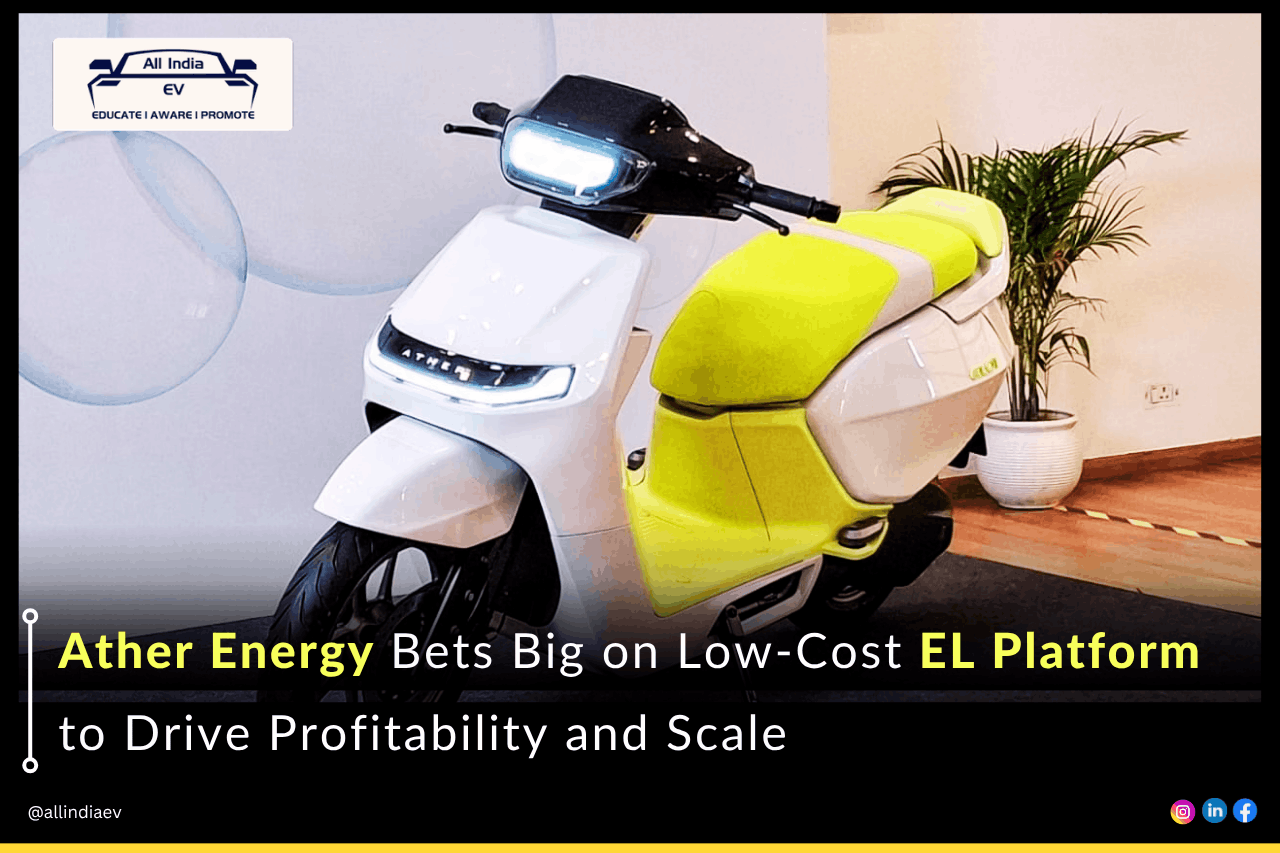

What: Ather Energy is preparing to launch its low-cost EL scooter platform while accelerating work on its new Submanager manufacturing facility. The company says the new architecture is designed to improve profitability and expand into the ₹1 lakh–₹1.25 lakh electric scooter segment.
The Number: Factory 3.0 is planned with a total annual production capacity of 10 lakh units, with Phase 1 alone expected to add 5 lakh units annually.
The Impact: The upcoming Ather Energy EL platform could significantly alter Ather’s cost structure by reducing dependence on expensive materials such as aluminium and copper. It also positions the company to compete more aggressively in India’s high-volume electric scooter market.

The Core News
The Ather Energy EL platform marks a strategic shift for the Bengaluru-based EV manufacturer as it moves beyond the premium scooter segment into more price sensitive territory. The company confirmed that the platform has been engineered with lower manufacturing costs in mind, including the transition from aluminium-heavy structures to steel frames and a simplified drivetrain setup. According to company executives, the platform is expected to support scooters priced between ₹1 lakh and ₹1.25 lakh, which currently represents one of the largest segments in India’s electric two-wheeler market.
Alongside the platform rollout, Ather is scaling its manufacturing footprint through its new Factory 3.0 facility at Chhatrapati Sambhajinagar in Maharashtra. The plant is expected to handle battery pack assembly, electronics assembly, transmission systems, painting, and coating operations in-house. This higher level of vertical integration is expected to improve production efficiency and strengthen unit economics at a time when raw material volatility continues to pressure EV manufacturers globally.
The EL architecture is also expected to broaden Ather’s product portfolio beyond its current 450 and Rizta scooter lines. Company management indicated that the platform can support multiple scooter formats, battery sizes, wheel configurations, and performance categories. Analysts tracking the sector believe the new platform could expand Ather’s total addressable market substantially while helping the company move closer to operating profitability.
More EV News

Breaking Down the Update
• The Ather Energy EL platform targets the ₹1 lakh–₹1.25 lakh electric scooter segment
• The platform reduces reliance on aluminium and copper-heavy components
• Factory 3.0 Phase 1 is expected to add 5 lakh units of annual production capacity
• The Sambhajinagar plant will increase vertical integration through in-house assembly operations
• Ather’s current Hosur plant is reportedly operating at nearly full utilisation
• EL-based scooters are expected around the 2026 festive season timeline
• The platform may support multiple scooter variants across commuter and premium segments
• Ather reported FY26 revenue growth of 63% while reducing annual losses significantly
How Ather Energy EL platform will help Indian EV Market
The Ather Energy EL platform could become an important development for India’s electric scooter ecosystem because it directly addresses the affordability gap that still limits EV penetration outside premium urban buyers. Ather has traditionally focused on performance-oriented and feature-rich scooters, but the Indian market continues to be dominated by cost-sensitive consumers looking for practical mobility solutions in the ₹1 lakh range.
By shifting toward steel frames, simplified transmissions, and more cost-efficient manufacturing processes, Ather may reduce production expenses without completely sacrificing software integration and connected features. This matters because rising raw material costs have affected profitability across India’s EV industry over the last two years.
The new platform also aligns with increasing localisation and manufacturing integration trends. The Sambhajinagar facility’s in-house battery pack assembly and electronics production could improve supply chain stability while reducing dependence on external vendors. This becomes especially important as competition intensifies among legacy manufacturers and EV startups.
If executed properly, the Ather Energy EL platform could help expand EV adoption beyond metro cities into Tier-2 and Tier-3 markets where pricing remains the biggest purchase factor. It may also push competitors to rethink pricing and manufacturing efficiency strategies across the electric two-wheeler segment.
Way Forward ….
The Ather Energy EL platform represents more than just another scooter launch. It is a broader attempt to improve margins, increase manufacturing scale, and capture India’s fast-growing mass-market EV segment. The next major milestones will be timely commissioning of Factory 3.0, execution of cost reduction targets, and how aggressively Ather prices its first EL-based products in a highly competitive market.
Read More: Catch up on All India EV’s related coverage on India’s evolving commercial EV subsidies and battery swapping policies at All India EV