

What Happened:
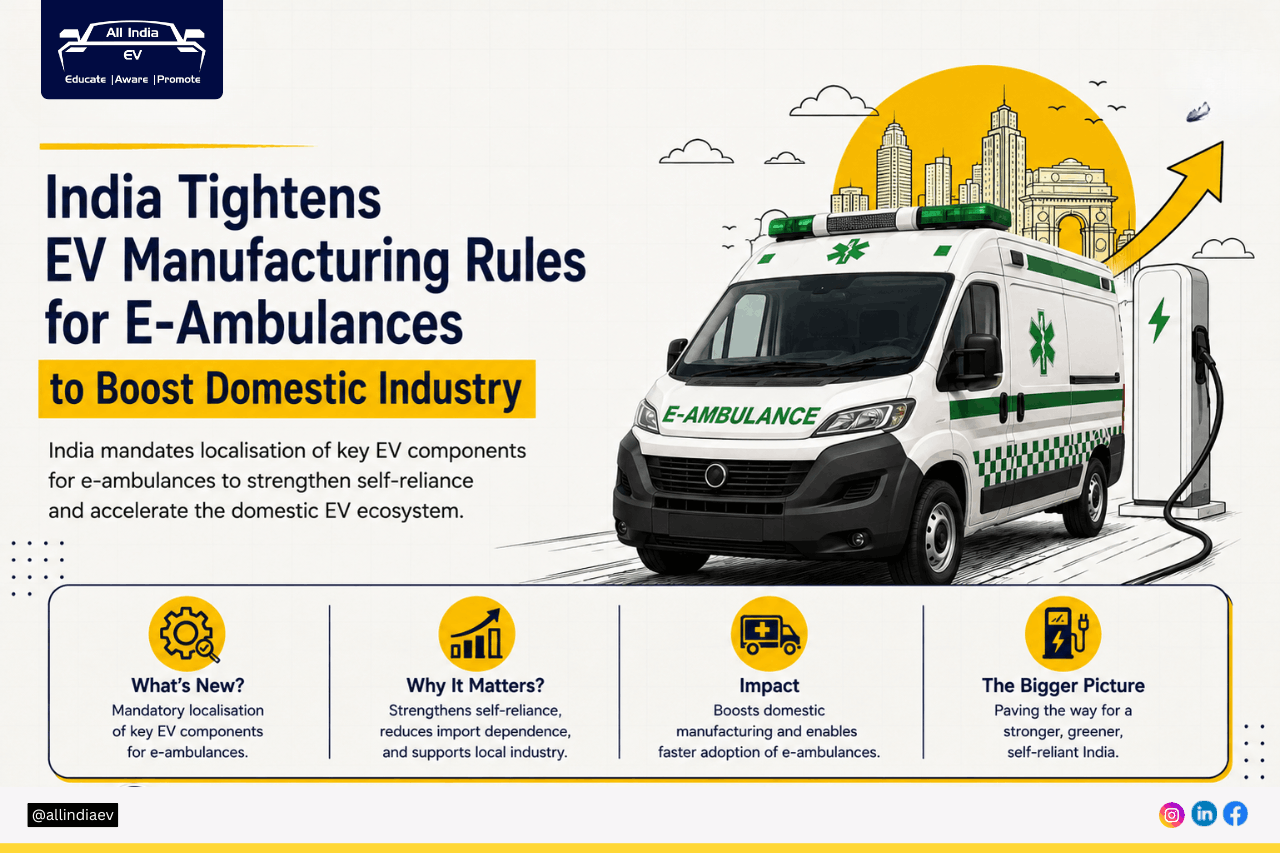
The Union government has introduced a phased manufacturing programme (PMP) for electric ambulances, making the domestic manufacturing of several critical EV components mandatory. The move is aimed at increasing local value addition while reducing India’s dependence on imported electric vehicle systems.
Why It Matters:
The policy strengthens the government’s localisation strategy for the emerging e-ambulance segment. It also aligns domestic manufacturing requirements with India’s broader EV and industrial development goals.

The Core News
The Facts
- e-ambulance localisation programme requires manufacturers to produce key EV components domestically.
- The Ministry of Heavy Industries has notified phased localisation requirements for critical electric vehicle systems.
- Mandatory localisation covers traction battery packs, Battery Management Systems (BMS), traction motors, motor controllers, Vehicle Control Units (VCUs), DC-DC converters, instrument clusters and on-board chargers.
The Context
- The notification forms part of the government’s phased manufacturing programme for electric ambulances.
- Traction battery packs must be manufactured in India from the date of notification.
- Imported battery modules will not be permitted under the localisation framework.
The Significance
- The policy is expected to encourage investment across India’s EV component supply chain.
- Domestic manufacturing requirements could reduce long-term dependence on imported high-value EV components.
- The programme provides a manufacturing roadmap for companies planning to enter the e-ambulance market.
🔹 Breaking Down the Update
- Battery Packs: Local manufacturing becomes mandatory immediately after the notification.
- Battery Modules: Imports of battery modules are not permitted under the new framework.
- Battery Assembly: Local production must include cell-to-cell connections, bus bar fitment, wiring, connector integration, thermal management systems, safety devices, BMS integration and enclosure fitment.
- Critical Components: Motors, motor controllers, VCUs, DC-DC converters, instrument clusters and on-board chargers are covered under phased localisation.
- Policy Objective: The programme aims to increase domestic value addition and reduce import dependence in the electric ambulance segment.
🔹 How e-ambulance localisation programme Will Help the Indian EV Market
The e-ambulance localisation programme extends India’s localisation strategy into one of the newest commercial EV segments. By requiring manufacturers to source and produce major vehicle systems domestically, the government is encouraging suppliers to build manufacturing capabilities within the country rather than relying on imports.
For component manufacturers, the policy creates fresh opportunities across battery pack assembly, power electronics, electric drivetrains and vehicle control systems. This could encourage new investments in production facilities and strengthen India’s EV supplier ecosystem.
Original equipment manufacturers (OEMs) may also benefit from a more predictable domestic supply chain as localisation improves. Reduced dependence on imported components can help mitigate global supply-chain disruptions while supporting faster procurement for specialised emergency vehicles.
From a policy perspective, the programme complements India’s broader Make in India and EV manufacturing initiatives by promoting higher domestic value addition. As demand for electric ambulances grows under government procurement programmes, manufacturers with established local supply chains could be better positioned to meet future requirements.
More EV News

Over the longer term, stronger localisation across critical EV systems may also enhance India’s competitiveness as a manufacturing hub for specialised electric commercial vehicles.
🔹 Conclusion & Next Steps
The introduction of the e-ambulance localisation programme marks another step in India’s effort to build a self-reliant electric mobility ecosystem. The immediate localisation requirement for traction battery packs and the restriction on imported battery modules signal a stronger policy push toward domestic manufacturing. The next phase will depend on how quickly manufacturers and suppliers expand local production capabilities while maintaining quality, cost competitiveness and supply-chain readiness.
Read More: Catch up on All India EV’s related coverage on India’s evolving commercial EV subsidies and battery swapping policies at All India EV