
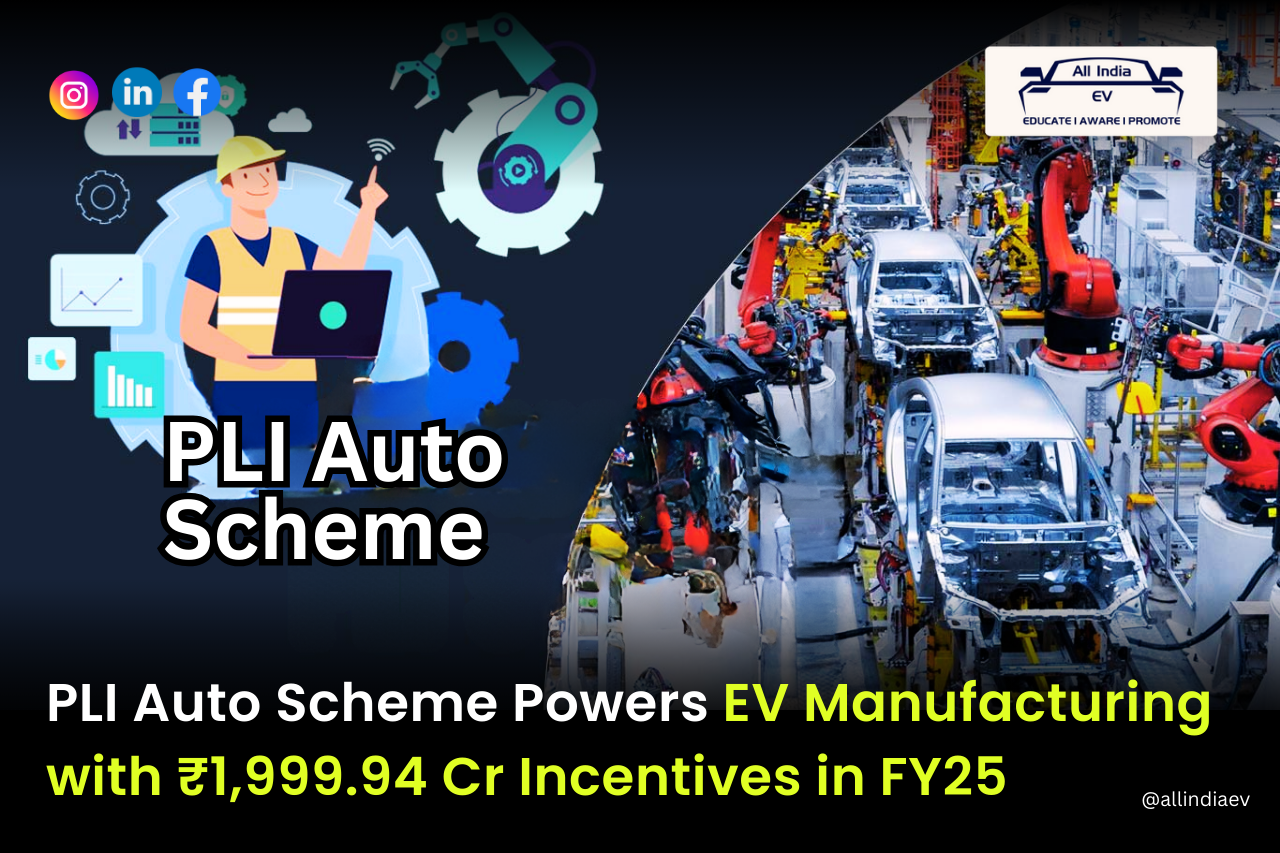

₹19,994 crore is a large number. Released under the PLI Auto scheme in FY25, it signals intent, follow-through, and administrative momentum. But for anyone actually running an EV P&L, building factories, or planning supply chains in India, the real question isn’t how much was released—it’s what this release structurally changes.
- 1. The Signal Is Strong. The Constraint Has Shifted.
- 2. Incentives Reward Output, Not System Health
- 3. EV Manufacturing ≠ EV Ecosystem Readiness
- a) Grid & Utilities
- b) Skilled Labour
- c) Aftermarket & Lifecycle Economics
- 4. Capital Is Flowing—But Not Always Smart Capital
- 5. What This Means for Decision-Makers
- Final Thought: PLI Is a Lever, Not a Strategy
- Author’s Comment
This isn’t about EV optimism. It’s about execution physics.
1. The Signal Is Strong. The Constraint Has Shifted.
PLI disbursement removes one uncertainty: policy credibility. For the first time since the scheme’s announcement, capital planners can point to actual cash flow, not promises.
That matters. Especially for large OEMs like Tata Motors and Mahindra & Mahindra, and Tier-1s who need confidence before locking long-cycle investments in motors, power electronics, and platform localisation.
But here’s the shift many miss:
The binding constraint for EV manufacturing in India is no longer incentive certainty. It’s execution depth.
PLI solved the whether. It hasn’t solved the how fast, how integrated, or how resilient.
More EV News
2. Incentives Reward Output, Not System Health
PLI is output-linked by design. That’s logical. But it also creates second-order effects that are now becoming visible:
- OEMs optimise for eligible SKUs, not necessarily system efficiency
- Suppliers prioritise PLI-aligned volumes over long-term R&D
- Capital flows faster into assembly and integration than into deep component IP
This explains a paradox senior leaders are already debating internally:
Why manufacturing capacity is rising faster than manufacturing sophistication.
Battery packs? Improving.
BMS logic? Still imported or lightly adapted.
Motor controllers? Local assembly, limited algorithmic control.
Semiconductor exposure? Barely dented.
PLI money lands after production. It doesn’t underwrite the riskiest part of the value chain—the part that fails quietly before scale.
3. EV Manufacturing ≠ EV Ecosystem Readiness
Another uncomfortable truth: manufacturing success is now running ahead of ecosystem readiness.
We see it in three places:
a) Grid & Utilities
EV output is rising faster than coordinated demand planning with utilities. Peak-load stress is a 2026–27 problem, not a distant one. Yet grid-linked incentives remain weakly coupled to manufacturing incentives.
b) Skilled Labour
Factories are being built faster than control engineers, thermal specialists, and embedded systems talent can be developed or retained. Skill shortages don’t show up in incentive dashboards—but they cap quality and yield.
c) Aftermarket & Lifecycle Economics
PLI rewards production, not uptime. Yet fleet operators increasingly care about TCO volatility, software reliability, and serviceability. Manufacturing incentives don’t penalise poor lifecycle performance.
This gap will matter more than sticker prices.
4. Capital Is Flowing—But Not Always Smart Capital
The release of ₹19,994 crore will unlock follow-on private capital. That’s inevitable.
But here’s the harder question boards should be asking:
Are we deploying this capital to reduce long-term structural risk—or just to scale faster?
Scaling without:
- battery mineral hedging,
- power electronics IP,
- or software-defined vehicle capability
…creates a fragile growth curve. Fast, but brittle.
India risks building capacity-led competitiveness, not capability-led resilience.
5. What This Means for Decision-Makers
If you’re an OEM, supplier, policymaker, or utility planner, the PLI release should trigger different questions, not celebration:
- Should the next incentive tranche be partially capability-linked, not just output-linked?
- How do we align EV manufacturing growth with grid modernisation timelines?
- Are we measuring localisation by bill of materials, or by control over failure modes?
- What happens when incentives taper—but global competition intensifies?
These are not theoretical. They determine whether India exports EVs—or merely assembles them competitively for a few years.
Final Thought: PLI Is a Lever, Not a Strategy
The FY25 disbursement proves the Indian state can execute at scale. That’s no small thing.
But PLI is a lever, not a system.
The next phase of EV leadership will be decided not by incentive size, but by:
- engineering depth,
- ecosystem coordination,
- The willingness to fund what doesn’t show immediate output.
The industry now has momentum. The harder work—turning momentum into durable advantage—starts here.
Author’s Comment
The ₹19,994 crore PLI Auto disbursement proves intent and restores policy credibility—but it doesn’t resolve the harder problem. Incentives have removed whether India’s EV manufacturing will scale; they haven’t answered how deeply it will integrate, localise, or endure once incentives taper.
Capacity is rising faster than capability, output faster than ecosystem readiness. PLI is a powerful lever—but unless the next phase rewards engineering depth, grid alignment, and control over failure modes, India risks building fast, fragile scale rather than durable EV leadership.