
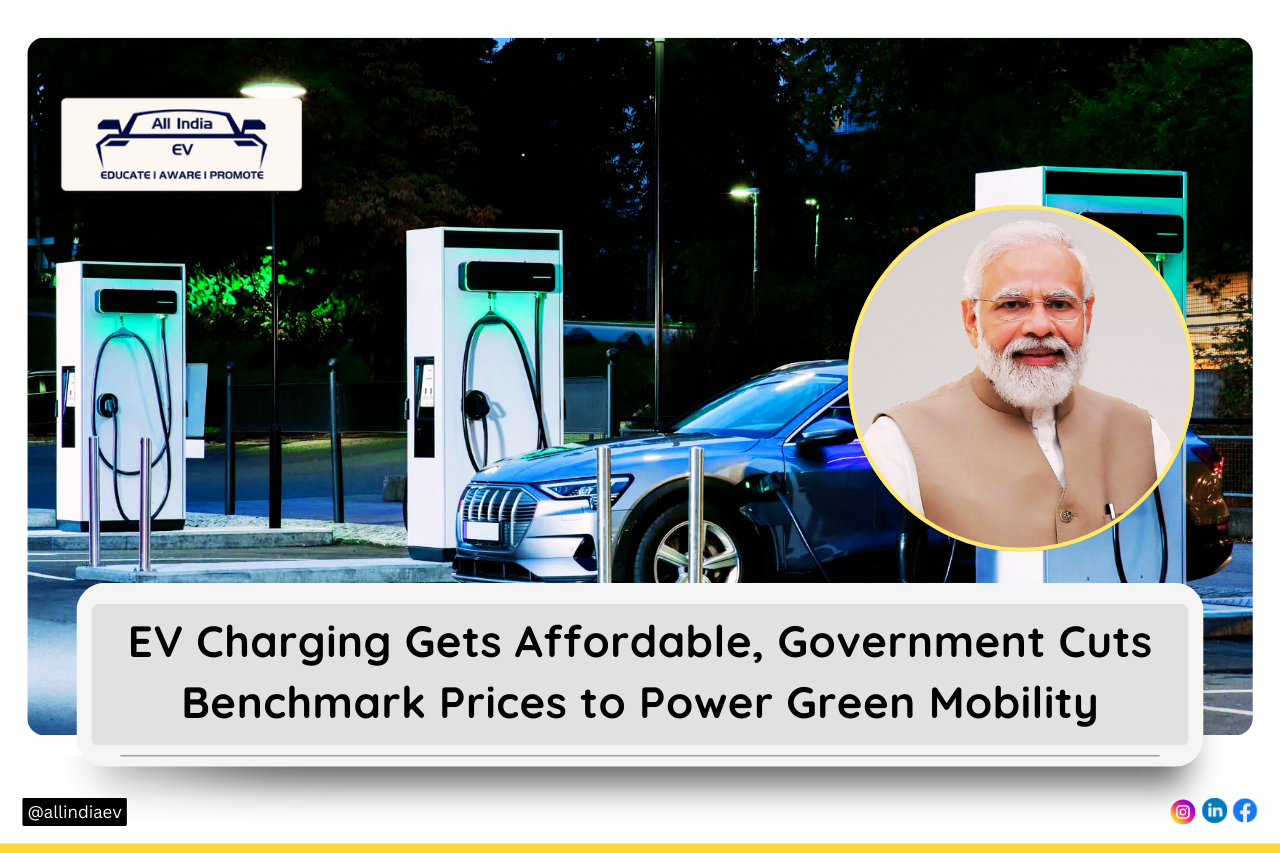

Revised benchmarks cut costs by up to 28%, align subsidies with market rates, and encourage private investment in charging infrastructure
In a significant step to strengthen India’s electric mobility ecosystem, the central government has sharply reduced benchmark prices for electric vehicle (EV) chargers. The move is expected to lower subsidy outgo, reflect falling equipment costs, and speed up the expansion of public charging infrastructure across the country.
According to officials cited in recent reports, the Ministry of Heavy Industries (MHI) has revised the benchmark costs for EV chargers of multiple capacities after observing a steep decline in hardware prices and intensifying competition among domestic and global manufacturers. These benchmark prices are used by the government to determine subsidy levels under various EV support schemes, including the PM E-Drive programme, which focuses on accelerating EV adoption and charging infrastructure deployment.
Under the revised structure, the benchmark price for a 60 kW charger has been cut by 28%, while the 30 kW charger has seen a reduction of 17%. The 120 kW fast charger benchmark has also been lowered by around 13%. Industry sources noted that these cuts bring government reference prices much closer to prevailing market rates, correcting the gap created when earlier benchmarks were set in 2022, a time when charger equipment was significantly more expensive.
As per estimates shared by industry executives, the benchmark cost for a 100 kW charger has now been reduced to around ₹13 lakh, compared with nearly ₹18 lakh earlier. This downward revision is expected to optimize subsidy allocations, as government incentives are calculated based on benchmark prices. In some categories, subsidies have previously been structured to cover the full cost of chargers, particularly in the 50 kW and 100 kW segments. With the revised benchmarks, the overall fiscal burden on the exchequer is likely to come down, allowing funds to be spread across a larger number of installations.
Operators and charging infrastructure developers believe the policy shift will also encourage more private participation in the sector. By aligning subsidy support with actual market prices, the government is sending a signal that the charging ecosystem is moving towards commercial maturity, where private investments can play a larger role without excessive dependence on state support. This could lead to faster deployment of chargers in urban centres, highways, and tier-2 and tier-3 cities, where charging access remains limited.
India currently has around 29,200 public EV charging stations, according to official data. While this marks steady progress, the pace of infrastructure rollout needs to accelerate to keep up with the rapid growth in EV adoption. The government has been focusing on building a dense and reliable charging network, particularly to support the fast-growing two-wheeler, three-wheeler, and passenger vehicle segments.
More EV News
EV adoption in India has been rising sharply, with penetration increasing from about 1.3% in FY22 to nearly 4.7% in FY24. This growth has been driven by a combination of declining vehicle prices, supportive government policies, and expanding charging infrastructure. The revised charger benchmarks are expected to further reinforce this momentum by reducing project costs and improving the viability of charging businesses.
Overall, the reduction in EV charger benchmark prices reflects the evolving maturity of India’s EV ecosystem. With falling technology costs and stronger competition among manufacturers, policymakers are recalibrating support mechanisms to ensure efficient use of public funds, while continuing to push towards the country’s broader goals of clean mobility and decarbonisation.
Comment by Author:
The government’s decision to revise EV charger benchmark prices is a timely policy correction that reflects how quickly the charging technology market is maturing. By aligning subsidies with current market rates, the move can help optimise public spending while unlocking greater private sector participation in charging infrastructure.
If implemented alongside faster approvals and supportive state-level policies, the revised benchmarks could play a meaningful role in closing India’s charging infrastructure gap and sustaining the momentum of EV adoption across cities and highways.