
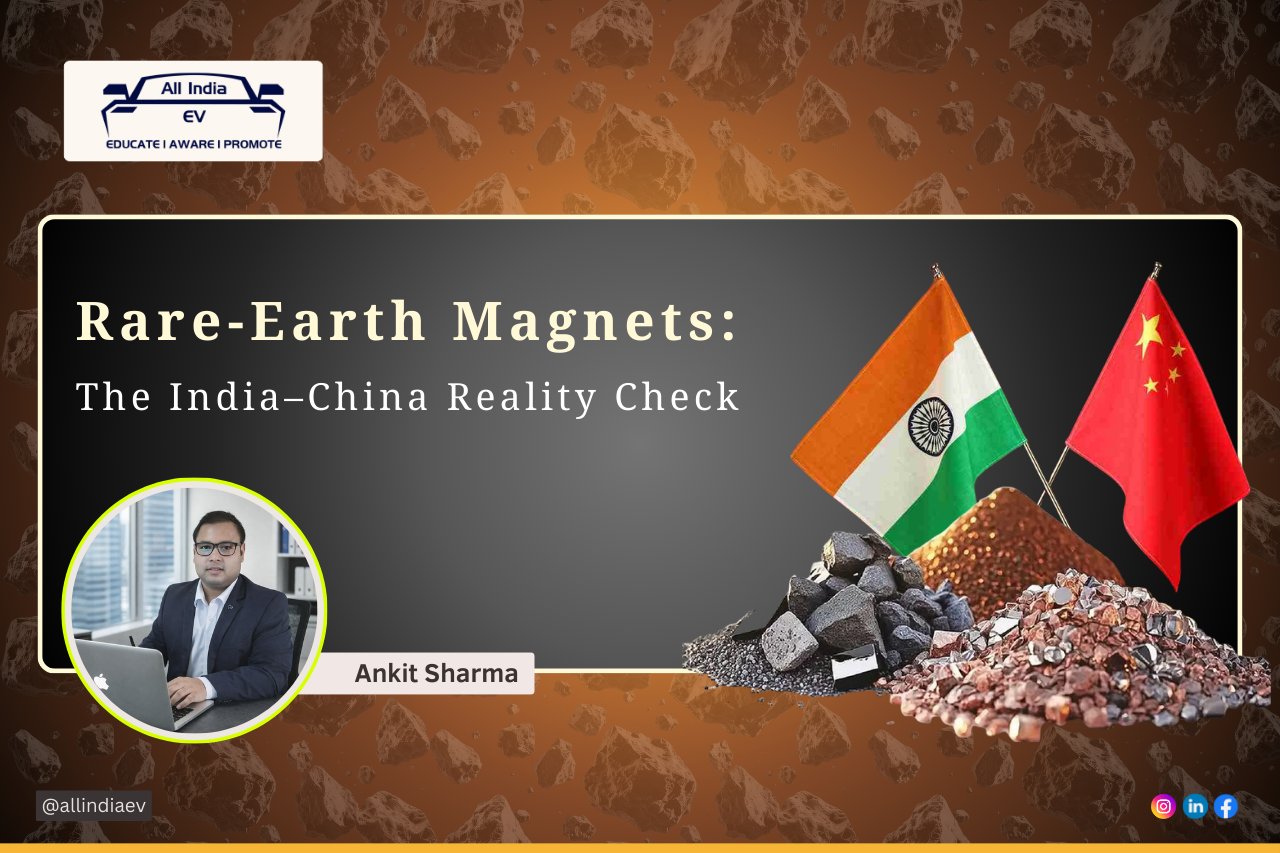

If you want a clean metaphor for how geopolitics enters your motor, your wind turbine, and your defence supply chain, look at rare-earth permanent magnets (REPMs), especially NdFeB magnets. These aren’t “materials”. They’re industrial leverage.
China doesn’t need to blockade ships to squeeze the world. It just needs to slow-walk export licences on dysprosium/terbium-heavy magnet grades and watch EV and electronics supply chains start sweating.
Why this matters: magnets are a bottleneck, not a commodity
High-performance permanent magnets sit inside:
- EV traction motors (especially high-temperature, high-power-density designs)
- Wind turbines (direct-drive designs particularly)
- Robotics, aerospace, defence, precision industrial drives
And the uncomfortable part: the choke point isn’t mining alone, it’s processing + separation + magnet-making.
Global assessments repeatedly point to China’s control across the value chain, including ~70% approx. of processing/refining capacity in many segments.
CY2024: Beijing rehearses the playbook
More EV News

CY2024 was not “the rare-earth year” headline-wise, but it was the year the control architecture hardened.
China tightened the critical-minerals export posture through 2023–2024 waves (gallium, germanium, graphite, antimony etc.), and by Dec 2024 the direction was explicit: this is a strategic toolkit tied to tech and national-security competition.
What changed in market psychology in 2024:
- OEMs and Tier-1s stopped treating “China concentration” as a cost issue and started treating it as availability risk.
- The question moved from “what’s the price?” to “will the shipment clear?”
That shift is exactly what export controls are designed to create.
CY2025: Rare-earths move from leverage to live-fire
CY2025 is where the magnet story turned operational.
Multiple credible analyses point to China’s April 2025 export control move covering selected rare earth elements and related magnets/compounds, with export volumes reportedly falling sharply in the immediate months, creating downstream stress for manufacturers.
This isn’t always an “outright ban”. It’s often licensing + uncertainty, which is worse for factories than a simple tariff because it breaks planning.
India’s position in 2024–2025: importer first, manufacturer later
Here’s the hard dependency India walked into:
- India imported ~53,000 tonnes (approx.) of finished permanent magnets in 2024–25, with ~90% approx. sourced from China, plus ~3,000 tonnes (approx.) of rare-earth metal.
- Reuters also reported India imports ~53,000 tonnes (approx.) annually and lacks domestic magnet manufacturing at scale.
So yes, we can talk about “Atmanirbhar magnets” all day, but the baseline is dependency by design.
What steps India took in CY2025 (the “oh, this is real” year)
1) India tried to conserve domestic rare earth output
A key 2025 datapoint: Reuters reported India asked state miner IREL to suspend rare-earth exports to Japan to conserve supply domestically, since India was exposed to global disruptions triggered by China’s restrictions.
IREL’s exports to Toyota Tsusho (2012 agreement) were reported as about one-third of its output in that arrangement.
Translation (non-PR version): India realised it was exporting upstream material while importing downstream magnets. That’s not a supply chain. That’s a leak.
2) Building magnet-making, not just mining
IREL states it is setting up a Rare Earth Permanent Magnet (REPM) plant at Visakhapatnam (Vizag) based on indigenous technology.
This is directionally right, but the execution questions start immediately:
- What is the nameplate capacity, commissioning date, and product mix (NdFeB vs SmCo)?
- Are we building sintered magnets suitable for traction motors and wind, or low-end grades?
- Where do Dy/Tb and separation technologies come from, given China’s tightening controls?
3) National-level schemes (late 2025, but triggered by 2025 stress)
India approved a ₹7,280 crore scheme to promote sintered REPM manufacturing with 6,000 MTPA integrated capacity across the chain (oxides to finished magnets).
This is the first time the response looks like a system rather than a press note.
But 6,000 MTPA only matters if:
- it is actually integrated, not assembled from imported intermediate products,
- it achieves quality + yield + coercivity needed for high-temp motors,
- and it has bankable offtake from EV OEMs, wind OEMs, and defence.
The uncomfortable questions All India EV should ask (because nobody else will)
1) Is India solving “magnets” or just building a brochure plant?
A permanent magnet facility without competitive separation, metal-making, alloying, and powder metallurgy is basically import substitution theatre.
If the plant depends on Chinese-origin oxide/metal inputs, you haven’t diversified. You’ve moved the dependency upstream.
2) Who will buy Indian magnets if China undercuts on price again?
China has played this game before: allow alternatives to scale, then reopen flows and crush margins.
So India needs procurement strategy, not just capacity:
- anchor offtake via defence + rail + wind tenders
- qualification support for EV OEMs (testing, durability, thermal behaviour)
- clear rules on domestic value addition thresholds
3) Are we investing enough in recycling and scrap loops?
Magnets are unusually recyclable compared to many “critical minerals” narratives. If India imported ~53,000 tonnes (approx.) of magnets in 2024–25, that’s future scrap inventory.
Recycling won’t replace primary supply overnight, but it reduces exposure to “licence shocks”.
4) Does India have a realistic timeline?
Building high-grade sintered NdFeB at global quality is not just capex. It’s process discipline:
- oxygen control, grain boundary diffusion, coating reliability,
- yield curves,
- IP + equipment ecosystem.
A policy outlay is not a factory, and a factory is not stable output.
What the 2024–2025 arc actually tells us
CY2024 was the quiet build-up: control regimes matured.
CY2025 was the stress test: export controls hit magnets and forced countries to react fast.
India’s response has started to shift from “we have rare earths” to “we need magnets”, which is the correct mental model. The schemes and conservation moves suggest Delhi finally understands the difference between:
- owning ore, and
- owning industrial capability.
Now the real test: delivery.
If All India EV wants to lead this narrative, the editorial line should be blunt:
India’s rare-earth magnet problem is not a mining problem. It’s a midstream manufacturing, technology, and procurement problem.
And that’s where the story gets interesting, because that’s where execution fails most often.
Author By- Ankit Sharma