


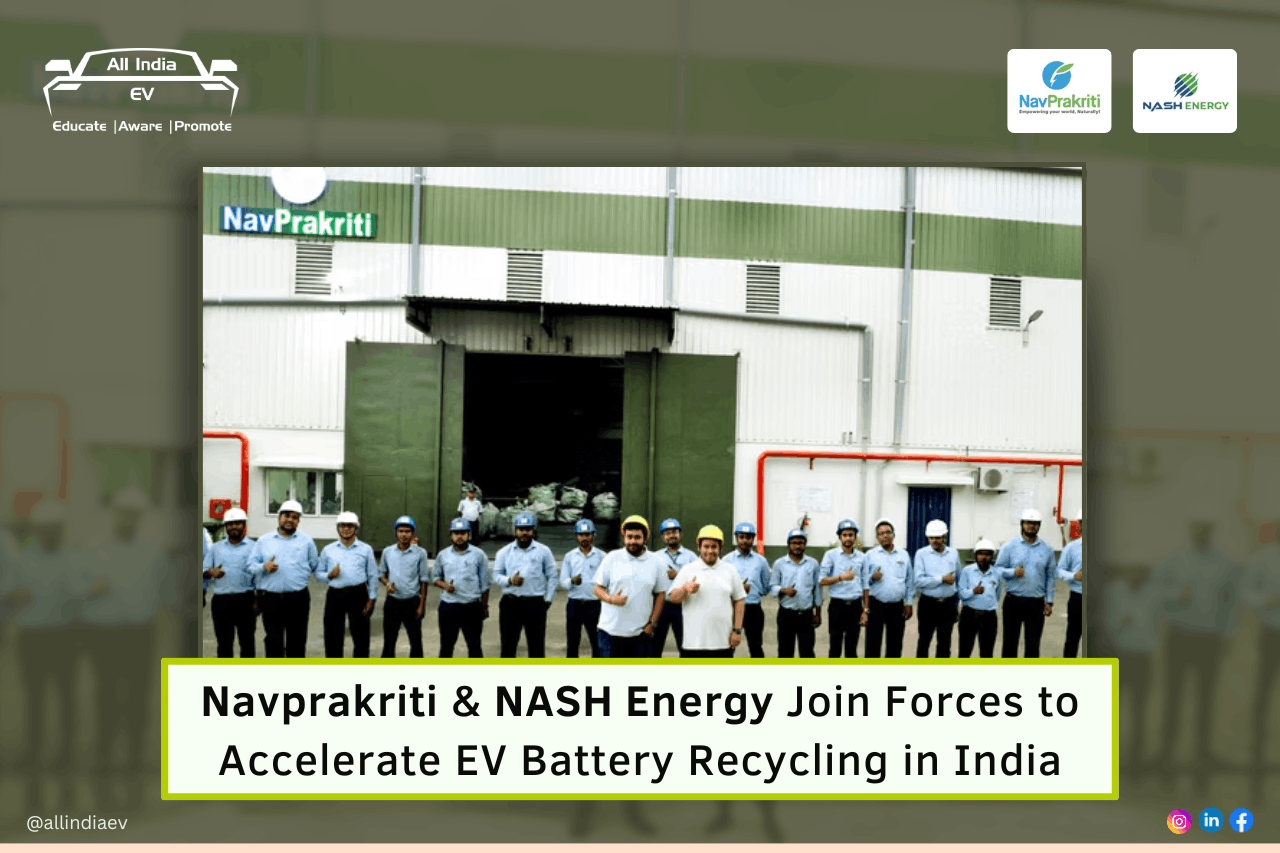
NavPrakriti Green Energies Pvt. Ltd. and NASH Energy have entered into a strategic partnership to strengthen closed-loop battery lifecycle management in India. The collaboration is aimed at ensuring responsible end-of-life management for lithium-ion batteries produced by NASH Energy, including production scrap generated during manufacturing.
Under this partnership, NavPrakriti will support recycling and material recovery using its battery recycling capabilities, while NASH Energy will integrate responsible disposal and circularity into its battery manufacturing operations. The move also aligns with India’s growing focus on Extended Producer Responsibility, or EPR, which is becoming increasingly important as EV battery volumes rise across the country.

One of the notable aspects of this development is NavPrakriti’s recycling infrastructure at Serampore, which can currently process around 1,000 tonnes of spent batteries per month. That gives this partnership immediate operational relevance, instead of remaining just a policy-aligned announcement on paper.
As battery adoption grows across electric two-wheelers, three-wheelers, passenger EVs, and stationary storage, the question is no longer just about battery manufacturing capacity. The bigger question is what happens after the battery reaches end of life. This is where partnerships like NavPrakriti and NASH Energy matter. They connect manufacturing with recovery, compliance, and resource circularity in a more structured way.
India’s EV transition will eventually depend not just on how many batteries it can deploy, but also on how efficiently it can recover critical minerals and reduce waste. Lithium, nickel, cobalt, and other valuable materials locked inside spent batteries represent both an environmental responsibility and a future supply-chain opportunity. This partnership signals that parts of the Indian battery ecosystem are beginning to think beyond first-life sales and toward full lifecycle accountability.
How this will help Indian EV Market
This partnership can help the Indian EV market in a very practical way. India is scaling EV adoption, battery manufacturing, and energy storage at the same time, but the recycling ecosystem is still at a relatively early stage. When companies like NavPrakriti and NASH Energy create a closed-loop system, they help the market prepare for the next phase of EV growth, where battery retirement, scrap recovery, and raw material reuse become mission-critical.
For India, this matters on three levels.
More EV News

First, it strengthens resource security. India still depends heavily on imported battery materials and cell components. Efficient recycling can help recover part of that value domestically and reduce pressure on imports over time.
Second, it improves regulatory readiness. EPR compliance is not just a box to tick. It will increasingly shape how battery makers, OEMs, and storage players design their business models. A formal recycling tie-up gives manufacturers a more credible compliance pathway.
Third, it supports long-term investor confidence in India’s EV value chain. A mature EV market cannot run only on vehicle sales and battery production. It also needs reverse logistics, recycling capacity, material recovery, and environmental accountability. That is how India can move from being just an EV demand market to becoming a more complete and resilient battery economy.