
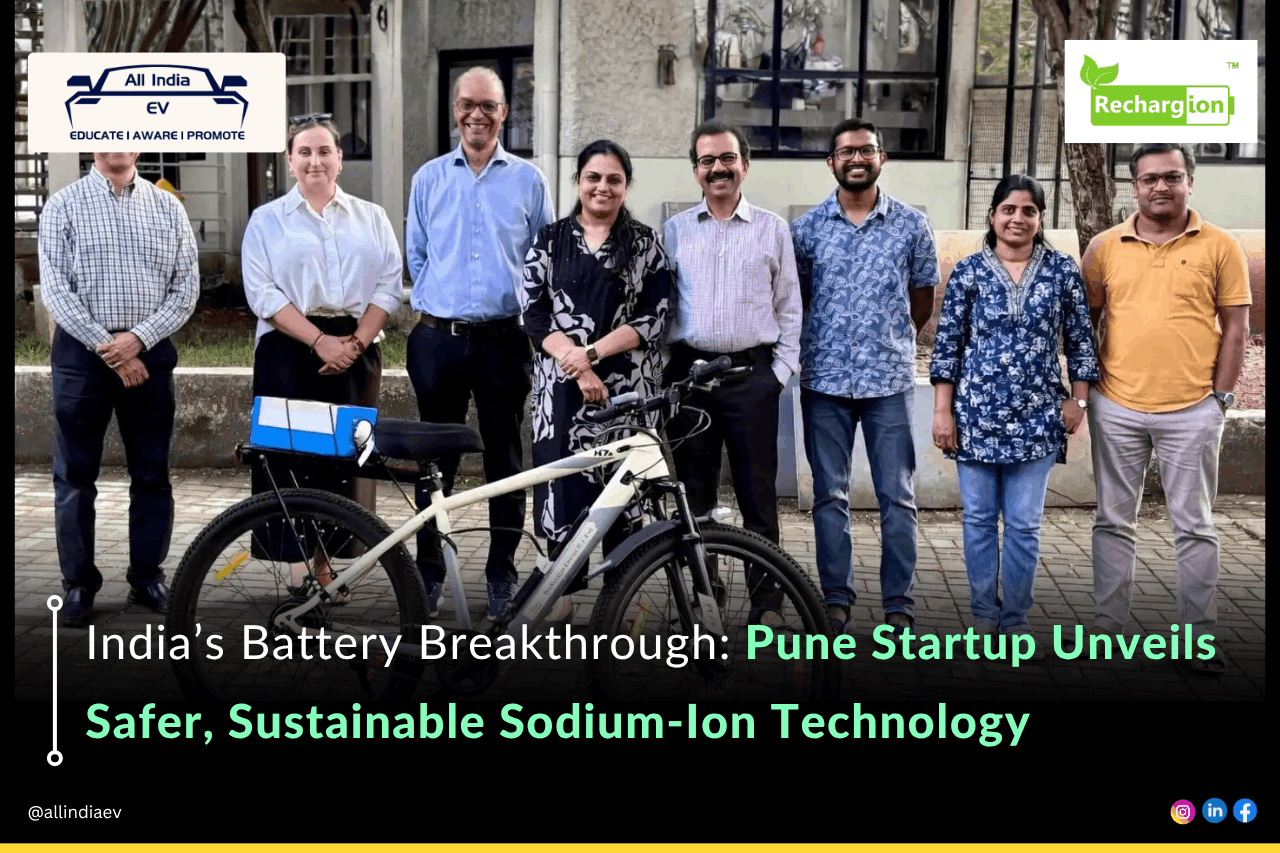

What: Pune-based startup Recharging Energy has developed a sodium-ion battery using entirely Indian raw materials, positioning it as a safer alternative to lithium-ion cells.
The Number: 100% indigenous raw materials; startup founded in 2021 with pilot-scale development underway.
The Impact: This could reduce India’s dependence on imported lithium and improve battery safety in EV applications.

The Core News
India’s push toward energy self-reliance gets a notable boost with Pune Startup Sodium-Ion Battery India, as Recharging Energy advances a fully indigenous sodium-ion chemistry. Developed as a spin-off from CSIR-National Chemical Laboratory (NCL), the technology replaces lithium with sodium — a far more abundant and locally available resource.
The startup’s approach goes beyond chemistry innovation. It is attempting to build an end-to-end domestic supply chain from raw material sourcing to cell manufacturing a gap that currently limits India’s battery ecosystem. Lithium-ion battery supply chains remain heavily import-dependent, particularly on China-controlled processing and materials.
From a technical standpoint, sodium-ion batteries offer inherent safety advantages due to better thermal stability and reduced risk of thermal runaway compared to lithium-ion systems. They also align with cost reduction goals, given sodium’s widespread availability. However, energy density and scalability remain key challenges before mass EV deployment becomes viable.
More EV News
Breaking Down the Update
• Developed by Rechargion Energy, a Pune-based deeptech startup
• Built entirely using domestically sourced raw materials
• Focus on sodium-ion chemistry as an alternative to lithium-ion
• Strong emphasis on supply chain localisation
• Technology offers improved thermal safety and sustainability
• Currently in early-stage scaling and pilot deployment
How Pune Startup Sodium-Ion Battery India will help Indian EV Market
The emergence of Pune Startup Sodium-Ion Battery India signals a structural shift in India’s EV battery strategy. Today, over 70% of lithium-ion cell demand is met through imports, exposing the sector to geopolitical risks and price volatility. Sodium-ion technology, especially when built on domestic raw materials, can significantly reduce this dependency.
From a cost perspective, sodium-based batteries can lower overall battery pack costs by eliminating expensive materials such as lithium, cobalt, and nickel. This has direct implications for EV affordability, particularly in the two-wheeler and three-wheeler segments where cost sensitivity is high.
On the safety front, sodium-ion cells are inherently more stable under high temperatures, making them better suited for Indian climatic conditions. This could reduce fire-related risks a key concern in India’s EV adoption curve.
Additionally, localisation of materials and manufacturing can accelerate India’s “Make in India” ambitions in advanced cell chemistry. It opens opportunities for domestic mining, refining, and component manufacturing ecosystems to evolve alongside EV growth.
However, the technology still needs to prove itself at scale, especially in terms of energy density and lifecycle performance. If these barriers are addressed, sodium-ion batteries could become a strong parallel pathway to lithium-ion in India’s EV transition.
Way Forward…
The development of Pune Startup Sodium-Ion Battery India marks an early but important step toward battery independence. The next phase will depend on scaling manufacturing, improving performance metrics, and securing industry partnerships. If executed well, this could reshape India’s EV supply chain economics and reduce strategic vulnerabilities in the long term.
Read More: Catch up on All India EV’s related coverage on India’s evolving commercial EV subsidies and battery swapping policies at All India EV