
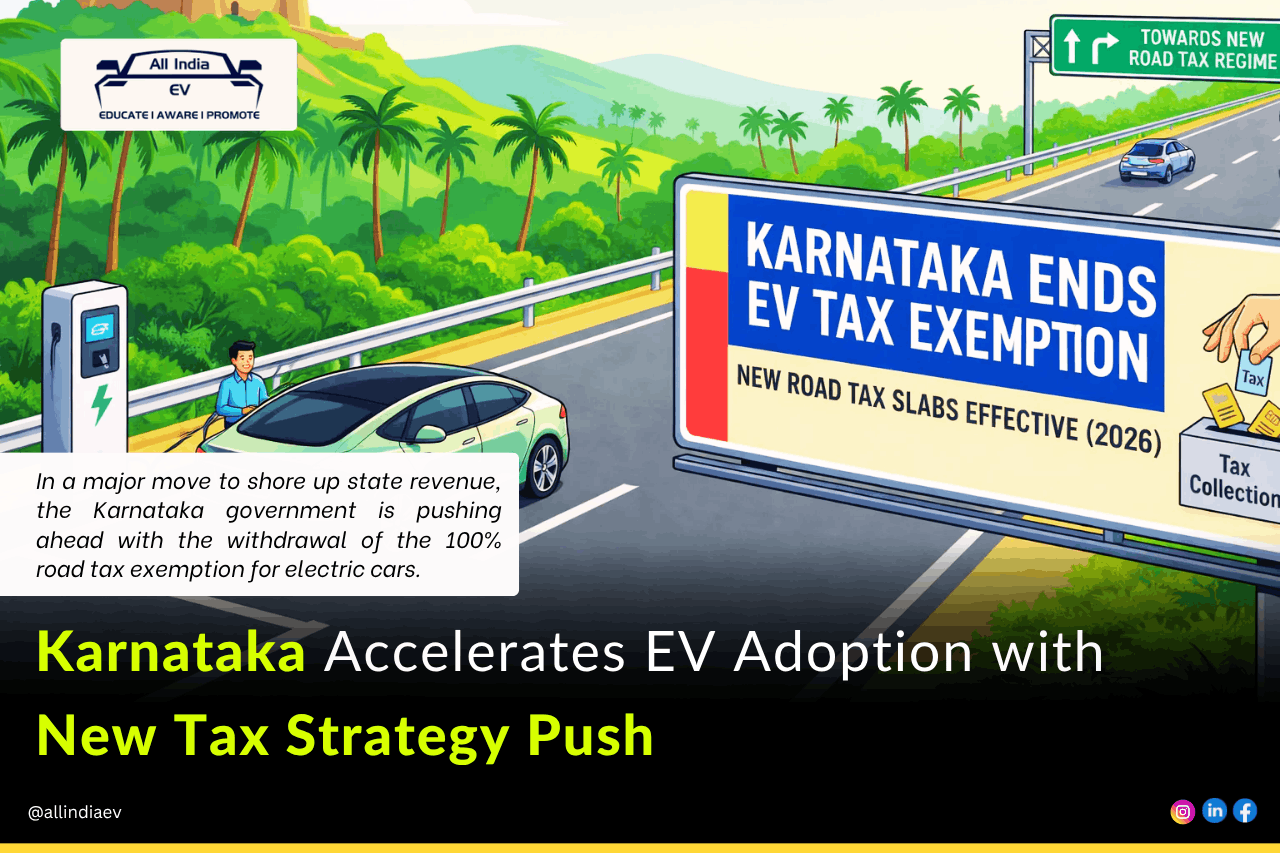

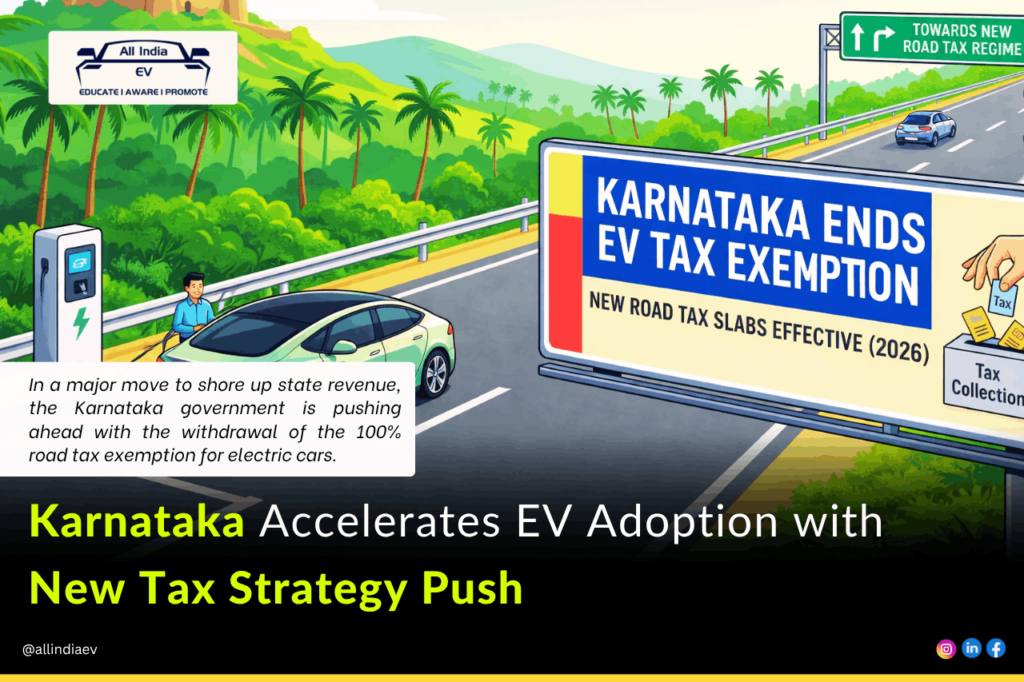
What: Karnataka is moving ahead with its Karnataka EV tax rollout despite opposition from industry and policymakers.
The Number:5%,10% lifetime road tax on electric cars; ~₹249 crore expected revenue.
The Impact: The move could increase upfront EV costs and potentially slow adoption in one of India’s leading EV states.

The Core News
The Karnataka government is proceeding with the Karnataka EV tax rollout, introducing a lifetime road tax on all electric cars under the amended Motor Vehicles Taxation Act, 2026. The rollout is expected within weeks, with backend integration underway on the Vahan portal to enable tax collection at the point of registration.
The revised taxation structure introduces a slab-based levy: 5% for EVs priced under ₹10 lakh, 8% for those between ₹10–25 lakh, and 10% for vehicles above ₹25 lakh. This marks a significant policy shift, as Karnataka had maintained a near-zero road tax regime for EVs since 2016 to accelerate clean mobility adoption.
The policy reversal expands taxation beyond premium EVs ,already taxed since 2024,to mass-market segments. Industry stakeholders, including major OEMs, have raised concerns that this could weaken price competitiveness against ICE vehicles and disrupt the state’s EV growth trajectory, especially at a time when affordability remains a key barrier to adoption.
More EV News

Breaking Down the Update
• Lifetime road tax now applies to all electric cars, ending full exemption
• Tax slabs structured at 5%, 8%, and 10% based on vehicle cost
• Expected annual revenue generation of around ₹249 crore
• Electric two-wheelers remain exempt, preserving mass adoption push
• Policy shift contrasts with incentive-led EV strategies in states like Delhi
• Strong opposition from OEMs citing impact on adoption and investments
How Karnataka EV tax rollout will help Indian EV Market
The Karnataka EV tax rollout signals a transition from incentive-driven EV policy to a revenue-linked framework, which could reshape how states approach electric mobility economics. While the immediate impact may be negative for consumer adoption, the move introduces a structured fiscal model that other states may evaluate as EV penetration rises.
From a policy standpoint, this shift highlights the growing pressure on state finances as EV adoption scales without corresponding tax inflows from fuel, based revenues. By introducing a calibrated tax structure, Karnataka is attempting to balance sustainability goals with revenue stability.
However, the broader Indian EV market may experience mixed effects. On one hand, it could slow momentum in price-sensitive segments, particularly in urban passenger vehicles. On the other, it may push OEMs to focus more aggressively on cost optimization, localization, and total cost of ownership (TCO) improvements.
The divergence between states, some offering incentives while others introduce taxes—also underscores the lack of a unified national EV taxation strategy. This policy fragmentation could influence buyer decisions, investment flows, and long-term ecosystem development across regions.
Way Forward…
The Karnataka EV tax rollout introduces a critical policy inflection point for India’s EV ecosystem. The immediate focus will be on implementation timelines, consumer response, and potential revisions under industry pressure. Going forward, the key question is whether revenue-driven policies can coexist with aggressive electrification targets without slowing market momentum.
Read More: Catch up on All India EV’s related coverage on India’s evolving commercial EV subsidies and battery swapping policies at All India EV