
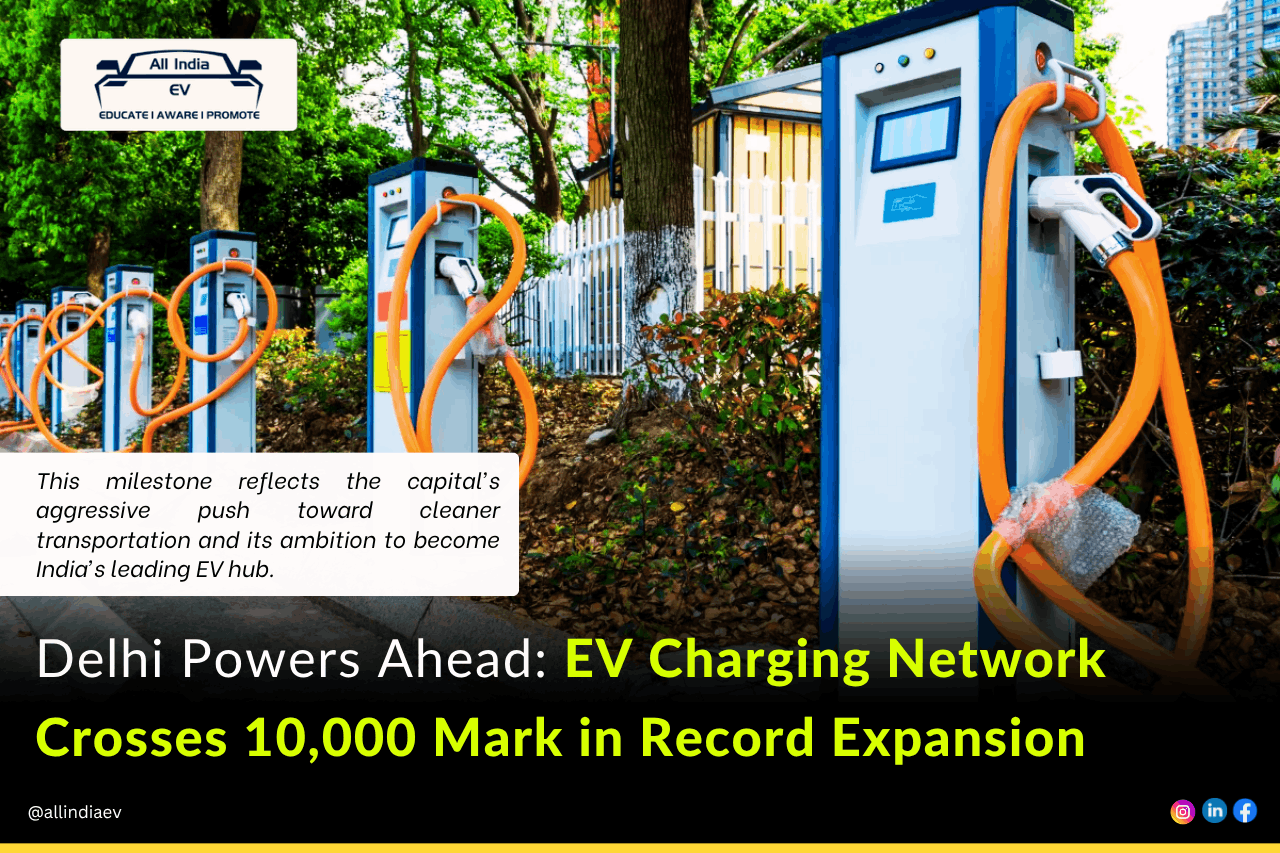

What: Delhi’s EV charging infrastructure has crossed 10,000 charging points after a rapid expansion phase in the past year.
The Number:10,000+ total charging points, with 3,000+ added in just the last few months.
The Impact: This signals a shift from policy intent to on-ground execution, reducing range anxiety and accelerating EV adoption in urban India.

The Core News
Delhi EV charging infrastructure expansion has entered a scale phase, with the capital now hosting over 10,000 charging points across public, private, and semi-public networks. The pace of deployment, especially the addition of more than 3,000 points within months, indicates a transition from pilot-stage rollout to mass deployment.
The expansion is being driven by policy clarity and faster execution under the evolving EV framework. Government officials have linked the growth to targeted infrastructure planning under the draft EV policy, which prioritises charging accessibility as a foundational requirement for EV adoption. This reflects a correction from earlier policy gaps where infrastructure targets significantly lagged implementation.
On, ground execution is being led by distribution companies (discoms), particularly BSES, which has deployed over 6,500 charging points across more than 3,400 locations. The network includes a mix of public chargers, private setups, and battery swapping stations, indicating a diversified infrastructure approach rather than reliance on a single charging model.
More EV News

Breaking Down the Update
• Over 10,000 EV charging points now operational in Delhi
• 3,000+ new points added within a short recent window
• BSES discoms alone account for 6,500+ charging points
• Deployment spans 3,400+ locations across multiple zones
• Policy push linked to draft EV policy and faster approvals
• Grid upgrades underway to support rising charging demand
How Delhi EV charging infrastructure expansion will help Indian EV Market
Delhi EV charging infrastructure expansion provides a real-world template for scaling urban EV ecosystems in India. The capital’s approach demonstrates that infrastructure growth must move in parallel with vehicle adoption, not lag behind it.
First, dense charging networks reduce range anxiety, which remains one of the biggest barriers for EV buyers. With over 10,000 points already operational, Delhi is moving closer to a distributed charging model where access becomes predictable rather than uncertain.
Second, the involvement of discoms highlights a critical structural shift. Power utilities are no longer passive suppliers but active infrastructure developers, integrating EV demand into grid planning. This improves load management and ensures long-term scalability.
Third, the mix of public chargers, private installations, and battery swapping creates flexibility across vehicle segments—especially for two-wheelers and commercial fleets. This multi-model strategy is essential for Indian conditions, where usage patterns vary widely.
Finally, Delhi EV charging infrastructure expansion sets a benchmark for other states. Replication of this model, combined with policy execution discipline, can accelerate nationwide EV adoption without waiting for centralised infrastructure rollouts.
Way Forward…
Delhi EV charging infrastructure expansion has crossed a critical threshold, but the next phase will depend on utilisation efficiency, grid readiness, and equitable distribution across residential zones. As EV volumes rise, the focus will shift from installation numbers to uptime, speed, and network reliabilitykey factors that will determine whether infrastructure keeps pace with adoption.
Read More: Catch up on All India EV’s related coverage on India’s evolving commercial EV subsidies and battery swapping policies at All India EV