
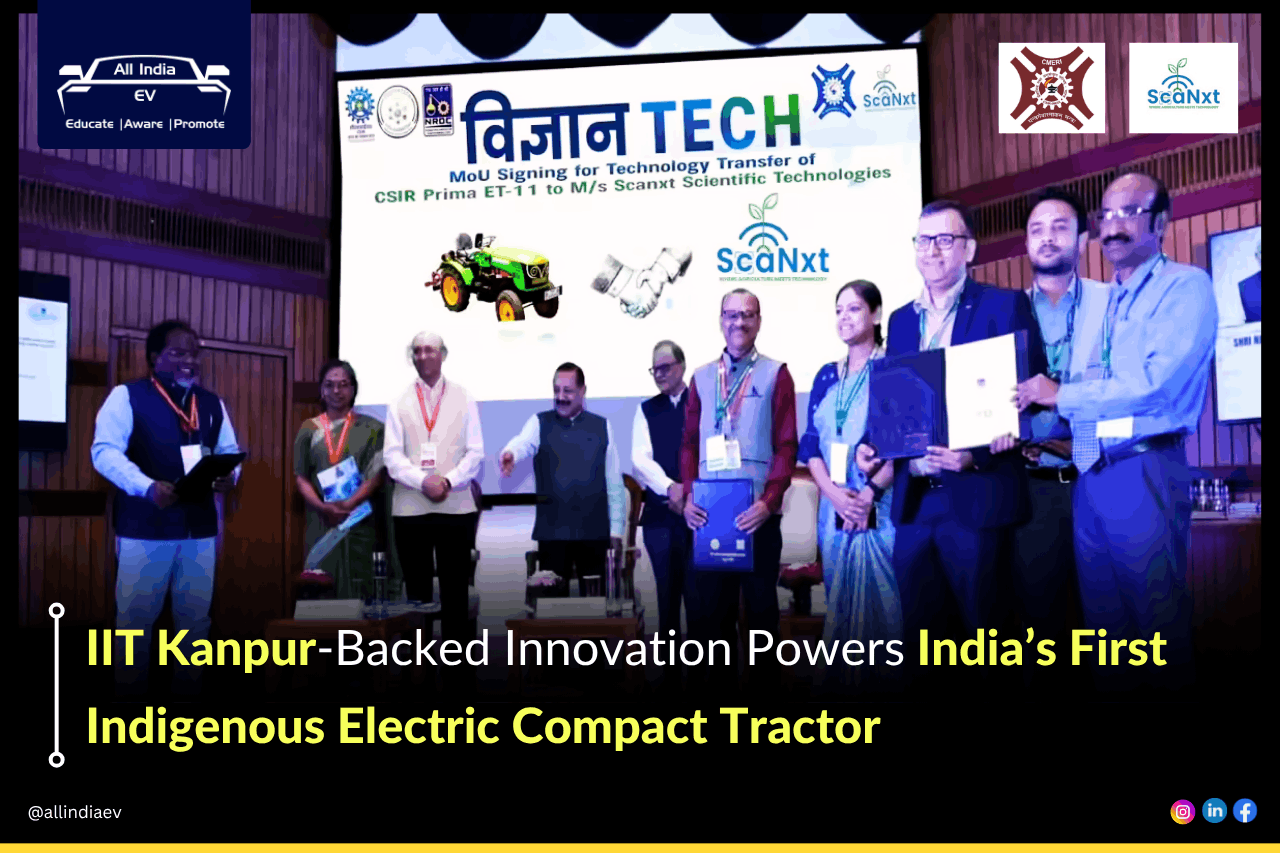

What: India’s first indigenously developed electric compact tractor has entered the commercialisation phase through a technology transfer agreement between ScaNxt Scientific Technologies, CSIR-CMERI, and NRDC. The platform is aimed specifically at small and marginal farmers.
The Number: The electric tractor has been developed with more than 90% indigenous components and is designed for India’s fragmented agricultural landholding structure.
The Impact: The launch of the indigenous electric compact tractor signals India’s deeper push into electrified agricultural mechanisation, where fuel savings, lower maintenance, and rural energy transition are becoming increasingly important.

The Core News
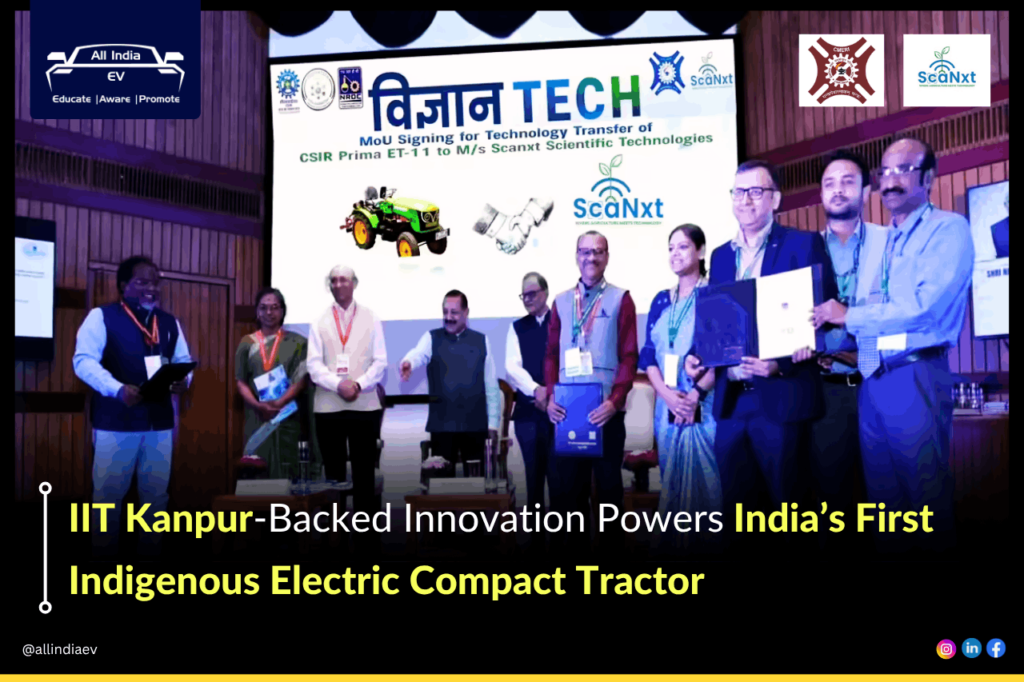
The indigenous electric compact tractor developed under the IIT Kanpur innovation ecosystem marks a significant shift in India’s agricultural electrification strategy. ScaNxt Scientific Technologies, incubated at SIIC IIT Kanpur, has signed an MoU with CSIR-CMERI and the National Research Development Corporation (NRDC) to commercialise the platform after a formal technology transfer agreement signed during Vigyan Tech 2026 in New Delhi.
Unlike large imported electric farm platforms that target high-horsepower commercial farming, this tractor has been engineered around India’s small and marginal farming realities. Developers say the compact EV tractor addresses fragmented landholdings, high diesel dependency, rising operating costs, and limited access to affordable mechanisation. The company claims the vehicle architecture has been built with simplified controls and a compact operating footprint, making it more usable across small farms and potentially more accessible for women farmers as well.
The broader timing is important for India’s agri-EV sector. Electric tractors remain at a very early adoption stage despite India being the world’s largest tractor market. Industry estimates show electric farm machinery penetration is still extremely limited compared to diesel tractor volumes. However, rising diesel prices, battery localisation efforts, and rural decarbonisation policies are creating early commercial opportunities for low-power electric agricultural equipment.
More EV News
Breaking Down the Update
• ScaNxt Scientific Technologies signed the commercialisation agreement with CSIR-CMERI and NRDC during Vigyan Tech 2026
• The tractor uses over 90% indigenous components
• The platform targets small and marginal Indian farmers instead of large commercial farming operations
• The compact electric architecture is designed for fragmented landholdings and lower operating costs
• Developers position the tractor as an alternative to diesel-powered mechanisation amid rising fuel prices
• The project highlights collaboration between public R&D institutions, startup incubation, and clean mobility ecosystems
• India’s agri-EV market is still nascent, making early localisation strategically important for future scale
How indigenous electric compact tractor will help Indian EV Market
The indigenous electric compact tractor could become an important catalyst for India’s non-passenger EV ecosystem, particularly in rural electrification and agricultural mobility. While most EV policy attention has remained focused on electric two-wheelers, passenger cars, and commercial fleets, agriculture represents one of India’s largest untapped electrification opportunities.
India operates millions of diesel-powered tractors, many of which are used by small and marginal farmers with high fuel sensitivity. An electric alternative designed specifically for low-acreage farming could significantly reduce operating expenses over time through lower energy and maintenance costs. The localisation level above 90% is also strategically important because it aligns with India’s broader manufacturing and supply-chain independence goals.
The indigenous electric compact tractor may also help accelerate rural charging ecosystems, distributed battery servicing networks, and local EV component manufacturing. If commercial deployment succeeds, it could encourage more Indian agritech startups and OEMs to enter the agricultural EV segment.
The project also demonstrates how government-backed research institutions and startup incubators can work together to convert laboratory innovation into market-ready mobility products. That model could become increasingly relevant as India expands EV adoption beyond urban transportation into agriculture, logistics, and rural utility vehicles.
Way Forward ..
The indigenous electric compact tractor now moves into the critical commercialisation and deployment phase, where affordability, battery durability, charging access, and farmer adoption will determine market success. The next major milestone will be field-scale deployment and production economics. If execution remains strong, India’s agri-EV segment could emerge as a serious growth area alongside mainstream electric mobility.
Read More: Catch up on All India EV’s related coverage on India’s evolving commercial EV subsidies and battery swapping policies at All India EV