
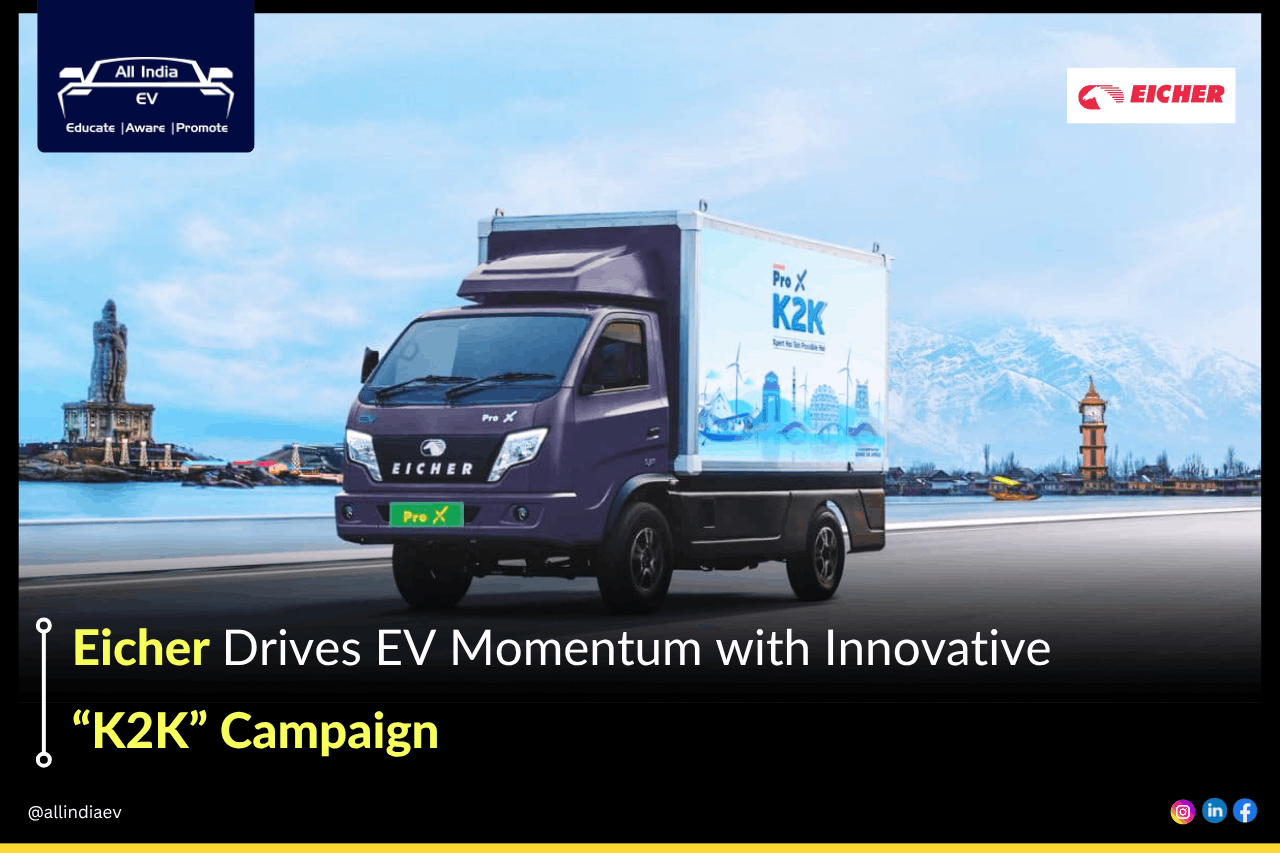

What: Eicher has completed a Kashmir-to-Kanyakumari (K2K) endurance run using its fully loaded Eicher Pro X EV commercial truck, positioning the campaign as a real-world validation of electric logistics capability in India. The company claims the vehicle became the first and fastest electric commercial vehicle to complete the route under loaded operating conditions.
The Number: The Eicher Pro X EV covered over 4,000 km in six days across diverse terrain and temperature conditions ranging from approximately -2°C to 40°C, while setting four India Book of Records milestones during the journey.
The Impact: The Eicher Pro X EV Kashmir Kanyakumari run directly addresses one of the biggest concerns in India’s electric commercial vehicle segment — operational reliability over long distances. The campaign also highlights the growing viability of public charging infrastructure for commercial EV deployment.

The Core News
VE Commercial Vehicles, through its Eicher Trucks and Buses division, has launched a proof-focused electric mobility campaign centred around the Eicher Pro X EV’s successful Kashmir-to-Kanyakumari expedition. The campaign, branded around the “#XpertHaiTohPossibleHai” initiative, is aimed at demonstrating practical commercial EV readiness instead of relying solely on specification-based marketing claims.
The vehicle reportedly completed the Srinagar-to-Kanyakumari route while operating under fully loaded conditions, travelling through highways, plains, ghats, urban corridors, and varying climate zones. Eicher stated that the vehicle depended on public charging infrastructure accessed through the MyEicher App ecosystem during the expedition. The company used third-party validation through the India Book of Records to independently verify route compliance, charging stops, distance covered, and operational conditions.
The campaign reflects a broader shift underway in India’s commercial EV industry, where manufacturers are increasingly focusing on operational economics, fleet confidence, uptime assurance, and infrastructure reliability rather than only announcing vehicle launches. Long-haul and mid-mile logistics remain one of the most difficult electrification segments due to concerns around charging availability, payload impact, range predictability, and route downtime. Eicher’s demonstration appears strategically designed to reduce these concerns for fleet operators evaluating electric truck adoption.
More EV News

Breaking Down the Update
• The Eicher Pro X EV completed a Kashmir-to-Kanyakumari expedition under loaded commercial operating conditions
• The journey covered more than 4,000 km in six days across multiple terrain conditions
• Eicher claims the run established four India Book of Records milestones
• Public charging infrastructure was used throughout the route via the MyEicher App ecosystem
• The campaign focused on proving operational reliability instead of conventional promotional messaging
• The route included highways, mountainous regions, urban corridors, and coastal stretches
• The initiative targets commercial fleet operators evaluating electric logistics deployment
• The campaign aligns with India’s broader decarbonisation and green logistics objectives
How Eicher Pro X EV Kashmir Kanyakumari run will help Indian EV Market
The Eicher Pro X EV Kashmir Kanyakumari run could become an important reference point for India’s electric commercial vehicle sector because it focuses on real operational validation instead of controlled test conditions. One of the largest barriers to electric truck adoption in India has been fleet operator hesitation around range reliability, charging access, payload capability, and uptime consistency during long-distance movement.
By completing a loaded multi-state logistics route using public charging infrastructure, Eicher is attempting to demonstrate that electric commercial vehicles can gradually move beyond short urban delivery applications into more demanding logistics operations. This is particularly important for India’s mid-mile and intra-city freight segments, where electrification potential remains significant but operational confidence is still developing.
The campaign also indirectly highlights improvements in India’s charging infrastructure ecosystem. Commercial EV adoption depends heavily on charger availability, route planning tools, energy management systems, and service support networks. Demonstration runs like this help validate ecosystem readiness for fleet operators who typically evaluate vehicles based on total operational efficiency rather than environmental positioning alone.
If more OEMs begin showcasing real-world logistics deployment data instead of laboratory claims, the Indian commercial EV sector could move faster toward practical fleet electrification and wider private-sector adoption.
Way Forward ..
The Eicher Pro X EV Kashmir Kanyakumari run reflects a growing maturity in India’s electric commercial vehicle market, where operational proof is becoming more valuable than launch announcements alone. The next challenge will involve scaling charging reliability, lowering fleet transition costs, and ensuring consistent uptime performance under commercial deployment conditions. As electric logistics adoption expands, real-world validation exercises like this are likely to become increasingly important for fleet decision-making across India’s freight sector.
Read More: Catch up on All India EV’s related coverage on India’s evolving commercial EV subsidies and battery swapping policies at All India EV