
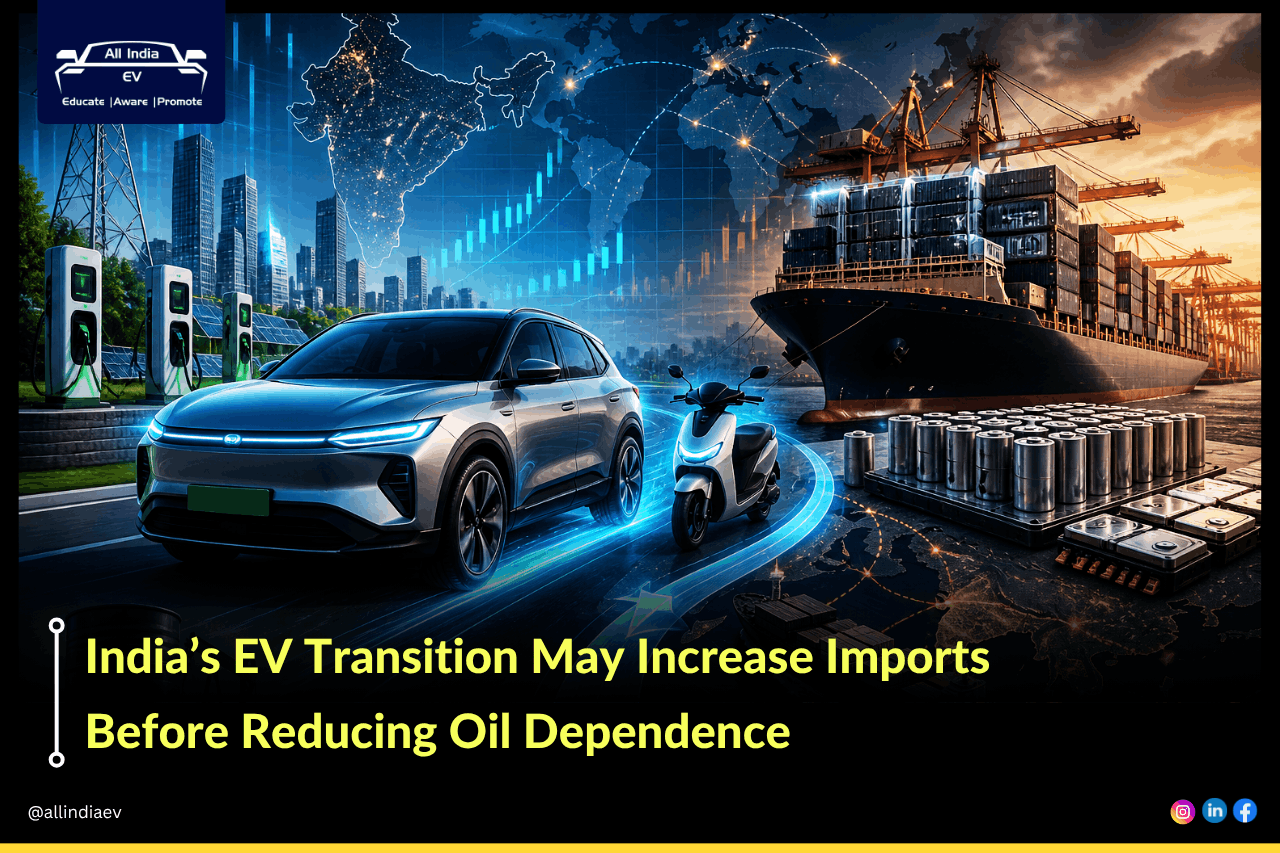

What: India’s aggressive EV transition could increase the country’s import dependence in the short term as battery material and cell imports rise faster than immediate savings from reduced crude oil consumption.
The Number: At 30% electric passenger vehicle penetration, India’s battery-linked import bill could touch $26.4 billion. At full EV transition levels, imports could rise to nearly $87.9 billion, according to estimates cited in the report.
The Impact: The EV battery import bill India challenge highlights a critical gap in the country’s EV strategy reducing oil imports alone will not

guarantee energy independence unless battery manufacturing and raw material localization scale simultaneously.
The Core News
The EV battery import bill India debate is gaining attention as policymakers push faster electrification to reduce dependence on imported fossil fuels. While electric mobility is expected to lower crude oil consumption over the long term, current supply-chain realities indicate India may initially face a parallel surge in imports linked to lithium-ion batteries, critical minerals, and cell manufacturing components.
The concern becomes more significant as EV penetration accelerates across passenger vehicles and two-wheelers. India’s electric two-wheeler market has already crossed 12.9 lakh annual unit sales with penetration reaching 6.3% of the total segment, while passenger EV adoption remains relatively low at 4.4%. However, scaling these numbers aggressively would substantially increase dependence on imported lithium, nickel, cobalt, graphite, battery cells, and electronic components unless domestic refining and manufacturing ecosystems mature quickly.
This creates a strategic policy dilemma. India currently spends heavily on crude imports, but replacing oil dependency with battery material dependency could simply shift the external trade burden rather than eliminate it. The government has already launched PLI schemes, battery manufacturing incentives, and mineral security partnerships to address this issue, but domestic upstream capacity remains limited. The next phase of India’s EV transition will therefore depend less on vehicle adoption alone and more on how rapidly the country can localize battery chemistry, refining, recycling, and cell production infrastructure.
More EV News

Breaking Down the Update
• EV adoption may initially increase India’s non-oil import exposure
• Battery cells and critical minerals remain heavily import-dependent
• Passenger EV penetration in India currently stands at 4.4%
• Electric two-wheelers have crossed 12.9 lakh annual sales
• A 30% passenger EV penetration scenario could raise battery imports to $26.4 billion
• Full-scale EV transition could push battery-linked imports near $87.9 billion
• Oil import savings may remain relatively smaller during early adoption phases
• Localization of battery manufacturing is becoming strategically critical
• Battery recycling and mineral processing could become major policy focus areas
How EV battery import bill India will help Indian EV Market
The EV battery import bill India challenge could ultimately accelerate the development of India’s domestic EV manufacturing ecosystem. Rising import exposure often forces faster industrial policy execution, and the EV sector is already witnessing stronger focus on battery localization, mineral security, and advanced manufacturing investments.
India’s Production Linked Incentive (PLI) schemes for Advanced Chemistry Cells (ACC) are designed specifically to reduce dependency on imported battery cells over the next decade. As EV demand scales, domestic manufacturers are expected to increase investments in lithium-ion cell assembly, battery pack manufacturing, thermal management systems, and recycling infrastructure.
The situation may also push Indian companies toward alternative chemistries such as LFP batteries and sodium-ion technologies that reduce exposure to expensive imported minerals like cobalt and nickel. Simultaneously, recycling could emerge as a major industry because recovering lithium, nickel, and other materials from used batteries can significantly reduce future import pressure.
For India’s EV market, this transition phase may create short-term trade challenges, but it could also strengthen long-term industrial capability. Companies able to localize battery supply chains early are likely to gain significant cost advantages as EV adoption expands across two-wheelers, passenger cars, commercial fleets, and public transport.
Conclusion & Next Steps
The EV battery import bill India issue underlines that electrification alone is not enough to guarantee energy security. The next stage of India’s EV policy will likely focus heavily on battery manufacturing, recycling, mineral partnerships, and localized supply-chain development. The real test now is whether India can scale EV adoption while simultaneously reducing strategic dependence on imported battery ecosystems.
Read More: Catch up on All India EV’s related coverage on India’s evolving commercial EV subsidies and battery swapping policies at All India EV