

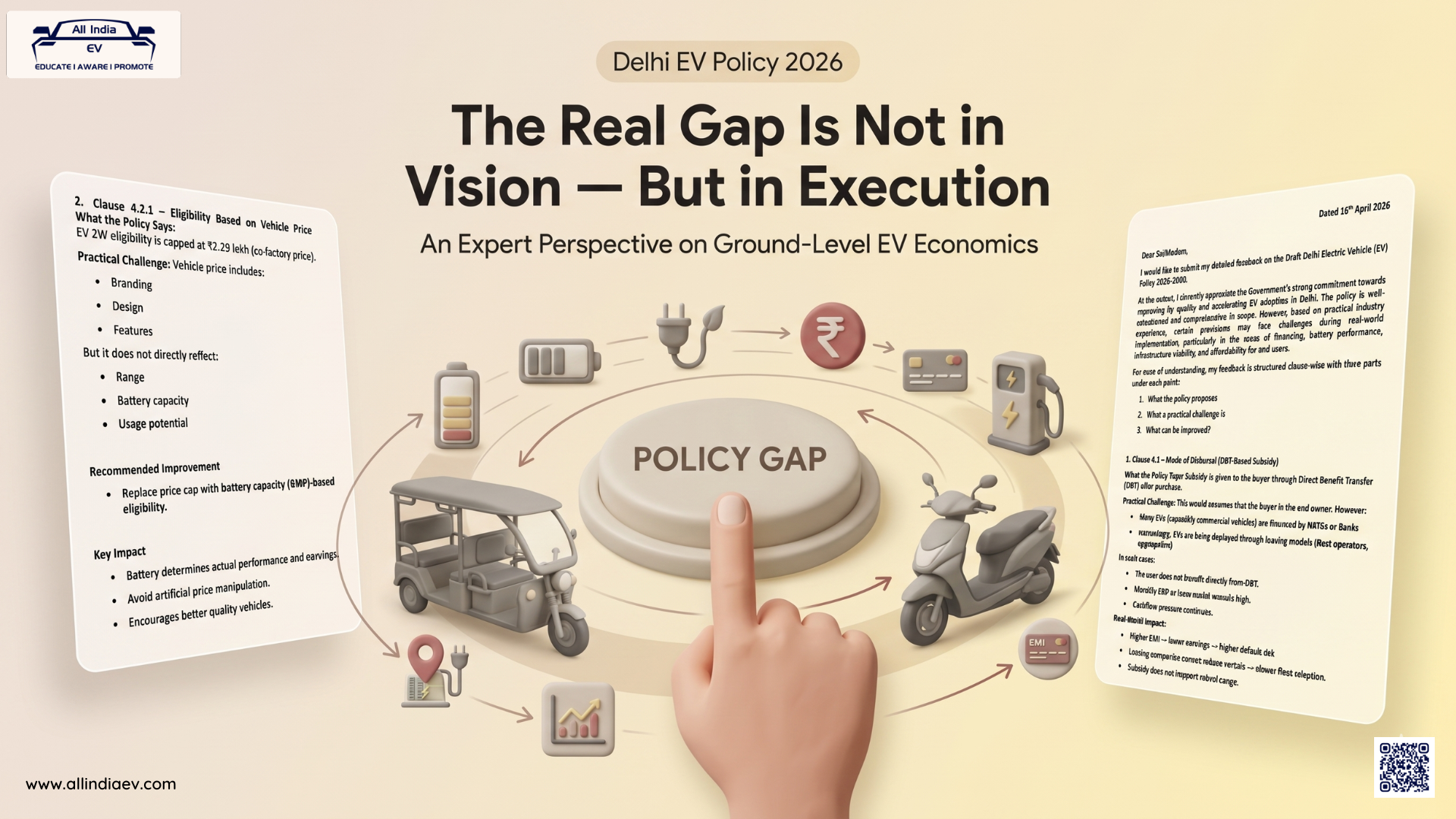


An Expert Perspective by Jay Ranvir, Vice President – Credit Risk Management, AltMobility
- Delhi EV Policy 2026 With the Right Intentions — But Is It Asking the Right Questions?
- “An EV Is Not Just a Vehicle — It Is a Source of Daily Income”
- The Battery Performance Gap: The Most Critical Oversight
- Financing and Leasing: The Invisible Backbone the Policy Has Ignored
- Charging Infrastructure: Strong Intent, Weak Economics
- One Size Does Not Fit All: The School Bus Problem
- Scrappage Incentives Need to Reflect Reality, Not Just Intent
- The Bigger Shift: From Promoting Adoption to Ensuring Sustainability
- Closing: A Model Policy in the Making — If the Gaps Are Closed
Delhi EV Policy 2026 With the Right Intentions — But Is It Asking the Right Questions?
The Draft Delhi Electric Vehicle Policy 2026–2030 has arrived at the right moment. Delhi’s air quality crisis is undeniable, mobility electrification is inevitable, and the policy ticks many of the expected boxes — purchase incentives, charging infrastructure targets, and segment-wise electrification mandates.
As a city-level EV policy, its ambition is commendable and its direction is progressive.
But All India EV reached out to Jay Ranvir, Vice President of Credit Risk Management at AltMobility, to get a sharper read on the policy — not from a cheerleader’s lens, but from the perspective of someone who sits at the intersection of EV finance, risk, and real-world asset performance. His assessment cuts to the core of what most policy documents miss: the difference between enabling a purchase and enabling a livelihood.
Here is what he had to say.
“An EV Is Not Just a Vehicle — It Is a Source of Daily Income”
For most EV users in Delhi — delivery riders, auto drivers, fleet operators — every vehicle purchase is a financial commitment tied to daily earnings. The math they run is simple: how much do I earn today versus how much do I owe?

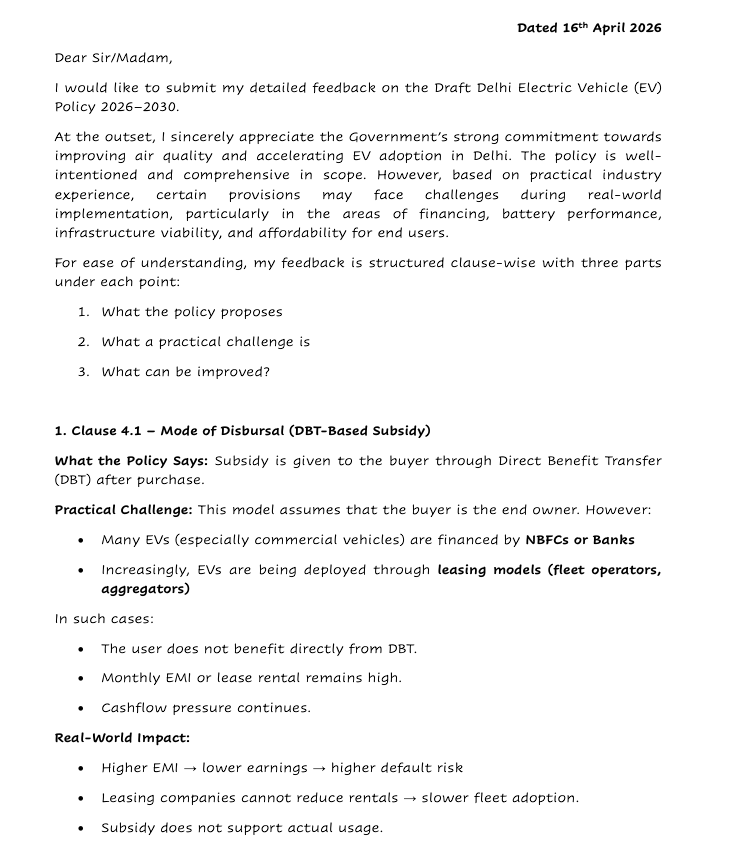
The current policy concentrates its benefits heavily at the point of purchase through upfront subsidies. But the monthly burden — EMIs, lease rentals, maintenance — remains unchanged. A cheaper vehicle at purchase does not automatically translate into financial relief over the ownership lifecycle.
More EV News

What needs to change:
- A portion of the subsidy should be structured as interest subvention, reducing monthly EMI burden rather than front-loading the benefit
- Subsidies should be released in phases tied to actual vehicle usage, not just at the point of sale
- This ensures benefits align with the reality of running a vehicle for income, not just owning one on paper
The Battery Performance Gap: The Most Critical Oversight
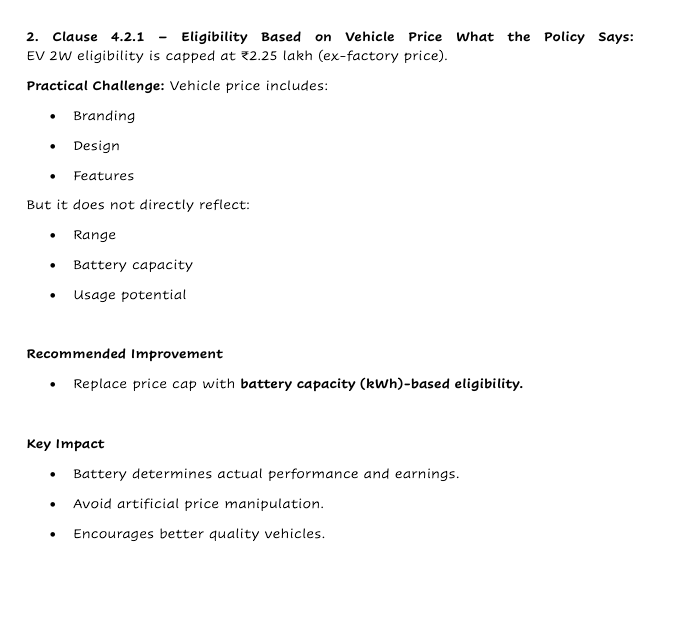
If there is one structural flaw in the policy that demands urgent correction, it is the complete absence of battery performance accountability.
In an EV, the battery is the asset. It determines range, determines daily trip capacity, and therefore determines income potential. As batteries degrade over time — which they inevitably do — range shrinks, productivity drops, and earning capacity falls. But the EMI stays the same.
This creates a compounding financial trap for users that no upfront subsidy can fix.
Jay’s recommended intervention:
- Link subsidy disbursement to State of Health (SOH) — a measurable metric of battery performance over time
- If battery health is maintained, the OEM receives the full subsidy benefit
- If battery health degrades below benchmarks, remaining subsidy is withheld, making the OEM financially accountable for product quality
- This single policy mechanism can elevate product standards, protect users, and build lasting ecosystem trust
Financing and Leasing: The Invisible Backbone the Policy Has Ignored
The policy largely assumes a direct ownership model. In reality, a significant portion of EVs in Indian markets are financed by NBFCs or deployed through leasing and fleet structures.
This assumption creates a structural blind spot. Leasing companies will not scale deployment if they lack confidence in asset value — and asset value in EVs is almost entirely a function of battery health and residual value predictability.
What the policy must address:
- Enable subsidy flow-through to financing and leasing structures, not just direct buyers
- Create regulatory clarity around residual value frameworks for EVs, especially batteries
- Engage NBFCs and fleet operators as first-class participants in the policy architecture, not afterthoughts
Without this, large-scale adoption — which will come through leasing and fleet models, not individual purchases — will remain constrained.
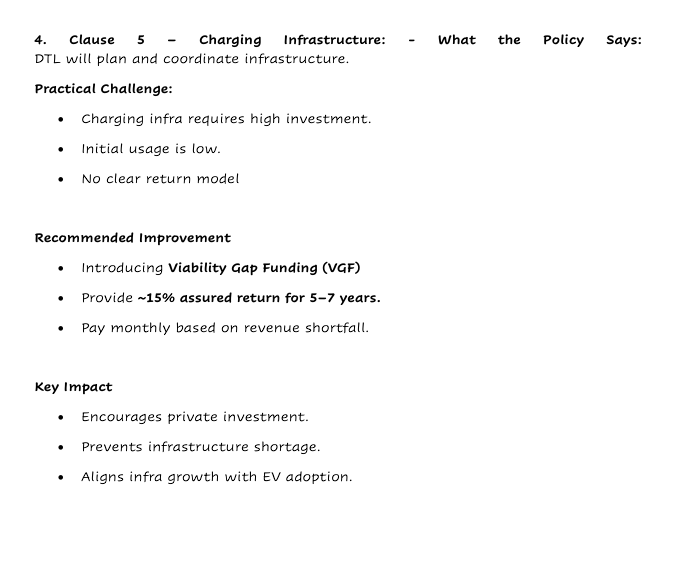
Charging Infrastructure: Strong Intent, Weak Economics
The policy signals strong intent on charging infrastructure. But intent does not recover capital.
Setting up charging stations requires significant upfront investment. In early deployment phases, utilisation is low and payback periods stretch uncomfortably long. This makes private participation inherently risky without de-risking mechanisms.
A workable solution:
- Introduce Viability Gap Funding (VGF) for charging station operators during the initial rollout phase
- Provide assured return structures for a limited period to de-risk early investors
- Align infrastructure deployment timelines with vehicle adoption projections so charging availability precedes — rather than follows — vehicle growth
If charging infrastructure lags vehicle adoption, the policy’s ambition will stall on the road.
One Size Does Not Fit All: The School Bus Problem
Mandating full fleet electrification across all segments without accounting for usage patterns can backfire.
School buses, for example, typically operate 50–60 km per day — a low-utilisation cycle that makes EV economics difficult. EVs perform best under high-usage conditions where per-kilometre costs come down quickly. In low-utilisation segments, the cost per kilometre remains elevated and will likely be passed on to parents through higher school fees.
A more pragmatic approach:
- Allow retrofitting of existing school buses to electric drivetrains with partial government co-funding
- This achieves the same environmental outcome without forcing full fleet replacement costs onto schools and families
- Phase mandates based on daily kilometre thresholds rather than a blanket segment rule
Scrappage Incentives Need to Reflect Reality, Not Just Intent
The current scrappage incentive structure offers a fixed benefit regardless of the vehicle being scrapped. A three-year-old vehicle and a ten-year-old vehicle retiring on the same day receive the same incentive.
This is economically illogical and creates perverse outcomes — newer, higher-value vehicles have less reason to exit the market, while the policy fails to appropriately reward those making the larger financial sacrifice.
The fix is straightforward:
- Link scrappage incentives to the residual market value of the vehicle being retired
- A dynamic, value-linked structure makes the system both fairer and more efficient
The Bigger Shift: From Promoting Adoption to Ensuring Sustainability
The Delhi EV Policy 2026 must evolve its framing. The measure of success cannot be units sold. It must be vehicles that continue to run, continue to earn, and remain financially viable every single day of their operational life.
For that to happen, four pillars must hold simultaneously:
- Users must be able to earn through their EVs without chronic financial stress
- Lenders and NBFCs must feel secure about asset value and repayment capacity
- Leasing companies must see predictable residual value and deployment economics
- Manufacturers must be held accountable for long-term battery and vehicle performance
The policy, in its current form, addresses the first pillar partially and the remaining three inadequately.
Closing: A Model Policy in the Making — If the Gaps Are Closed
Delhi has the opportunity to build the definitive EV policy template for India. The foundation is solid. The intent is clear. The targets are ambitious.
But ambition without economic grounding produces adoption spikes, not transitions.
The gaps Jay Ranvir identifies — monthly affordability, battery accountability, financing integration, infrastructure economics, and segment-specific design — are not peripheral concerns. They are the difference between a policy that moves vehicles and a policy that moves an ecosystem.
Close these gaps, and Delhi’s EV transition will not need to be mandated. It will be chosen — because it will make financial sense for everyone involved.
Because in the end, an EV policy succeeds not when a vehicle is sold — but when it continues to run, earn, and remain viable every single day.
Read More: Catch up on All India EV’s related coverage on India’s evolving commercial EV subsidies and battery swapping policies at All India EV





An insightful read by PolicyIndex on the Delhi EV Policy and its impact on India’s electric mobility future. The breakdown of regulations, incentives, and sustainability goals makes the topic easy to understand and highly relevant.