
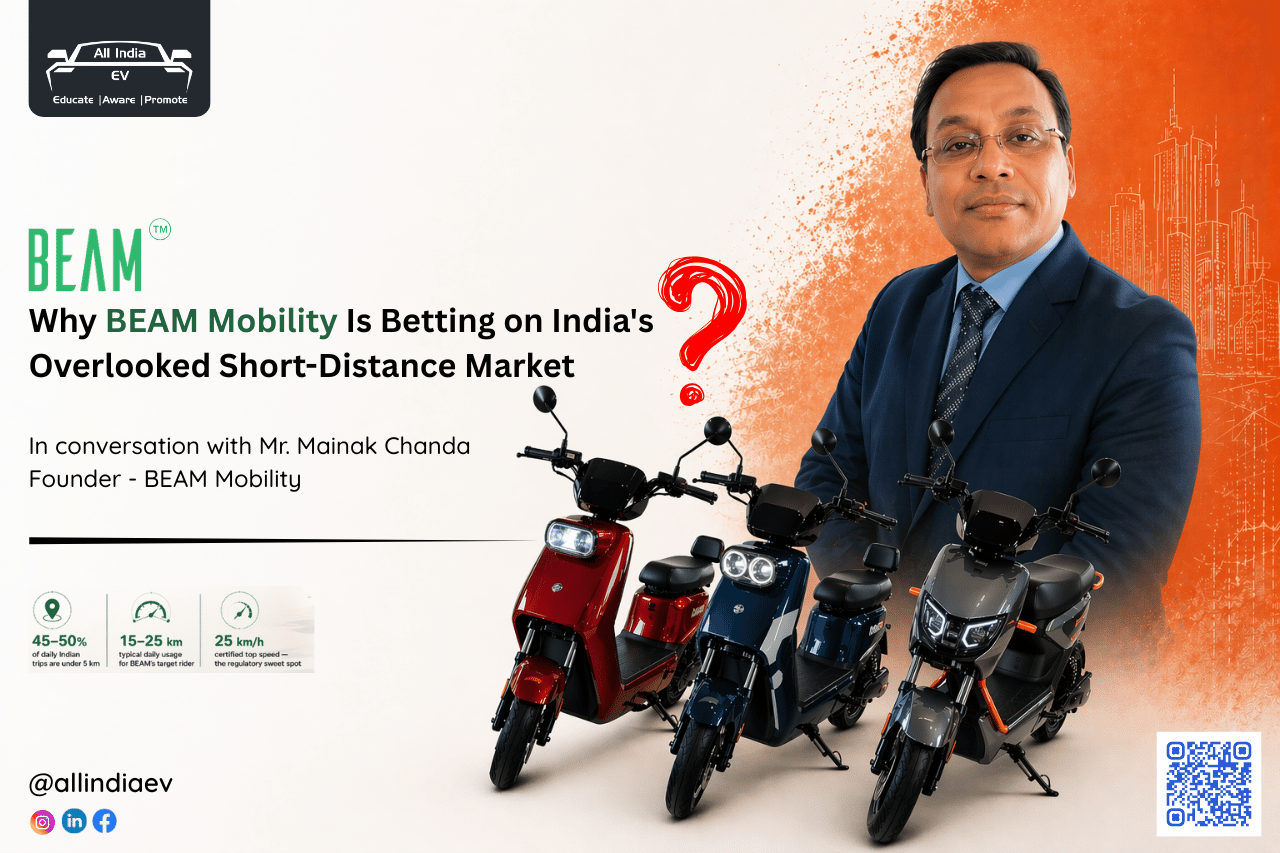


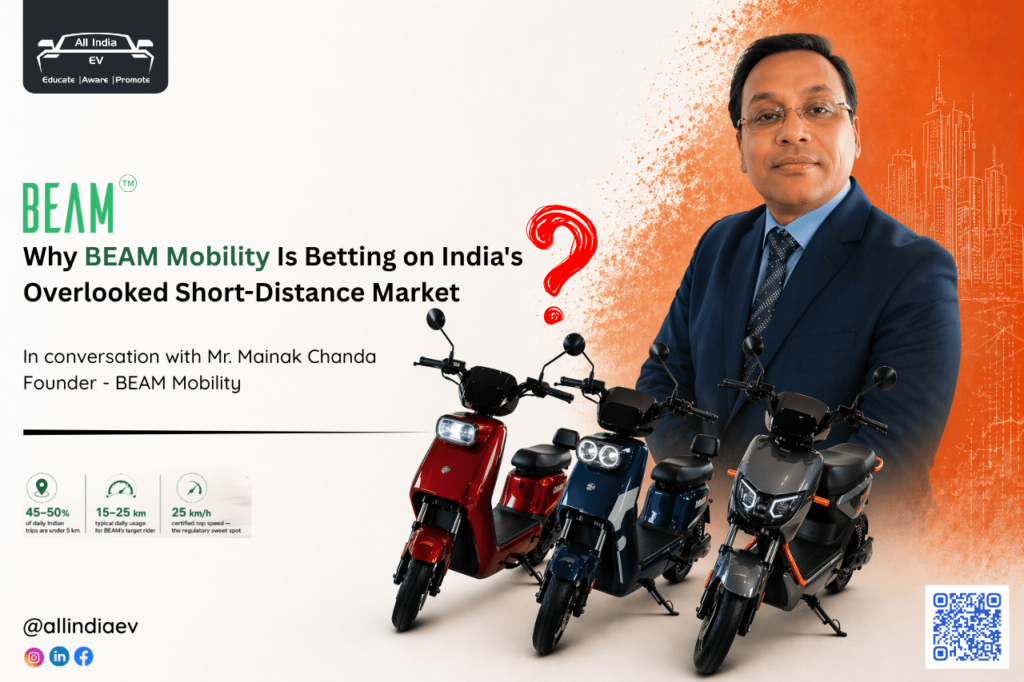
While the industry chases highway-capable scooters and premium urban commuters, BEAM Mobility has quietly built an entire product philosophy around 5-km trips, license-free riders, and the 400 million Indians that conventional EVs were never really designed for. We spoke to founder Mainak Chanda to understand why.
All India EV Editorial Desk
In conversation with Mainak Chanda, Founder, BEAM Mobility
Mainak Chanda – Founder, BEAM Mobility
Building India’s certified low-speed electric 2W platform — BL1.O, BL2.O, BL3.O — targeting neighbourhood mobility, rural women, campus commutes, and student-age riders across Tier-2 and Tier-3 India.
The EV industry loves a big number. Range. Top speed. Charging time. Horsepower. Every press release, every product launch, every media conversation in the Indian electric two-wheeler space is built around performance metrics borrowed from the ICE world, scaled up and electrified.
But Mainak Chanda, founder of BEAM Mobility, starts with a completely different number. One that doesn’t appear in any competitor’s brochure. 45%.

That is the share of daily trips in India that are under five kilometres. The morning school run. The local market dash. The inter-department shuttle on a hospital campus. The evening errand inside a gated community. These are not fringe use cases. They are the dominant pattern of mobility across semi-urban India, and according to Chanda, they remain almost entirely unaddressed by the existing EV product lineup.
The Market Gap
“Most vehicles in the market are designed for high-speed commuting,” Chanda told All India EV. “They are expensive, complex, and frankly unnecessary for short-distance travel. The person making a five-kilometre round trip every day doesn’t need a 90 km/h scooter with a 100-km range and a ₹1.5 lakh price tag. They need something simple, safe, and affordable — and nobody was really building that.”

A 70-km range covers 2–3 days of usage for most of our riders. That reduces range anxiety and charging frequency in a way that a 100-km range on a high-speed scooter never will — because those riders are still anxious about the daily recharge routine.”
— Mainak Chanda, Founder, BEAM Mobility
The 25 km/h Strategy
The speed cap is where BEAM’s product architecture becomes genuinely interesting. Under Indian EV regulation — specifically Clause 2 of GSR 291(E) dated January 2014, as amended by GSR 823(E) and GSR 838(E) in November 2023 — electric vehicles operating below 25 km/h are exempt from registration and licensing requirements. BEAM has built its entire go-to-market thesis around this provision.
More EV News

“Any member of the family can ride it,” Chanda explains. “No paperwork, no compliance, no waiting. You buy it and you use it immediately.” For a first-time EV buyer in a Tier-2 town — perhaps a school student, a homemaker, a senior citizen, or a campus worker — that friction elimination is not a minor convenience. It is the difference between purchase and no purchase.
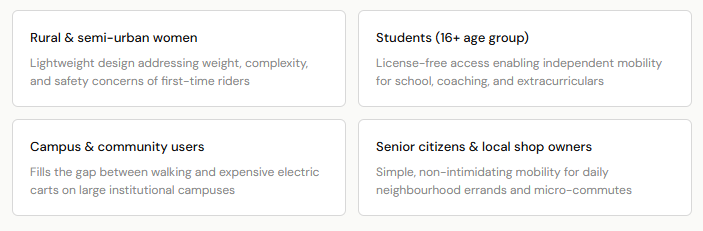
The segment targeting is correspondingly precise. BEAM has identified four primary user archetypes through market research: rural and semi-urban women who find conventional two-wheelers heavy and intimidating; students aged 16 and above navigating multiple daily activities without a license; campus and closed-community users in hospitals, universities, and industrial parks; and residents of gated communities making intra-colony trips. Each product in the BL lineup is mapped to one or more of these profiles.
Connected Intelligence in a Low-Speed Vehicle
One of the more counterintuitive aspects of BEAM’s positioning is the emphasis on connected technology in a vehicle category that the industry rarely associates with sophistication. Through the BEAM Connect App, users can remotely switch the vehicle on or off, arm and disarm security functions, receive theft alerts, track the vehicle’s location in real time, and monitor battery state of charge. For campus deployments, the BEAM EYE App adds geo-fencing and fleet immobilization capabilities.
Chanda is emphatic that this is not a feature add-on — it is trust infrastructure. “A vehicle should provide not just mobility but confidence and control to the user,” he said. “Many of our buyers are first-time EV owners. Connected intelligence transforms a simple vehicle into something that feels safe, accountable, and transparent. That matters enormously when you are asking someone to make a technology shift.”
All India EV Perspective
BEAM’s connected tech approach is worth examining beyond the feature list. In the low-speed EV category — which has historically struggled with consumer trust due to quality concerns from unbranded manufacturers — app-based oversight gives buyers a verifiable, real-time window into their vehicle. This is not smartphone integration for its own sake. It is a trust-building mechanism targeted squarely at first-generation EV adopters who have limited reference points for what “a reliable EV” should feel like.
The addition of the BEAM Connect App as a service channel — with owner’s manuals, technician connectivity, and YouTube tutorials built in — also signals a mature understanding of after-sales economics in Tier-2 and Tier-3 markets, where physical service touchpoints are sparse and digital-first support can be a genuine differentiator.
Physical Retail in an EV World
At a time when several EV companies have doubled down on direct-to-consumer digital sales, BEAM is expanding its physical dealership footprint — with a deliberate focus on Tier-2, Tier-3, and taluka markets. Chanda’s reasoning is anchored in consumer psychology rather than operational convenience. “Purchasing an EV is not just a deal for many customers — it represents a shift to completely new technology,” he noted. “Buyers want to see the vehicle, experience the ride quality, ask practical questions about charging, battery life, and post-sales service. That human interaction cannot be replicated by a website.”
For the segments BEAM is targeting — women riders making a first vehicle purchase, students seeking family approval, campus administrators evaluating fleet solutions — the dealer relationship carries disproportionate weight. And Chanda acknowledges that dealer economics matter as much as consumer experience: “Higher-speed vehicles typically offer better dealership economics, including higher ticket sizes and improved service revenue. That is one reason why our roadmap extends beyond the low-speed category — because a strong dealer network needs the economics to sustain itself.”
In Tier-2, Tier-3, and taluka markets, personal interaction and local trust play a very important role in purchase decisions. Our dealers are not just distribution channels — they are the face of BEAM in those communities.”
— Mainak Chanda, Founder, BEAM Mobility
The Longer Game
BEAM’s current positioning as a low-speed EV specialist is, by Chanda’s own admission, a starting point rather than a ceiling. The company has articulated a product roadmap extending into mid-speed and higher-speed electric two-wheelers — not as a pivot away from its core market, but as a natural extension of it. “Many users who begin with low-speed EVs will eventually need higher speed and longer range,” Chanda explained. “We want them to find that upgrade within the BEAM ecosystem, not somewhere else.”
The strategic logic holds. BEAM’s Tier-2 and Tier-3 customer base is precisely the segment that mid-speed EVs are beginning to target aggressively. If BEAM can establish brand trust in those markets through its accessible, license-free entry products, the economics of an upgrade purchase become considerably easier — for the customer and for the dealer.
On the policy front, Chanda prioritised two specific interventions when asked what would most accelerate responsible EV adoption: stronger dealer-level support ecosystems, and platform commonisation across EV products. The latter — standardising key components and architectures across vehicle models — is a supply-side efficiency argument that the Indian EV industry has discussed for years without decisive action. BEAM’s own multi-model lineup gives it a direct stake in making that argument heard.
What is clear from this conversation is that BEAM Mobility is not trying to out-range or out-accelerate the mainstream EV pack. It is working a different problem set entirely — one defined by accessibility, trust, and the unglamorous daily reality of how most Indians actually move through their neighbourhoods. In a market that consistently overvalues speed and undervalues simplicity, that might just be the most defensible position of all.
Read More: Catch up on All India EV’s related coverage on India’s evolving commercial EV subsidies and battery swapping policies at All India EV